


The Hakka Affairs Council has made multiple errors in an online report about an Yimin temple, former Hsinchu County commissioner Lin Kuang-hua (林光華) said on Friday.
Yimin (義民, righteous people) worship is the veneration of loyalist militiamen who died fighting for the Qing empire against rebels and invaders.
Lin, who recently returned from a Hakka cultural festival in Australia, said that historical inaccuracies on the council’s Web site plagued the introduction of Paojhong Ting, an Yimin temple in Shinpu Township (新埔).
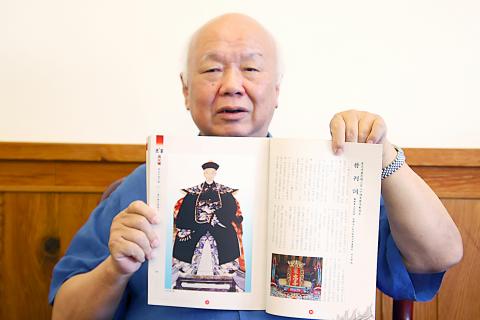
Photo: Huang Mei-chu, Taipei Times
The council asserted that Qing officials had built Paojhong Ting after the Lin Shuang-wen (林爽文) rebellion in 1787 and 1788, Lin said.
After temple board member Huang Yuan-hsien (黃遠賢) pointed out the mistake, the council changed the text to read that Paojhong Ting was founded by Wang Ting-chun (王廷昌) and other unnamed local gentry, which is still wrong, Lin said.
The temple’s founder was his ancestor Lin Hsien-kun (林先坤), a loyalist Hakka who played a major role in stemming the rebellion in the area, he said.
During the late Qing Dynasty, many Hakka people migrated from China to Taiwan, including his ancestors, who established the Lioujhangli (六張犁) settlement, he said.
For self-defense, Hakka organized village militias to protect their settlements from bandits and Aboriginal headhunters, he said.
During the rebellion, Lin Shuang-wen’s forces took the city of Jhucian (竹塹), now Hinschu City, from which the rebels launched raids into the rice-bearing regions of Lioujhangli and Siayuan Mountain (下員山), he said.
The pillaging committed by the ill-disciplined rebels prompted Hakka leaders to summon their militia, including Lin Hsien-kun, which contributed to the imperial victory over the insurgents, he said.
After the war, Lin Hsien-kun became concerned about burying the dead, many of whom had been migrant workers at his estate, he said, adding that these men were far from home and unmarried, so they could not be interred in ancestral shrines of their own.
Consequently, Lin Hsien-kun, his cousin Liu Chao-chen (劉朝珍) and another landowner surnamed Tai (戴) donated land so that the men could be buried with native-born loyalists, Lin Kuang-hua said.
The council said the current version of the text on its Web site was supplied by the county government, which had verified the account.

Considering that most countries issue more than five denominations of banknotes, the central bank has decided to redesign all five denominations, the bank said as it prepares for the first major overhaul of the banknotes in more than 24 years. Central bank Governor Yang Chin-lung (楊金龍) is expected to report to the Legislative Yuan today on the bank’s operations and the redesign’s progress. The bank in a report sent to the legislature ahead of today’s meeting said it had commissioned a survey on the public’s preferences. Survey results showed that NT$100 and NT$1,000 banknotes are the most commonly used, while NT$200 and NT$2,000

The Centers for Disease Control (CDC) yesterday reported the first case of a new COVID-19 subvariant — BA.3.2 — in a 10-year-old Singaporean girl who had a fever upon arrival in Taiwan and tested positive for the disease. The girl left Taiwan on March 20 and the case did not have a direct impact on the local community, it said. The WHO added the BA.3.2 strain to its list of Variants Under Monitoring in December last year, but this was the first imported case of the COVID-19 variant in Taiwan, CDC Deputy Director-General Lin Ming-cheng (林明誠) said. The girl arrived in Taiwan on

South Korea is planning to revise its controversial electronic arrival card, a step Taiwanese officials said prompted them to hold off on planned retaliatory measures, a South Korean media report said yesterday. A Yonhap News Agency report said that the South Korean Ministry of Foreign Affairs is planning to remove the “previous departure place” and “next destination” fields from its e-arrival card system. The plan, reached after interagency consultations, is under review and aims to simplify entry procedures and align the electronic form with the paper version, a South Korean ministry official said. The fields — which appeared only on the electronic form

The Ministry of Foreign Affairs (MOFA) is suspending retaliation measures against South Korea that were set to take effect tomorrow, after Seoul said it is updating its e-arrival system, MOFA said today. The measures were to be a new round of retaliation after Taiwan on March 1 changed South Korea's designation on government-issued alien resident certificates held by South Korean nationals to "South Korea” from the "Republic of Korea," the country’s official name. The move came after months of protests to Seoul over its listing of Taiwan as "China (Taiwan)" in dropdown menus on its new online immigration entry system. MOFA last week


 RSS
RSS