


Keeping ants as pets is like having an aquarium, as its main purpose is for viewing pleasure, but it is less work, said Sun Huai-yi (孫懷義), creative director of start-up Empire of Ants.
Ants do not need to have fresh air and water pumped into their tank and keepers have little to worry about other than environmental humidity and temperature, Sun said.
Having a formicarium is a hobby that appeals to children, office workers who want something different to decorate their cubicles and curious people who like to spend time observing ants, he said.
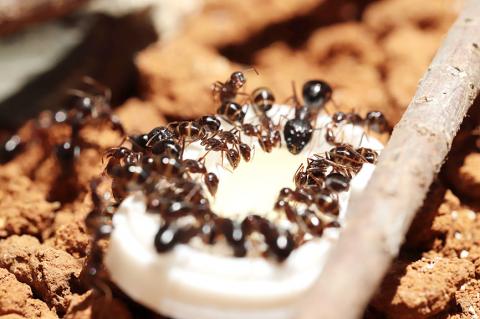
Photo: Chen Yu-jui, Taipei Times
The joy of ant-keeping is watching the complex social life of ants and gaining a sense of achievement when a colony is thriving, Sun said, adding that he hopes the market for Taiwan’s indigenous ants will grow among hobbyists.
Governed by a clearly defined social hierarchy, each ant in a colony has a specific task, ranging from guarding the colony, maintaining the habitat’s hygiene, foraging, or caring for the grubs and the queen, he said.
An ant colony is viable as long as the queen is alive, as the queen replenishes the colony’s ranks of soldier and worker ants throughout her life, Sun said.
By insect standards, ant queens have a long life of 10 to 20 years, so unless she has a congenital disease or develops a fungal infection — most commonly caused by leaving too much food with the colony — most ant-keepers could expect to keep their ant farm for that long, he said.
However, ant-keepers are advised not to leave dead cockroaches for their pet ants, as pesticide residue could kill all of the ants, he said.
For legal and environmental reasons, people should avoid buying alien ant species, Sun added.
While ants are mostly omnivores, different species lean toward a more carnivorous or herbivorous diet, he said, adding that different food mixes and live insect prey can be obtained from Empire of Ants.
For beginners, he recommends Camponotus variegatus dulcis, a hardy Taiwanese carpenter ant with a vegetable-heavy diet, Sun said.
When worker ants forage, they gorge on any food they encounter, which they regurgitate after returning to the nest, he said, adding that the process is fun to watch with Camponotus variegatus dulcis, because the workers bloat after ingesting food and their light-colored carapace makes it more obvious.
Huang Yi-hao (黃奕豪), the company’s product director, said that beginners could also consider other members of the carpenter ant family, such as Camponotus albosparsus, friedae and irritans, as they are easy to keep alive.
Ants are limited to living in an environment with a humidity of 60 to 80 percent, he said, adding that formicariums are constructed with a water-absorbent casing, which allows added water to permeate through the walls to enter the internal space as vapor, thereby maintaining the humidity in the habitat.
Ant farm hobbyist Lin Yu-heng (林佑衡) said that a physical nest, anti-escape oils, ant food and feeding equipment are the essentials of a formicarium.
Newcomers to the hobby should consider limiting their purchase to a manageable size of about one queen and 10 to 20 workers, he said.
Ants detect each other by scent and instinctively avoid ants from a different colony, so prospective ant-keepers do not have to worry about a formicarium attracting unwanted ants to their homes, he added.
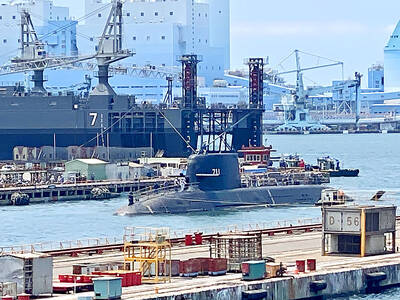
AGING: While Japan has 22 submarines, Taiwan only operates four, two of which were commissioned by the US in 1945 and 1946, and transferred to Taiwan in 1973 Taiwan would need at least 12 submarines to reach modern fleet capabilities, CSBC Corp, Taiwan chairman Chen Cheng-hung (陳政宏) said in an interview broadcast on Friday, citing a US assessment. CSBC is testing the nation’s first indigenous defense submarine, the Hai Kun (海鯤, Narwhal), which is scheduled to be delivered to the navy next month or in July. The Hai Kun has completed torpedo-firing tests and is scheduled to undergo overnight sea trials, Chen said on an SET TV military affairs program. Taiwan would require at least 12 submarines to establish a modern submarine force after assessing the nation’s operational environment and defense

A white king snake that frightened passengers and caused a stir on a Taipei MRT train on Friday evening has been claimed by its owner, who would be fined, Taipei Rapid Transit Corp (TRTC) said yesterday. A person on Threads posted that he thought he was lucky to find an empty row of seats on Friday after boarding a train on the Bannan (Blue) Line, only to spot a white snake with black stripes after sitting down. Startled, he jumped up, he wrote, describing the encounter as “terrifying.” “Taipei’s rat control plan: Release snakes on the metro,” one person wrote in reply, referring
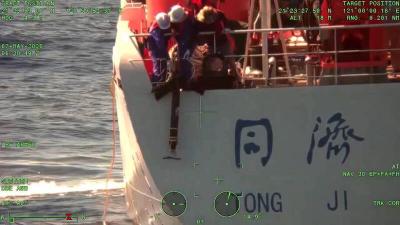
The coast guard today said that it had disrupted "illegal" operations by a Chinese research ship in waters close to the nation and driven it away, part of what Taipei sees a provocative pattern of China's stepped up maritime activities. The coast guard said that it on Thursday last week detected the Chinese ship Tongji (同濟號), which was commissioned only last year, 29 nautical miles (54km) southeast of the southern tip of Taiwan, although just outside restricted waters. The ship was observed lowering ropes into the water, suspected to be the deployment of scientific instruments for "illegal" survey operations, and the coast
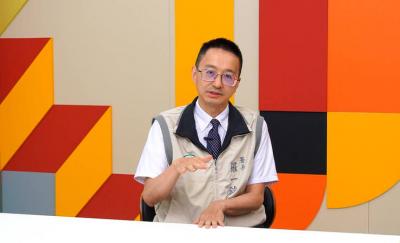
Taiwan’s two cases of hantavirus so far this year are on par with previous years’ case numbers, and the government is coordinating rat extermination work, so there should not be any outbreaks, Centers for Disease Control (CDC) Director-General Philip Lo (羅一鈞) said today in an interview with the Liberty Times (the Taipei Times’ sister newspaper). An increase in rat sightings in Taipei and New Taipei City has raised concerns about the spread of hantavirus, as rats can carry the disease. In January, a man in his 70s who lived in Taipei’s Daan District (大安) tested positive posthumously for hantavirus, Taiwan’s


 RSS
RSS