


A visit to Democratic Progressive Party (DPP) Legislator Cheng Yun-peng’s (鄭運鵬) office in the Legislative Yuan gives a glimpse of a different side to the politician.
Inside Cheng’s office are shelves lined with various figurines and models. On one wall hangs a sketch of Joe Yabuki, the main character from Japanese comic Tomorrow’s Joe, which Cheng, who represents Taoyuan’s first constituency, drew during an all-night session at the legislature.
He said that he previously kept beetles in his office — a classic case of parents taking care of the pets that their children wanted.

Photo: Chen Yu-chia, Taipei Times
His son, influenced by Japanese arcade game Mushiking: King of the Beetles and the animated movies it spawned, as well as his classmates, started raising rhinoceros beetles, Cheng said.
His son did not stop there and started raising other kinds of beetles, but soon there was not enough space at home for all of them, so he started keeping them in his office, he said.
Cheng said that his children are younger than those of his colleagues, and that he had not met anyone who was also interested in raising beetles.
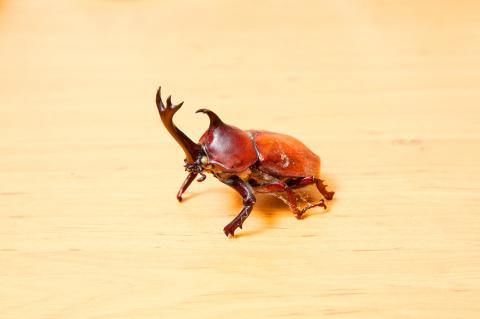
Photo: Chen Yu-chia, Taipei Times
However, he said that he had learned that pan-blue commentator Tang Hsiang-lung (唐湘龍) has children of the same age and was considering raising beetles when they met on a talk show, so he gifted Tang a whole set of equipment and some larvae.
“It was a while before we met again and I fully expected the larvae to have grown into adult beetles,” Cheng said, but added that Tang told him the larvae had all died before entering the chrysalis stage.
Beetle larvae are not difficult to raise and only require that attention be paid to the temperature and moisture of the humus they are in to survive, he said, adding that he surmised that Tang had not paid attention and allowed the humus to dry out.
“Tang can talk up a storm, but boy he cannot raise beetles! I can attest to that!” Cheng said.
The life expectancy of a beetle after emerging from the chrysalis is about three months, he said, adding that he has collected the dead beetles to remind himself and his son about the time they raised the insects.
His son has moved on from beetles after the last one died and is now looking to raise hamsters, Cheng said, adding that he has been researching how to look after the animals.
Cheng urged people not to capture wild beetles, as doing so could upset the ecological balance.
People interested in raising beetles should instead buy larvae or adult beetles from specialty shops, Cheng said.
Beetle enthusiasts would find it worthwhile to visit the Yangchou Path in Taoyuan’s Lujhu District (蘆竹), as there are many beetles in the area, he added.

The military has spotted two Chinese warships operating in waters near Penghu County in the Taiwan Strait and sent its own naval and air forces to monitor the vessels, the Ministry of National Defense (MND) said. Beijing sends warships and warplanes into the waters and skies around Taiwan on an almost daily basis, drawing condemnation from Taipei. While the ministry offers daily updates on the locations of Chinese military aircraft, it only rarely gives details of where Chinese warships are operating, generally only when it detects aircraft carriers, as happened last week. A Chinese destroyer and a frigate entered waters to the southwest

The eastern extension of the Taipei MRT Red Line could begin operations as early as late June, the Taipei Department of Rapid Transit Systems said yesterday. Taipei Rapid Transit Corp said it is considering offering one month of free rides on the new section to mark its opening. Construction progress on the 1.4km extension, which is to run from the current terminal Xiangshan Station to a new eastern terminal, Guangci/Fengtian Temple Station, was 90.6 percent complete by the end of last month, the department said in a report to the Taipei City Council's Transportation Committee. While construction began in October 2016 with an

NON-RED SUPPLY: Boosting the nation’s drone industry is becoming increasingly urgent as China’s UAV dominance could become an issue in a crisis, an analyst said Taiwan’s drone exports to Europe grew 41.7-fold from 2024 to last year, with demand from Ukraine’s fight against Russian aggression the most likely driver of growth, a study showed. The Institute for Democracy, Society and Emerging Technology (DSET) in a statement on Wednesday said it found that many of Taiwan’s uncrewed aerial vehicle (UAV) sales were from Poland and the Czech Republic. These countries likely transferred the drones to Ukraine to aid it in its fight against the Russian invasion that started in 2022, it said. Despite the gains, Taiwan is not the dominant drone exporter to these markets, ranking second and fourth

Japanese Prime Minister Sanae Takaichi’s comment last year on Tokyo’s potential reaction to a Taiwan-China conflict has forced Beijing to rewrite its invasion plans, a retired Japanese general said. Takaichi told the Diet on Nov. 7 last year that a Chinese naval blockade or military attack on Taiwan could constitute a “survival-threatening situation” for Japan, potentially allowing Tokyo to exercise its right to collective self-defense. Former Japan Ground Self-Defense Force general Kiyofumi Ogawa said in a recent speech that the remark has been interpreted as meaning Japan could intervene in the early stages of a Taiwan Strait conflict, undermining China’s previous assumptions


 RSS
RSS