


Kaohsiung Mayor Han Kuo-yu (韓國瑜) yesterday said that civil servants must remain politically neutral during work hours, following allegations that the Kaohsiung City Government banned its employees from joining any recall petitions.
According to leaked meeting minutes obtained by the Chinese-language Liberty Times (sister newspaper of the Taipei Times), city officials asked every civil servant present if they had received any recall petition documents and instructed them not to take part.
They were also told not to post any inappropriate comments on Facebook during work hours, such as remarks that would breach the government’s principle of political neutrality, the newspaper reported.
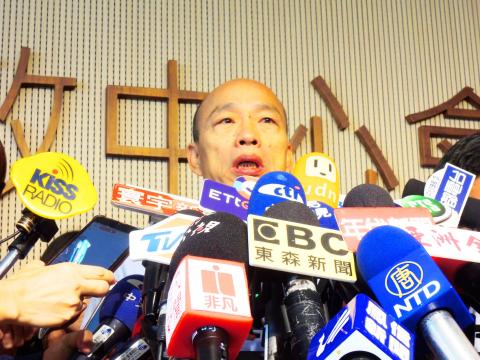
Photo: Wang Jung-hsiang, Taipei Times
The document raised concerns over possible government interference, as a petition to recall Han launched in June by Citizens Mowing Action and We Care Kaohsiung is still gathering signatures.
We Care Kaohsiung has called Han — who is to represent the Chinese Nationalist Party (KMT) in next year’s presidential election — a “runaway mayor” ready to abandon Kaohsiung to become president.
The city government said that Han respects residents’ right to recall politicians, but as the mayor has previously said, such petitions must adhere to the law.
The meeting was held to remind staff to remain politically neutral at work after receiving a report that certain staffers were distributing recall petitions and making political comments online during work hours, it said.
The Public Servants’ Administrative Neutrality Act (公務人員行政中立法) stipulates that civil servants may not participate in political activities while at work, it said.
In addition, the Civil Servants Election and Recall Act (公職人員選舉罷免法) bans civil servants from initiating a recall petition, it added.
“I have repeatedly told city employees to remain politically neutral at work, but in their free time they can take any political stance — that is without a doubt,” Han said when asked about the leaked minutes.
Although the act bans civil servants from initiating a recall petition, it allows them to sign one, We Care Kaohsiung said.
“Han’s team is asking its employees not to sign any recall petition” apparently in an attempt to police their thought, it said, adding that the petition is not the first recall campaign targeting Han, as he has been “fooling around” in politics for more than two decades.
In 1994, nearly 378,000 residents of then-Taipei County voted to recall Han, who was representing the county as a legislator, it said.
Knowing that residents would not be able to reach the unreasonably high recall threshold at the time, Han did not even offer a defense against the recall in the election notice, it said.
If a campaign to recall Han could garner nearly 400,000 votes back then, getting 500,000 votes this time is possible, it said, adding that Han is now much more well-known and disliked.
Additional reporting by Wang Jung-hsiang

Considering that most countries issue more than five denominations of banknotes, the central bank has decided to redesign all five denominations, the bank said as it prepares for the first major overhaul of the banknotes in more than 24 years. Central bank Governor Yang Chin-lung (楊金龍) is expected to report to the Legislative Yuan today on the bank’s operations and the redesign’s progress. The bank in a report sent to the legislature ahead of today’s meeting said it had commissioned a survey on the public’s preferences. Survey results showed that NT$100 and NT$1,000 banknotes are the most commonly used, while NT$200 and NT$2,000

The Centers for Disease Control (CDC) yesterday reported the first case of a new COVID-19 subvariant — BA.3.2 — in a 10-year-old Singaporean girl who had a fever upon arrival in Taiwan and tested positive for the disease. The girl left Taiwan on March 20 and the case did not have a direct impact on the local community, it said. The WHO added the BA.3.2 strain to its list of Variants Under Monitoring in December last year, but this was the first imported case of the COVID-19 variant in Taiwan, CDC Deputy Director-General Lin Ming-cheng (林明誠) said. The girl arrived in Taiwan on

South Korea is planning to revise its controversial electronic arrival card, a step Taiwanese officials said prompted them to hold off on planned retaliatory measures, a South Korean media report said yesterday. A Yonhap News Agency report said that the South Korean Ministry of Foreign Affairs is planning to remove the “previous departure place” and “next destination” fields from its e-arrival card system. The plan, reached after interagency consultations, is under review and aims to simplify entry procedures and align the electronic form with the paper version, a South Korean ministry official said. The fields — which appeared only on the electronic form

The Ministry of Foreign Affairs (MOFA) is suspending retaliation measures against South Korea that were set to take effect tomorrow, after Seoul said it is updating its e-arrival system, MOFA said today. The measures were to be a new round of retaliation after Taiwan on March 1 changed South Korea's designation on government-issued alien resident certificates held by South Korean nationals to "South Korea” from the "Republic of Korea," the country’s official name. The move came after months of protests to Seoul over its listing of Taiwan as "China (Taiwan)" in dropdown menus on its new online immigration entry system. MOFA last week


 RSS
RSS