


Taoyuan prosecutors yesterday charged five former managers and engineers of the Taiwanese subsidiary of German chemical giant BASF for technology theft and passing the information on to a Chinese competitor.
Former senior manager Huang Yi-lin (黃奕霖), 45, and four others were indicted on charges of breach of trust, along with contravening the Trade Secrets Act (營業秘密法), the Copyright Act (著作權法) and the Criminal Code.
Huang had allegedly recruited other managers and engineers to steal proprietary technology for Jiangyin Jianghua Microelectronics Materials Co in China’s Jiangsu Province, resulting in estimated annual losses of NT$3.5 billion (US$112.6 million at the current exchange rate) for BASF, Taoyuan deputy head prosecutor Yang Ting-hung (楊挺宏) said.
BASF Group, headquartered in Germany, set up its Taiwanese subsidiary in 1990, while Jiangyin Jianghua was founded in 2001.
Huang, who headed BASF Taiwan’s global electronics material section in Taoyuan’s Kuanyin Industrial Park, was contacted by executives of Jiangyin Jianghua, including its chairman, surnamed Yin (殷), and vice general manager, surnamed Zhu (朱), who offered him a huge financial reward if he leaked the German firm’s key technology, Yang said.
After agreeing to the deal, Huang founded Yang Yi International Co in June 2017 and recruited four colleagues — surnamed Lin (林), 55; Yu (余), 45; Yeh (葉), 45; and Hsu (許), 44.
The five allegedly targeted the proprietary process for making electronic-grade sulfuric acid and other high-quality chemicals for supply to the semiconductor industry, according to findings by Taoyuan prosecutors and the Criminal Investigation Bureau (CIB), adding that Huang had allegedly stolen BASF’s piping and instrumentation diagrams and other proprietary files.
“It was a case of Chinese industrial espionage focused on new know-how in production and proprietary technologies at Taiwanese and international companies,” Yang said. “Huang and his men were enticed by the money to carry out intellectual property theft for China.”
The investigation found that Huang and his company signed an agreement with Jiangyin Jianghua, which paid him NT$179 million to assist the Chinese firm in setting up an electronic chemical manufacturing plant, as well as helping with marketing and sales.
Although Huang was still working at BASF Taiwan at the time, he collected NT$700,000 as consulting fees from Jiangyin Jianghua.
Huang was reportedly offered an annual salary of NT$14 million, plus bonuses and stock options, to work at the Chinese company’s plant, while his four colleagues were promised annual salaries of between NT$2.8 million and NT$5.5 million.
Surveillance of the men began after a tip-off, and prosecutors and CIB agents arrested the five on Jan. 3 when they returned from a trip to China.
Yang said key technology data and BASF company materials were found in the possession of the five suspects.
Investigators said Huang had sent the proprietary files via e-mails to the Chinese business collaborators from his home computer.
BASF said it is aware that its former employees had been indicted, adding that the company takes the matter seriously and supports the investigation.
It has been protecting related information and had filed a criminal complaint, its office in Taiwan said in a statement.
“At BASF, we do not tolerate such kinds of non-compliant activities,” it said.
The company is committed to investment and protection of intellectual property resulting from research and development, as well as production know-how both by BASF and its customers, it said.
Toward this end, the company has set up systems and policies to minimize risks and conduct internal training for employees, it said, adding that BASF encourages employees to seek guidance on compliance issues if in doubt.
Employees can consult their managers, specialist departments, compliance officers and anonymous external hotlines, it said.
Additional reporting by Crystal Hsu

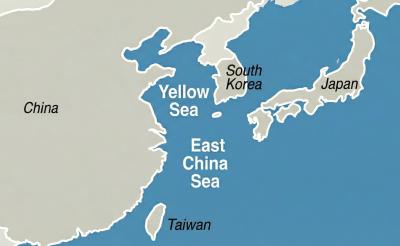
China has reserved offshore airspace in the Yellow Sea and East China Sea from March 27 to May 6, issuing alerts usually used to warn of military exercises, although no such exercises have been announced, the Wall Street Journal (WSJ) reported yesterday. Reserving such a large area for 40 days without explanation is an “unusual step,” as military exercises normally only last a few days, the paper said. These alerts, known as Notice to Air Missions (Notams), “are intended to inform pilots and aviation authorities of temporary airspace hazards or restrictions,” the article said. The airspace reserved in the alert is
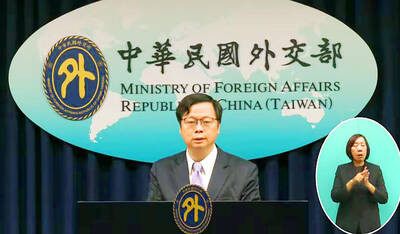
NAMING SPAT: The foreign ministry called on Denmark to propose an acceptable solution to the erroneous nationality used for Taiwanese on residence permits Taiwan has revoked some privileges for Danish diplomatic staff over a Danish permit that lists “Taiwan” as “China,” Eric Huang (黃鈞耀), head of the Ministry of Foreign Affairs’ Department of European Affairs, told a news conference in Taipei yesterday. Reporters asked Huang whether the Danish government had responded to the ministry’s request that it correct the nationality on Danish residence permits of Taiwanese, which has been listed as “China” since 2024. Taiwan’s representative office in Denmark continues to communicate with the Danish government, and the ministry has revoked some privileges previously granted to Danish representatives in Taiwan and would continue to review
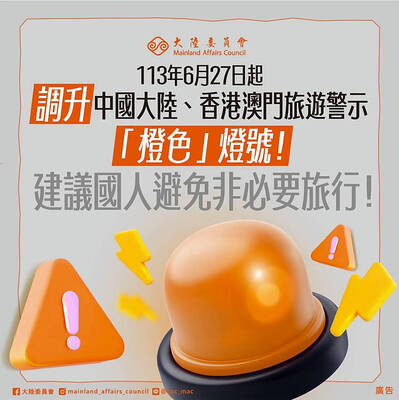
More than 6,000 Taiwanese students have participated in exchange programs in China over the past two years, despite the Mainland Affairs Council’s (MAC) “orange light” travel advisory, government records showed. The MAC’s publicly available registry showed that Taiwanese college and university students who went on exchange programs across the Strait numbered 3,592 and 2,966 people respectively. The National Immigration Agency data revealed that 2,296 and 2,551 Chinese students visited Taiwan for study in the same two years. A review of the Web sites of publicly-run universities and colleges showed that Taiwanese higher education institutions continued to recruit students for Chinese educational programs without

A bipartisan group of US senators has introduced a bill to enhance cooperation with Taiwan on drone development and to reduce reliance on supply chains linked to China. The proposed Blue Skies for Taiwan Act of 2026 was introduced by Republican US senators Ted Cruz and John Curtis, and Democratic US senators Jeff Merkley and Andy Kim. The legislation seeks to ease constraints on Taiwan-US cooperation in uncrewed aerial systems (UAS), including dependence on China-sourced components, limited access to capital and regulatory barriers under US export controls, a news release issued by Cruz on Wednesday said. The bill would establish a "Blue UAS


 RSS
RSS