


The Food and Drug Administration (FDA) should clarify the rules governing imports of heated tobacco products, so people do not attempt to bring them through customs only to have them confiscated, Democratic Progressive Party legislators Ho Chih-wei (何志偉) and Tsai Yi-yu (蔡易餘) said yesterday.
While he does not encourage smoking, the IQOS tobacco heating system is a less harmful alternative to combustible cigarettes, Ho told a news conference in Taipei, citing a review of the product by the US Food and Drug Administration, which found that it produces lower levels of toxins than cigarettes.
Many people who cannot quit tobacco have switched to the new products, which have a much more subtle smell than traditional cigarettes, making them more acceptable for non-smokers, Ho said.
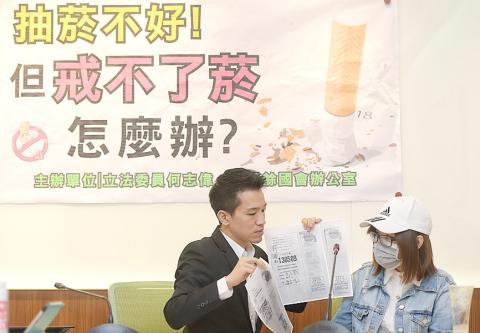
Photo: Chang Chia-ming, Taipei Times
However, some customs officers have confiscated heated tobacco products, even though they were declared, he said.
A man surnamed Liao (廖) told the news conference that he tried to import Heatsticks, but they were seized by customs officers, who could not provide him with a clear explanation as to what law he contravened.
An officer made him write a report “as if he were a drug smuggler,” Liao said.
The US agency has authorized the sale of heated tobacco products, and Taiwan should conduct a health risk assessment of the products to determine whether to allow them to be imported, Tsai said.
This would reduce the number of products circulating in the gray market and better safeguard public health, Tsai said.
Taiwan’s FDA should consult the Ministry of Finance to avoid forgoing potential tax revenue, he said.
Customs Administration Senior Auditor Chen Tai-ming (陳泰明) said that there is a lack of regulations over bringing heated tobacco products into the nation.
Even though it is not illegal, any such product shall be confiscated, Chen said.
Ko Ruei-chi (柯睿期), a section chief at the Health Promotion Administration’s Tobacco Control Division, said that internationally there is a lack of a standard testing procedure for assessing health risks posed by heated tobacco products.
Many studies suggest that the products still release toxins, he said.
Taiwan’s FDA should prepare a report on potential health issues associated with heated tobacco products within three months, Ho said.
Ko said it would do its best.
People who want to quit smoking should seek medical help rather than switching to emerging tobacco products, Ko said.

Considering that most countries issue more than five denominations of banknotes, the central bank has decided to redesign all five denominations, the bank said as it prepares for the first major overhaul of the banknotes in more than 24 years. Central bank Governor Yang Chin-lung (楊金龍) is expected to report to the Legislative Yuan today on the bank’s operations and the redesign’s progress. The bank in a report sent to the legislature ahead of today’s meeting said it had commissioned a survey on the public’s preferences. Survey results showed that NT$100 and NT$1,000 banknotes are the most commonly used, while NT$200 and NT$2,000

The Centers for Disease Control (CDC) yesterday reported the first case of a new COVID-19 subvariant — BA.3.2 — in a 10-year-old Singaporean girl who had a fever upon arrival in Taiwan and tested positive for the disease. The girl left Taiwan on March 20 and the case did not have a direct impact on the local community, it said. The WHO added the BA.3.2 strain to its list of Variants Under Monitoring in December last year, but this was the first imported case of the COVID-19 variant in Taiwan, CDC Deputy Director-General Lin Ming-cheng (林明誠) said. The girl arrived in Taiwan on

South Korea is planning to revise its controversial electronic arrival card, a step Taiwanese officials said prompted them to hold off on planned retaliatory measures, a South Korean media report said yesterday. A Yonhap News Agency report said that the South Korean Ministry of Foreign Affairs is planning to remove the “previous departure place” and “next destination” fields from its e-arrival card system. The plan, reached after interagency consultations, is under review and aims to simplify entry procedures and align the electronic form with the paper version, a South Korean ministry official said. The fields — which appeared only on the electronic form

The Ministry of Foreign Affairs (MOFA) is suspending retaliation measures against South Korea that were set to take effect tomorrow, after Seoul said it is updating its e-arrival system, MOFA said today. The measures were to be a new round of retaliation after Taiwan on March 1 changed South Korea's designation on government-issued alien resident certificates held by South Korean nationals to "South Korea” from the "Republic of Korea," the country’s official name. The move came after months of protests to Seoul over its listing of Taiwan as "China (Taiwan)" in dropdown menus on its new online immigration entry system. MOFA last week


 RSS
RSS