


The Taiwan High Court on Tuesday upheld a conviction against three men in the beating death of gang member Chen Chih-chiang (陳智強) in June last year, but handed down heavier punishments, saying the defendants had carried out the murder with extreme cruelty and had shown no remorse for their actions.
The High Court sentenced Lee Hao (李灝) to 18 years in prison, Lee Chih-hao (李志豪) to 13 years and Chen Po-an (陳柏安) to 12 years in the second ruling in the case.
The New Taipei City District Court in the first ruling sentenced the men to 14 years, 12 years and 11 years in prison respectively.
The suspects were all 25 years old when they kidnapped Chen Chih-chiang before beating him with a baseball bat and metal rods.
They have said they wanted to “teach him a lesson” over a dispute.
Background checks showed that Chen Chih-chiang was the boss of a local chapter of the Bamboo Union gang and was active in Taipei’s Nangang (南港) and New Taipei City’s Sijhih (汐止) districts, where the organized crime syndicate had been involved in loan sharking, debt collection and extortion, officials said.
The defendants were reportedly low-ranking members of a rival chapter of the Tien Dao Meng gang operating in the same areas, and they had a financial dispute with the victim over the operation of underground businesses.
Lee Hao led the beating and torture of Chen Chih-chiang, which involved using a heated metal rod to burn his back and buttocks, in addition to repeated blows using a bat and rods, investigators said.
After three hours of beating, the suspects wrapped duct tape around Chen Chih-chiang’s neck, who later died from the injuries he had sustained and loss of blood, investigators said.
An autopsy determined that Chen Chih-chiang’s body was covered in bruises and his skull was fractured, they added.
The suspects appealed the first ruling, saying they should not be charged with murder and that it was a case of causing unintentional death due to injuries, which carries a lighter sentence.
The High Court struck down the appeal, saying they had killed the victim in an extremely cruel manner, had initially denied taking part in the beating and showed no remorse for their actions.
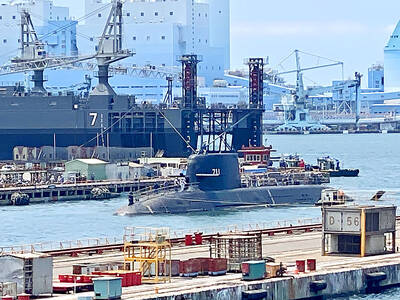
AGING: While Japan has 22 submarines, Taiwan only operates four, two of which were commissioned by the US in 1945 and 1946, and transferred to Taiwan in 1973 Taiwan would need at least 12 submarines to reach modern fleet capabilities, CSBC Corp, Taiwan chairman Chen Cheng-hung (陳政宏) said in an interview broadcast on Friday, citing a US assessment. CSBC is testing the nation’s first indigenous defense submarine, the Hai Kun (海鯤, Narwhal), which is scheduled to be delivered to the navy next month or in July. The Hai Kun has completed torpedo-firing tests and is scheduled to undergo overnight sea trials, Chen said on an SET TV military affairs program. Taiwan would require at least 12 submarines to establish a modern submarine force after assessing the nation’s operational environment and defense

A white king snake that frightened passengers and caused a stir on a Taipei MRT train on Friday evening has been claimed by its owner, who would be fined, Taipei Rapid Transit Corp (TRTC) said yesterday. A person on Threads posted that he thought he was lucky to find an empty row of seats on Friday after boarding a train on the Bannan (Blue) Line, only to spot a white snake with black stripes after sitting down. Startled, he jumped up, he wrote, describing the encounter as “terrifying.” “Taipei’s rat control plan: Release snakes on the metro,” one person wrote in reply, referring
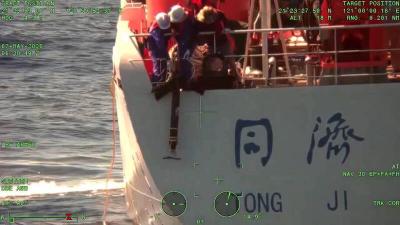
The coast guard today said that it had disrupted "illegal" operations by a Chinese research ship in waters close to the nation and driven it away, part of what Taipei sees a provocative pattern of China's stepped up maritime activities. The coast guard said that it on Thursday last week detected the Chinese ship Tongji (同濟號), which was commissioned only last year, 29 nautical miles (54km) southeast of the southern tip of Taiwan, although just outside restricted waters. The ship was observed lowering ropes into the water, suspected to be the deployment of scientific instruments for "illegal" survey operations, and the coast
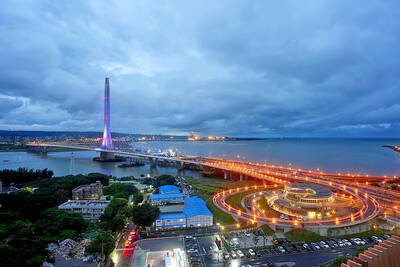
An inauguration ceremony was held yesterday for the Danjiang Bridge, the world’s longest single-mast asymmetric cable-stayed bridge, ahead of its official opening to traffic on Tuesday, marking a major milestone after nearly three decades of planning and construction. At the ceremony in New Taipei City attended by President William Lai (賴清德), Premier Cho Jung-tai (卓榮泰), Minister of Transportation and Communications Chen Shih-kai (陳世凱) and New Taipei City Mayor Hou Yu-ih (侯友宜), the bridge was hailed as both an engineering landmark and a long-awaited regional transport link connecting Tamsui (淡水) and Bali (八里)


 RSS
RSS