


President Tsai Ing-wen (蔡英文) yesterday assured fellow Democratic Progressive Party (DPP) members that she would win next year’s presidential election and that she has a mission to safeguard Taiwan’s freedom and democracy as the party officially nominated her as its presidential candidate.
Tsai explained her two main goals, saying: “We shall win the presidency and more than half of seats in the legislature,” in a speech following her nomination at a meeting of the DPP’s Central Executive Committee (CEC) at the party’s headquarters in Taipei.
In the party’s primary, Tsai defeated her sole challenger, former premier William Lai (賴清德), with an average support rating of 35.67 percent in five public opinion polls, which gave equal weighting to landline and mobile phone interviews, compared with 27.48 percent for Lai.
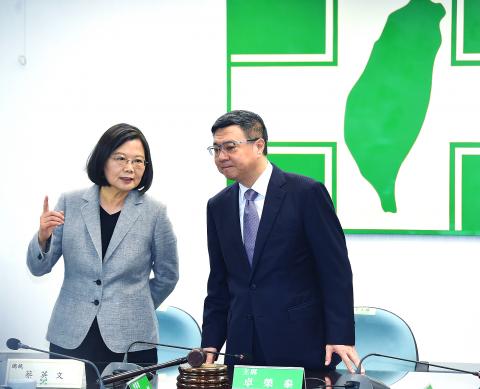
Photo: Liao Chen-huei, Taipei Times
“We have finished the primary process, but we will face greater challenges and heavier responsibilities in the next phase. Therefore, our party must rally together to accomplish our mission,” she said.
The DPP must become a unifying force to consolidate party machinery and the campaign team for the election to help people identify with the party’s vision for Taiwan and obtain the highest level of support from society, Tsai said.
“After winning the election, we shall safeguard Taiwan’s freedom and democracy, and we must defend the values and accomplishments in our government’s reform policies,” she said. “More importantly, we must uphold Taiwan’s sovereignty — this is the mission that we must undertake, and be successful in it.”
Support from younger people would be crucial to her re-election, she said, adding that the DPP must respond to the their needs and aspirations.
“The most critical factor is the power of the younger generation. I hope through the campaign efforts and in our future administration, we can garner more support from the ‘youth power’ and that they can build up our nation working together with the DPP,” Tsai said.
“We must thank former premier Lai for accompanying me all the way through to the end of the primary process. On this journey, Lai helped boost the morale of party members, as he gave them the opportunity to explain our government’s values and achievements to all Taiwanese,” she said.
“We must thank Lai for his display of determination and follow-through on democratic principles,” she added.
Tsai individually thanked party officials, lawmakers, CEC members, Central Standing Committee members and others for their support.
“There were some frictions during the primary ... but it is all in the past, and now is the time to rally together. We have to fully cooperate and spur on each other to take on the upcoming election battle. We must garner greater support from society, so that Taiwan can keep making strides forward,” Tsai said.
Tsai also thanked DPP Chairman Cho Yung-tai (卓榮泰) for his guidance of the party’s central leadership, through which they conducted the primary process with diligence and overcame challenges.
Cho in his speech spoke of a “main strategy” for the election.
“The central pillar for our campaign is based on winning the presidential race, which will bolster our battle to win a majority of the seats at the legislature, which is our main strategy,” he said.
“All the while we will work closely with all sectors of society for a ‘grand dialogue.’ These are the twin arrows of our party with which to gain the public’s trust,” Cho said.
The DPP’s central and local leadership, along with Tsai’s campaign team and the legislative candidates with their campaign teams, would form a “golden triangle” for the elections to ensure victory for the continued governance of the nation by Taiwanese, he said.

Chinese spouse and influencer Guan Guan’s (關關) residency permit has been revoked for repeatedly posting pro-China videos that threaten national security, the National Immigration Agency confirmed today. Guan Guan has said many controversial statements in her videos posted to Douyin (抖音), including “the red flag will soon be painted all over Taiwan” and “Taiwan is an inseparable part of China,” and expressing hope for expedited reunification. The agency last year received multiple reports alleging that Guan Guan had advocated for armed reunification. After verifying the reports, the agency last month issued a notice requiring her to appear and explain her actions. Guan

GIVE AND TAKE: Blood demand continues to rise each year, while fewer young donors are available due to the nation’s falling birthrate, a doctor said Blood donors can redeem points earned from donations to obtain limited edition Formosan black bear travel mugs, the Kaohsiung Blood Center said yesterday, as it announced a goal of stocking 20,000 units of blood prior to the Lunar New Year. The last month of the lunar year is National Blood Donation Month, when local centers seek to stockpile blood for use during the Lunar New Year holiday. The blood demand in southern Taiwan — including Tainan and Kaohsiung, as well as Chiayi, Pingtung, Penghu and Taitung counties — is about 2,000 units per day, the center said. The donation campaign aims to boost

The Kaohsiung Tourism Bureau audited six hotels in an effort to prevent price gouging ahead of Korean band BTS’ concert tour in the city scheduled for Nov. 19, 21 and 22 this year. The bureau on Friday said that the audits — conducted in response to allegations of unfair pricing posted on social media — found no wrongdoing. These establishments included the local branches of Chateau de Chine, Hotel Nikko, My Humble House, and Grand Hai Lai, it said, adding that the Consumer Protection Commission would have penalized price gougers had the accusations been substantiated. The bureau said the Tourism Development Act
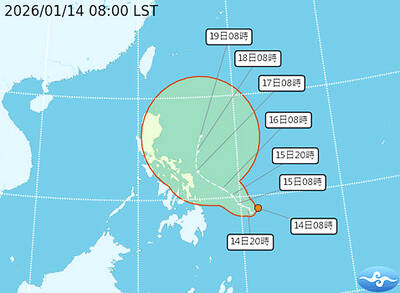
BACK TO WINTER: A strong continental cold air mass would move south on Tuesday next week, bringing colder temperatures to northern and central Taiwan A tropical depression east of the Philippines could soon be upgraded to be the first tropical storm of this year, the Central Weather Administration (CWA) said yesterday, adding that the next cold air mass is forecast to arrive on Monday next week. CWA forecaster Cheng Jie-ren (鄭傑仁) said the first tropical depression of this year is over waters east of the Philippines, about 1,867km southeast of Oluanpi (鵝鑾鼻), and could strengthen into Tropical Storm Nokaen by early today. The system is moving slowly from northwest to north, and is expected to remain east of the Philippines with little chance of affecting Taiwan,


 RSS
RSS