


Kaohsiung Mayor Han Kuo-yu’s (韓國瑜) proposed “get-rich diplomacy” has drawn mixed reactions from politicians.
Despite not announcing a presidential bid, Han has repeatedly said that he would accept if the Chinese Nationalist Party (KMT) included him in its primary.
Speaking at a rally on Ketagalan Boulavard in Taipei on Saturday, Han said that the Democratic Progressive Party (DPP) had been conducting “sucker diplomacy.”
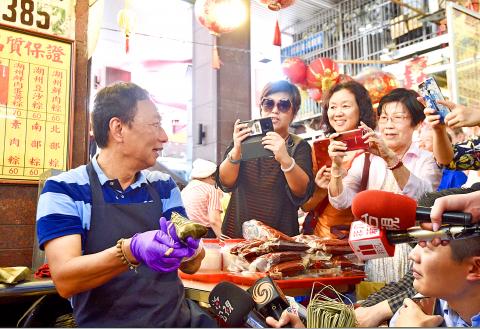
Photo: Peter Lo, Taipei Times
The rally was organized by Han’s supporters with the theme “President for the common people.”
Taiwan’s diplomacy should follow the US or Japanese model, establishing good international relations while boosting the economy, Han said, adding that he would “replace the sucker policy with get-rich diplomacy” if elected president.
President Tsai Ing-wen (蔡英文) yesterday said that Han was “inventing just another new slogan” when he should be paying attention to the administration of Kaohsiung.
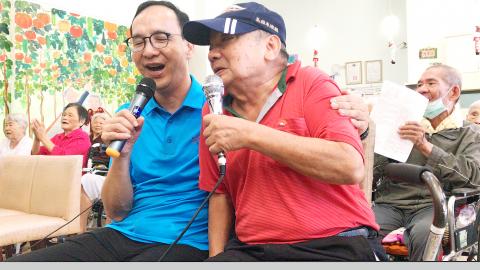
Photo: Huang Liang-chieh, Taipei Times
Former New Taipei City mayor Eric Chu (朱立倫), who is vying for the KMT’s presidential nomination, said that Han’s “get-rich diplomacy” was a verbal repacking of his own “economic and trade diplomacy” proposal.
“The correct term that Han should have used is ‘mutually beneficial relations that result in profits for everyone,’ but if Han wants to call it ‘get rich diplomacy,’ let him go with that,” Chu said.
Hon Hai Precision Industry Co chairman Terry Gou (郭台銘), another KMT presidential hopeful, said that after “hearing Han’s slogans about boosting the economy and ‘get-rich diplomacy,’ I think he is copying me.”
“I know the market better than any of the other candidates; it has been my business for 45 years,” he added.
“I do not understand what ‘get-rich diplomacy’ means, [Han] should explain it,” said Taipei Mayor Ko Wen-je (柯文哲), an independent who some have speculated might run for president in next year’s elections.
“Does he mean the Ministry of Foreign Affairs should be merged with the Taiwan External Trade Development Council?” Ko asked.
Asked to comment on Han’s remark that he would accept any important post, even if it meant “being beaten and smashed to pieces” for the Republic of China (ROC), Ko said that it would be good enough if the ROC does not get beaten and smashed to pieces.
In response to complaints by Han’s supporters that Ko did not allow vendors at Saturday’s rally, so they had nowhere to buy raincoats or drinking water, Ko said: “You cannot blame me for the rain.”
Taipei City Government spokesman Liu Yi-ting (劉奕霆) on Saturday afternoon said that Ko did not order the ban.
The city government was only following the law and the ban on vendors was clearly written on the application form, Liu said.
Meanwhile, former premier William Lai (賴清德) on Saturday said that Ko’s unwillingness to talk about China’s proposed “one country, two systems” framework shows that he is “burying his head in the sand.”
Ko’s controversial “two sides of the [Taiwan] Strait are one family” statement cannot achieve long-term peace and security for Taiwan, Lai said.
Lai is competing with Tsai in the DPP’s presidential primary.
His statement is not “excellent” for achieving peace between Taiwan and China, Ko said, adding that he said it to express a friendly attitude toward China.
“I think ... that sometimes the key point is not what you do, but what the recipient thinks you did,” Ko said.
“If the recipient cannot trust you, or feel your friendly intentions, then it will think you want to do harm, no matter what you say,” he said.
Additional reporting by Cho Yi-chun

Considering that most countries issue more than five denominations of banknotes, the central bank has decided to redesign all five denominations, the bank said as it prepares for the first major overhaul of the banknotes in more than 24 years. Central bank Governor Yang Chin-lung (楊金龍) is expected to report to the Legislative Yuan today on the bank’s operations and the redesign’s progress. The bank in a report sent to the legislature ahead of today’s meeting said it had commissioned a survey on the public’s preferences. Survey results showed that NT$100 and NT$1,000 banknotes are the most commonly used, while NT$200 and NT$2,000

The Centers for Disease Control (CDC) yesterday reported the first case of a new COVID-19 subvariant — BA.3.2 — in a 10-year-old Singaporean girl who had a fever upon arrival in Taiwan and tested positive for the disease. The girl left Taiwan on March 20 and the case did not have a direct impact on the local community, it said. The WHO added the BA.3.2 strain to its list of Variants Under Monitoring in December last year, but this was the first imported case of the COVID-19 variant in Taiwan, CDC Deputy Director-General Lin Ming-cheng (林明誠) said. The girl arrived in Taiwan on

South Korea is planning to revise its controversial electronic arrival card, a step Taiwanese officials said prompted them to hold off on planned retaliatory measures, a South Korean media report said yesterday. A Yonhap News Agency report said that the South Korean Ministry of Foreign Affairs is planning to remove the “previous departure place” and “next destination” fields from its e-arrival card system. The plan, reached after interagency consultations, is under review and aims to simplify entry procedures and align the electronic form with the paper version, a South Korean ministry official said. The fields — which appeared only on the electronic form

The Ministry of Foreign Affairs (MOFA) is suspending retaliation measures against South Korea that were set to take effect tomorrow, after Seoul said it is updating its e-arrival system, MOFA said today. The measures were to be a new round of retaliation after Taiwan on March 1 changed South Korea's designation on government-issued alien resident certificates held by South Korean nationals to "South Korea” from the "Republic of Korea," the country’s official name. The move came after months of protests to Seoul over its listing of Taiwan as "China (Taiwan)" in dropdown menus on its new online immigration entry system. MOFA last week


 RSS
RSS