


Liao I-chiu (廖一久), a Taiwanese expert in shrimp farming, was on Wednesday awarded the prestigious Nikkei Asia Prize at a ceremony in Tokyo for his contribution to the development of aquaculture in Asia.
In his acceptance speech, Liao, who won in the science and technology category, said that he was grateful for the scholarship he received as a young man to study in Japan.
He said that he was pleased to be able to share the systems and technology he developed over the years with regional stakeholders in the aquaculture industry.
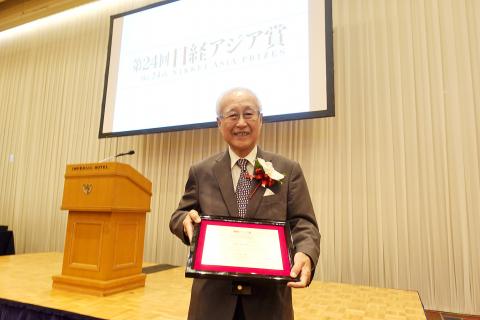
Photo: CNA
After the ceremony, the 82-year-old said that he hoped the Taiwanese government would focus on the development of agriculture and aquaculture, alongside the information technology industry.
Known in Taiwan as the “father of prawn farming,” Liao was nominated for the Nikkei Asia Prize by Yoshimatsu Takao, a professor at Japan’s Mie University.
One member of the panel of judges said that grass prawns, Thai shrimp and mullet roe are common ingredients on dining tables in Japan, all because of Liao’s research efforts.
Liao has made a great contribution to the development of the aquaculture industry, not just in Taiwan, but in the wider region and has also earned the title “father of aquaculture in Asia,” said Matsumoto Hiroshi, head of Japan’s National Institute of Physical and Chemical Research.
Liao was born in Japan to Taiwanese parents, who returned home when he was four years old. He grew up in what is now Taichung’s Fengyuan District (豐原) and went to the University of Tokyo in 1962, where he earned a doctorate in agriculture.
Liao returned to Taiwan in 1968 and began working at the Fisheries Research Institute. The following year, he gained distinction for developing the first artificial seeding technology to culture giant tiger prawns.
Liao is a fellow at Academia Sinica and at the World Academy of Sciences, and is a lifetime distinguished professor at National Taiwan Ocean University.
He was awarded the Order of the Rising Sun, Gold Rays with Rosette by the Japanese government in 2014 and became an honorary member of Japan International Food and Aquaculture Society in 2017.
The Nikkei Asia Prize is awarded annually to individuals, groups or organizations in Asia, excluding Japan, for achievements in the areas of economic and business innovation; science and technology; and culture and community.
The prize is designed to recognize outstanding achievements that contribute to the region’s sustainable development and to the creation of a better future for Asia.
Winners of the Nikkei Asia Prize are each awarded ¥3 million (US$27,571) and a certificate of recognition.
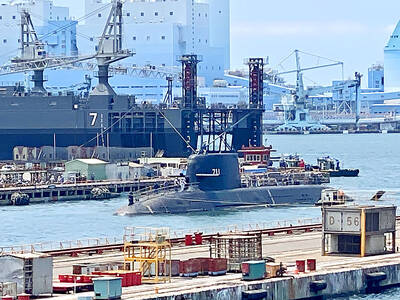
AGING: While Japan has 22 submarines, Taiwan only operates four, two of which were commissioned by the US in 1945 and 1946, and transferred to Taiwan in 1973 Taiwan would need at least 12 submarines to reach modern fleet capabilities, CSBC Corp, Taiwan chairman Chen Cheng-hung (陳政宏) said in an interview broadcast on Friday, citing a US assessment. CSBC is testing the nation’s first indigenous defense submarine, the Hai Kun (海鯤, Narwhal), which is scheduled to be delivered to the navy next month or in July. The Hai Kun has completed torpedo-firing tests and is scheduled to undergo overnight sea trials, Chen said on an SET TV military affairs program. Taiwan would require at least 12 submarines to establish a modern submarine force after assessing the nation’s operational environment and defense

A white king snake that frightened passengers and caused a stir on a Taipei MRT train on Friday evening has been claimed by its owner, who would be fined, Taipei Rapid Transit Corp (TRTC) said yesterday. A person on Threads posted that he thought he was lucky to find an empty row of seats on Friday after boarding a train on the Bannan (Blue) Line, only to spot a white snake with black stripes after sitting down. Startled, he jumped up, he wrote, describing the encounter as “terrifying.” “Taipei’s rat control plan: Release snakes on the metro,” one person wrote in reply, referring
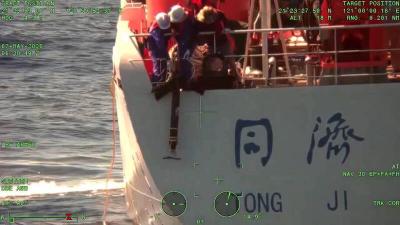
The coast guard today said that it had disrupted "illegal" operations by a Chinese research ship in waters close to the nation and driven it away, part of what Taipei sees a provocative pattern of China's stepped up maritime activities. The coast guard said that it on Thursday last week detected the Chinese ship Tongji (同濟號), which was commissioned only last year, 29 nautical miles (54km) southeast of the southern tip of Taiwan, although just outside restricted waters. The ship was observed lowering ropes into the water, suspected to be the deployment of scientific instruments for "illegal" survey operations, and the coast
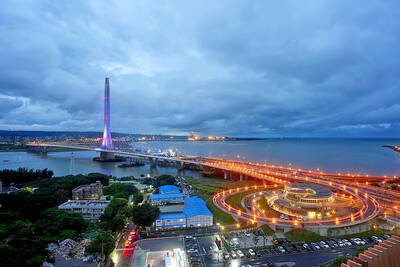
An inauguration ceremony was held yesterday for the Danjiang Bridge, the world’s longest single-mast asymmetric cable-stayed bridge, ahead of its official opening to traffic on Tuesday, marking a major milestone after nearly three decades of planning and construction. At the ceremony in New Taipei City attended by President William Lai (賴清德), Premier Cho Jung-tai (卓榮泰), Minister of Transportation and Communications Chen Shih-kai (陳世凱) and New Taipei City Mayor Hou Yu-ih (侯友宜), the bridge was hailed as both an engineering landmark and a long-awaited regional transport link connecting Tamsui (淡水) and Bali (八里)


 RSS
RSS