


The results of its investigations into the assets of all political parties, including proof that the Chinese Nationalist Party (KMT) helped an affiliate earn about NT$2 billion (US$64.73 million at the current exchange rate) from real estate, would be published on its Web site before June, the Ill-gotten Party Assets Settlement Committee said yesterday.
The published data would include information on how assets and property were obtained by each party, committee spokeswoman Shih Chin-fang (施錦芳) said.
The first step would be to publish information on assets owned by the KMT and the Democratic Progressive Party (DPP), which would be followed by information on the assets owned by party-affiliated organizations, she said.
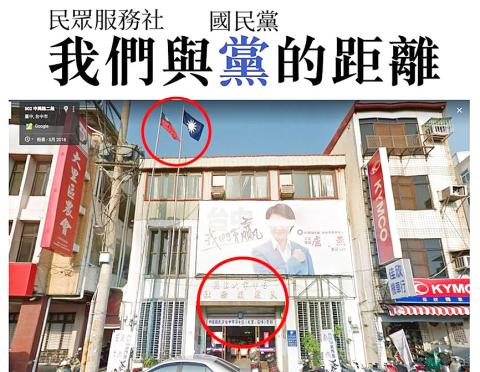
Photo courtesy of the Ill-gotten Party Assets Settlement Committee
The repository would continue to be updated as new findings emerged, she added.
Property obtained by the KMT was originally publicly owned or privately owned land, which would be listed in the repository using current property values, she said.
The KMT registered 139,935 ping (461,785m2) of real estate in 1994, She said.
However, 122,729 ping has since been sold off to party-affiliated organizations or third parties, she said.
The KMT began selling its public service centers to Central Investment Co’s subsidiaries such as Kuang Hua Co (光華公司) in 2006, and subsequently rented the properties from the companies, and the majority of the properties remain in use today as KMT divisional headquarters or public service centers, she said.
Properties that originally served as dormitories have since been resold by Central Investment Co or renovated for other purposes, she said.
Many properties sold to Kuang Hua Co were later reregistered under other party-affiliated companies such as Yuhua Co (昱華公司) or Hsin Kuang Hua Co (欣光華) following company mergers or splits, Shih said.
Having rental income from the KMT helps the Central Investment Co when it is preparing financial reports, or when it seeks bank loans, said one committee member who asked to remain anonymous, adding that the company handles stock investments on the KMT’s behalf.
The company earns “several hundred million New Taiwan dollars” annually in rent from the KMT, the member said, adding that the KMT Central Committee also rents the Bade Building in Taipei’s Zhongshan District (中山) from the company.
Assets sold by the KMT within the past 15 years include the Central Motion Picture Corp (中影), China Television Co (中視), the building housing the Institute on Policy Research and Development, the party’s Taipei headquarters, the building housing the KMT Central Committee’s old office and the Da Hsiao Building (大孝大樓) in Taipei, they said, adding that the details of these sales would appear in the repository.

Considering that most countries issue more than five denominations of banknotes, the central bank has decided to redesign all five denominations, the bank said as it prepares for the first major overhaul of the banknotes in more than 24 years. Central bank Governor Yang Chin-lung (楊金龍) is expected to report to the Legislative Yuan today on the bank’s operations and the redesign’s progress. The bank in a report sent to the legislature ahead of today’s meeting said it had commissioned a survey on the public’s preferences. Survey results showed that NT$100 and NT$1,000 banknotes are the most commonly used, while NT$200 and NT$2,000

The Centers for Disease Control (CDC) yesterday reported the first case of a new COVID-19 subvariant — BA.3.2 — in a 10-year-old Singaporean girl who had a fever upon arrival in Taiwan and tested positive for the disease. The girl left Taiwan on March 20 and the case did not have a direct impact on the local community, it said. The WHO added the BA.3.2 strain to its list of Variants Under Monitoring in December last year, but this was the first imported case of the COVID-19 variant in Taiwan, CDC Deputy Director-General Lin Ming-cheng (林明誠) said. The girl arrived in Taiwan on

South Korea is planning to revise its controversial electronic arrival card, a step Taiwanese officials said prompted them to hold off on planned retaliatory measures, a South Korean media report said yesterday. A Yonhap News Agency report said that the South Korean Ministry of Foreign Affairs is planning to remove the “previous departure place” and “next destination” fields from its e-arrival card system. The plan, reached after interagency consultations, is under review and aims to simplify entry procedures and align the electronic form with the paper version, a South Korean ministry official said. The fields — which appeared only on the electronic form

The Ministry of Foreign Affairs (MOFA) is suspending retaliation measures against South Korea that were set to take effect tomorrow, after Seoul said it is updating its e-arrival system, MOFA said today. The measures were to be a new round of retaliation after Taiwan on March 1 changed South Korea's designation on government-issued alien resident certificates held by South Korean nationals to "South Korea” from the "Republic of Korea," the country’s official name. The move came after months of protests to Seoul over its listing of Taiwan as "China (Taiwan)" in dropdown menus on its new online immigration entry system. MOFA last week


 RSS
RSS