


Hon Hai Group chairman Terry Gou (郭台銘) yesterday said his remark that “the nation should rely on peace for national defense” was misunderstood by many, adding that what he really meant was that the nation’s money should be spent on the “sharp edge of the knife” by developing high-tech weapons.
Gou made the remark on the sidelines of a general meeting of an association of township mayors in Taichung, which was also attended by former Taipei County commissioner Chou Hsi-wei (周錫瑋) and former New Taipei City mayor Eric Chu (朱立倫), both of whom have expressed an interest in being nominated as the Chinese Nationalist Party’s (KMT) candidate for next year’s presidential election.
Gou, who on April 17 announced that he would participate in the KMT primary, said that he was still not used to attending political events, but that he would get used to them with time and that many friends had suggested that he be “more down-to-earth.”
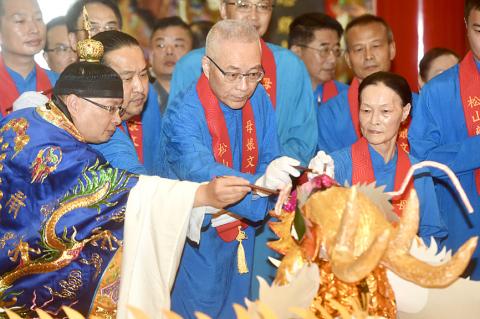
Photo: Chien Jung-fong, Taipei Times
Many people misunderstood his remark that “national defense should rely on peace,” Gou said.
He had not meant that Taiwan should not buy weapons or not have the capability of defending itself, but rather that the money should be spent where it would make the most difference, such as by choosing uncrewed weapons, Gou said, adding that he has been developing advanced technologies such as artificial intelligence applications, 5G wireless networks and 8K-resolution products.
Gou said that he believes weapons rely on technology and the more that national defense relies on peace, the more it relies on technology.
In facing China, there should be neither provocations nor fear, Gou said, adding: “Because why would Chinese people want to attack Chinese people?”
After saying on Thursday that his wife, Delia Tseng (曾馨瑩), left home in protest of his presidential bid, Guo yesterday said on Facebook that his wife had now “chosen to support him in an understanding way.”
In other news, Kaohsiung Mayor Han Kuo-yu (韓國瑜) of the KMT, who last year claimed that he won the mayoral election with “a bottle of mineral water” and “a bowl of braised pork rice” — implying his plainspoken public image — was accused by former KMT legislator Alex Tsai (蔡正元) of receiving a NT$40 million (US$1.29 million) in campaign contributions raised by KMT Chairman Wu Den-yih (吳敦義).
Wu yesterday reiterated that he did not personally handle the money, adding that “one can eat braised pork rice while running in an election, but can one offer other people braised pork rice, too? Or can one pay for putting out campaign advertisements with braised pork rice? That’s impossible.”
It is natural that there must be some money to pay for advertisements and promotional materials, he added.
The past two years were a difficult time for the KMT, as he had to go about borrowing money from good friends that he trusts and respects to finance the party, the former Kaohsiung mayor added.
Wu said that he is thankful to Tsai for his consideration and for mentioning his hard work, but added that Han also had a difficult time.
He was in Kaohsiung for many years and befriended businesspeople, Wu said, adding that he shared with them what a brave person Han is and that some of them donated NT$30,000, NT$50,000 or even NT$100,000.
However, he did not personally handle the donations, so he is not clear on the details, Wu said.

Considering that most countries issue more than five denominations of banknotes, the central bank has decided to redesign all five denominations, the bank said as it prepares for the first major overhaul of the banknotes in more than 24 years. Central bank Governor Yang Chin-lung (楊金龍) is expected to report to the Legislative Yuan today on the bank’s operations and the redesign’s progress. The bank in a report sent to the legislature ahead of today’s meeting said it had commissioned a survey on the public’s preferences. Survey results showed that NT$100 and NT$1,000 banknotes are the most commonly used, while NT$200 and NT$2,000

The Centers for Disease Control (CDC) yesterday reported the first case of a new COVID-19 subvariant — BA.3.2 — in a 10-year-old Singaporean girl who had a fever upon arrival in Taiwan and tested positive for the disease. The girl left Taiwan on March 20 and the case did not have a direct impact on the local community, it said. The WHO added the BA.3.2 strain to its list of Variants Under Monitoring in December last year, but this was the first imported case of the COVID-19 variant in Taiwan, CDC Deputy Director-General Lin Ming-cheng (林明誠) said. The girl arrived in Taiwan on

South Korea is planning to revise its controversial electronic arrival card, a step Taiwanese officials said prompted them to hold off on planned retaliatory measures, a South Korean media report said yesterday. A Yonhap News Agency report said that the South Korean Ministry of Foreign Affairs is planning to remove the “previous departure place” and “next destination” fields from its e-arrival card system. The plan, reached after interagency consultations, is under review and aims to simplify entry procedures and align the electronic form with the paper version, a South Korean ministry official said. The fields — which appeared only on the electronic form

The Ministry of Foreign Affairs (MOFA) is suspending retaliation measures against South Korea that were set to take effect tomorrow, after Seoul said it is updating its e-arrival system, MOFA said today. The measures were to be a new round of retaliation after Taiwan on March 1 changed South Korea's designation on government-issued alien resident certificates held by South Korean nationals to "South Korea” from the "Republic of Korea," the country’s official name. The move came after months of protests to Seoul over its listing of Taiwan as "China (Taiwan)" in dropdown menus on its new online immigration entry system. MOFA last week


 RSS
RSS