


Residents in Kaohsiung’s Dalinpu Village (大林蒲) have a higher risk of contracting cancer due to their exposure to carcinogenic pollutants, a survey by the Environmental Protection Administration (EPA) showed yesterday.
The EPA released the report at a meeting with Dalinpu residents and environmental groups at Fenglin Junior High School in the city’s Siaogang District (小港).
The village is surrounded by more than 800 industrial exhaust stacks owned by China Steel Corp, Taiwan Power Co and CPC Corp, Taiwan, as well as other firms.
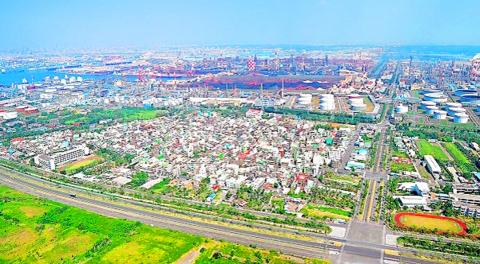
Photo courtesy of Kaohsiung Urban Development Bureau
After taking samples of air, water, soil, fishery products and vegetables, and testing emissions at plants, the EPA found that 70-year-old residents, for example, have a cancer risk 1.5 to 5.5 times higher than the “acceptable” risk range of 10-6 to 10-4 suggested by the US Environmental Protection Agency.
The six most harmful pollutants in the village are benzene, butadiene, vinyl chloride monomer, ethylene dichloride, acrylonitrile and acrolein, followed by other heavy metals, the agency said.
The pollutants are mainly emitted by industrial sources, especially petrochemical plants, while vehicles, such as ships, also caused pollution, the report showed.
Residents have a greater chance of developing cancers related to the respiratory system, liver and kidneys, as well as leukemia, it showed.
The survey was conducted from September 2017 to June last year, after then-EPA minister Lee Ying-yuan (李應元) promised residents that the risk air pollution posed to their health would be evaluated, EPA Environmental Analysis Laboratory director Yen Chun-lan (顏春蘭) said.
The agency commissioned the National Health Research Institutes to analyze the data collected, she said, adding that it completed the task at the end of last year.
Residents at yesterday’s meeting were concerned about what action the government would take after releasing the report, Yen said.
The government should conduct long-term surveys about all pollution sources in and outside the village and tighten regulations to cut the emissions of hazardous air pollutants, the institutes wrote in the report.
Then-premier Lin Chuan (林全) and then-Kaohsiung mayor Chen Chu (陳菊) in November 2016 apologized for the residents’ suffering due to decades of heavy pollution, but little progress has been made to relocate them.
Kaohsiung Mayor Han Kuo-yu (韓國瑜) met with Dalinpu residents on Tuesday.
He said that 14 percent of the residents still have problems with their relocation, but the city government is in communication with them.
Additional reporting by Hung Chen-hung

NATIONAL SECURITY: Authorities are working to confirm the identities of the military personnel involved and investigating possible illegal conduct and regulatory violations Authorities are probing possible national security implications after Kinmen police and immigration officers on Sunday found a Chinese woman allegedly posing as a tourist while engaging in prostitution involving more than 10 military personnel. The woman, surnamed Chen (陳), has since been deported, authorities said, adding that investigators are still working to confirm the identities of those implicated, as the records only listed code names and aliases. The case stemmed from a report received by the Kinmen District Prosecutors’ Office on Friday last week from the Jinhu Precinct of the Kinmen County Police Bureau. On Sunday, police, along with the National Immigration

GLOBALGIVING: ‘ Caving to external pressure is not acceptable for an organization that has cultivated justice reform and human rights for 30 years,’ one NGO said A slew of non-government organizations (NGOs) have withdrawn from the GlobalGiving fundraising platform after it announced it would use “Chinese Taipei” instead of “Taiwan” from next month. The Taiwan Good Rice Association wrote on Facebook on Friday that it was informed on April 28 via a teleconference call of the change, which was made because the platform wanted to operate in China. Taiwan Good Rice is to terminate all cooperative relationships with GlobalGiving in response to the platform’s “unilateral and non-negotiable” decision to remove references to Taiwan, the NGO said. “Taiwan is in the official name of Taiwan Good Rice Association and the

HEAVY WEATHER: Typhoon Jangmi is due to crash straight into the Ryukyus as airlines look to shift flights to larger aircraft or cancel flights to Okinawa entirely Taiwan’s international air carriers announced flight adjustments over the weekend as Typhoon Jangmi is forecast to hit the Ryukyu Islands today and tomorrow. The Central Weather Administration (CWA) upgraded Jangmi from a tropical storm to a typhoon at 8am yesterday, with the eye located 580km south of Naha city. It was moving north at 19kph. Today, China Airlines’ CI-120, CI-121, CI-122 and CI-123 flights between Taoyuan and Naha, Okinawa, have been canceled as well as CI-132 and CI-133 between Kaohsiung and Naha. EVA Air’s BR-112, BR-113, BR-186 and BR-185 flights between Taoyuan and Naha are also canceled. Low-cost carrier Tigerair Taiwan canceled IT-230,
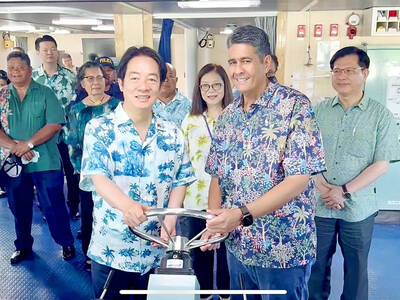
MULTIPRONGED APPROACH: China has sought to pressure Palau across a number of fronts, but the island nation has staunchly resisted overtures to ditch Taiwan Palau has been firm in backing Taiwan despite Chinese pressure that uses tourism economics, cyberattacks and criminal infiltration as tools to threaten the Pacific ally into renouncing its recognition of Taiwan as a sovereign state. The Presidential Office yesterday announced that Vice President Hsiao Bi-khim (蕭美琴) would visit Palau from Saturday to Wednesday next week at the invitation of Palauan President Surangel Whipps Jr. Whipps in April said in an interview that China had outspokenly asked Palau to “denounce Taiwan.” “And we have said: ‘We have no enemies, but nobody tells us who our friends are,’” he said. Whipps has told reporters multiple times


 RSS
RSS