


More young people are seeking a connection with the land and putting more emphasis on values instead of material gains, climate advocate and Central Taiwan Pingpu Indigenous Groups Youth Alliance founder Kaisanan Ahuan said.
The Pingpu people, also known as plains Aborigines, have traditionally lived in the lowland areas of Taiwan.
Also known by his Chinese name, Wang Shang-yi (王商益), the 25-year-old said he was not sure about himself until he embarked on an identity quest about five years ago.
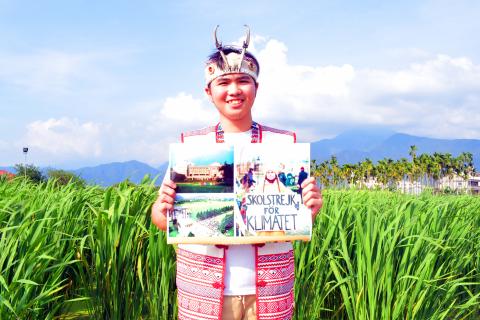
Photo: Lin Chia-nan, Taipei Times
Having worked at chipmaking firms for about two years after graduating from university as an electrical engineer, he returned to his hometown of Puli Township (埔里) in Nantou County to help revive the culture of Taokas, a Pingpu group, because “our culture was fading at a speed faster than I had imagined,” he told the Taipei Times.
He prefers using the term “indigenous” over “Aboriginal,” because the former is adopted by the UN’s Declaration on the Rights of Indigenous Peoples “and shows more respect to indigenous peoples,” Kaisanan said.
He said he had assumed that he was a Thao, as his father’s family lived near Sun Moon Lake, where the Thao predominantly lived.
He did not learn that he is a Taokas and has relatives in other municipalities until his parents told him that they have relatives in Miaoli County when he decided to study at National United University there.
Taokas culture is better preserved in Miaoli’s Houlong Township (後龍), which later became a second home for him, as he frequently visited the township, he said.
During his time at university, activities reviving Taokas culture began to flourish in Puli, and a member of the Kaxabu community asked him a question that left a long-lasting effect, Kaisanan said.
“Where do you come from?” they asked, to which he replied that he came from Puli’s Waraoral — where houses used to be built with red bricks — and was told that there are many Taokas there, to his surprise.
He learned from historical texts that his ancestors had fled from Miaoli and Taichung following a massacre during the Qing Dynasty, and that their languages and traditions quickly faded during the Japanese colonial era and the former Chinese Nationalist Party’s (KMT) authoritarian regime.
His grandparents rarely divulge information about Taokas traditions unless he asks them, while his parents know almost nothing about the past, Kaisanan said.
He said that community elders used to hide their rituals, as they feared that other people would jeer at their rituals and dancing.
Using Chinese names is another issue for them, Kaisanan said.
His mother is surnamed Chung (鐘) in Chinese, but her signature was often “corrected” to the character Chung (鍾), which also happened to her relatives, so they write their surnames using two characters, he said.
“This is ridiculous, because their surnames were given by other people anyway,” he added.
Not yet recognized by the law, Pingpu people cannot have their names officially registered and they feel ostracized by Han people and legally recognized groups when it comes to identification, Kaisanan said.
“Reassuming indigenous names is the first step to gaining self-respect,” he said, adding that his name — Kaisanan — means “stars” in the Taokas language.
Pingpu have been striving to gain official recognition for two or three decades, and they felt a sense of hope after President Tsai Ing-wen (蔡英文) assumed office in May 2016, he said.
“Compared with previous presidents, Tsai can be said the friendliest toward indigenous peoples, given that she has at least listed improving their rights as part of her policy program,” Kaisanan said.
Nonetheless, he did not forget that draft amendments to the Status Act for Indigenous Peoples (原住民身分法) launched in 2017 failed to give equal rights to Pingpu people, Kaisanan said, adding that many advocates, such as Amis singer Panai Kusui, continue to fight to retrieve traditional lands.
“Hopefully one day I will be proud to say that I am an indigenous person” without having to worry about discrimination, Kaisanan said when asked about the future he dreams for.
He also hopes that Taiwan would become a normal country without being suppressed by other powers.
It is unnerving to see how minorities in Xinjiang and Tibet are treated by Beijing authorities, Kaisanan said. “Indigenous people do not want to experience more colonization.”
However, people should not identify themselves with indigenous people just because they dislike being identified as Chinese, he added.
“Some independence advocates argue that every Taiwanese has certain blood ties with indigenous peoples just to prove that they are different from Chinese, which shows no respect to indigenous history,” Kaisanan said.
He also drew attention to environmental and social problems.
He was identified as one of the world’s youngest climate advocates in a report by the Guardian, after he took part in a climate strike on March 15 along with National Chi Nan University students in a global action inspired by Swedish student Greta Thunberg.
“Indigenous people are more susceptible to environmental changes because of their close ties to nature, but their voices are lacking in climate action,” he said.
Air pollution, an increasing number of landslides, warmer weather and unstable rainfall are primary environmental problems that also disrupt harvests in Puli, Kaisanan said.
“When it snowed on Hehuanshan (合歡山), we could see its snow-capped peak from Puli,” but now even blue skies are rarely seen, he said.
To combat air pollution, local residents report illegal burning of waste, Kaisanan said, calling on the government to take concrete action to curb carbon emissions.
He is willing to pay more money for a new scooter if it helps improve air quality, he said, adding that he supports the government’s plan to regulate emissions by older vehicles.
Young people care more about values than material gains, Kaisanan said, but added that many are anxious about the future after the results of the local elections in November last year turned out to be different from what they had expected.
The spread of misinformation has become a serious problem and the media should strive to broadcast correct and objective reports, he said.
Asked if he thinks Taiwan will become a better place, Kaisanan said: “I hope so.”
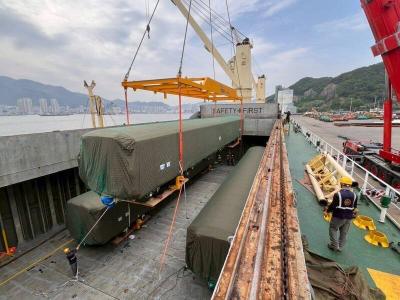
The first of 10 new high-capacity trains purchased from South Korea’s Hyundai Rotem arrived at the Port of Taipei yesterday to meet the demands of an expanding metro network, Taipei Rapid Transit Corp (TRTC) said yesterday. The train completed a three-day, 1,200km voyage from the Port of Masan in South Korea, the company said. Costing NT$590 million (US$18.79 million) each, the new six-carriage trains feature a redesigned interior based on "human-centric" transportation concepts, TRTC said. The design utilizes continuous longitudinal seating to widen the aisles and optimize passenger flow, while also upgrading passenger information displays and driving control systems for a more comfortable
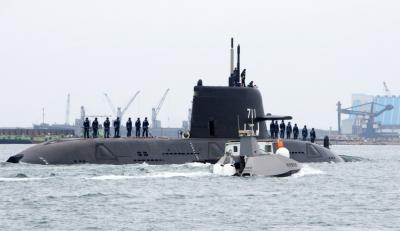
Taiwan's first indigenous defense submarine, the SS-711 Hai Kun (海鯤, or Narwhal), departed for its 13th sea trial at 7am today, marking its seventh submerged test, with delivery to the navy scheduled for July. The outing also marked its first sea deployment since President William Lai (賴清德) boarded the submarine for an inspection on March 19, drawing a crowd of military enthusiasts who gathered to show support. The submarine this morning departed port accompanied by CSBC Corp’s Endeavor Manta (奮進魔鬼魚號) uncrewed surface vessel and a navy M109 assault boat. Amid public interest in key milestones such as torpedo-launching operations and overnight submerged trials,
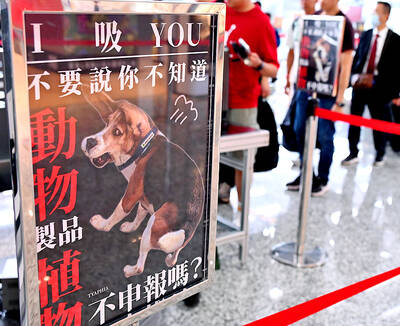
Quarantine awareness posters at Taiwan Taoyuan International Airport have gone viral for their use of wordplay. Issued by the airport branch of the Animal and Plant Health Inspection Agency, the posters feature sniffer dogs making a range of facial expressions, paired with advisory messages built around homophones. “We update the messages for holidays and campaign needs, periodically refreshing materials to attract people’s attention,” quarantine officials said. “The aim is to use the dogs’ appeal to draw focus to quarantine regulations.” A Japanese traveler visiting Taiwan has posted a photo on X of a poster showing a quarantine dog with a

Taiwan’s coffee community has launched a “one-person-one-e-mail” campaign, calling for people to send a protest-e-mail to the World Coffee Championships (WCC) urging it to redesignate Taiwanese competitors as from “Taiwan,” rather than “Chinese Taipei.” The call followed sudden action last week after the WCC changed all references to Taiwanese competitors from “Taiwan” to “Chinese Taipei,” including recent World Latte Art champion Bala (林紹興), who won the World Latte Art Championship in San Diego earlier this month. When Bala received the trophy, he was referred to as representing Taiwan, as well as in the announcement on the WCC’s Web site, until it


 RSS
RSS