


As the pet industry thrives, animal mortuary services are becoming a permanent part of the nation’s professional landscape, industry sources say.
Pet morticians are among the 10 most employable professions in Taiwan, according to a report by 1111 Job Bank last year.
As Taiwanese society ages and births decline, people are becoming more emotionally attached to pets, which they treat as something akin to children, said Hung Wen (洪聞), owner of Pet Castle, an exclusive pet cemetery in New Taipei City’s Wanli District (萬里).
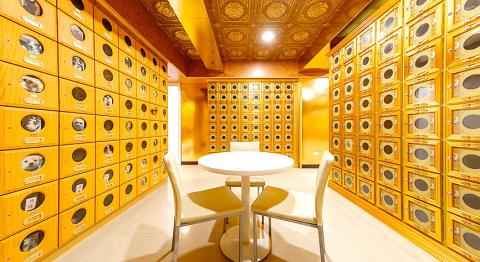
Photo courtesy of Pet Castle
That emotional factor and concern for the environment are responsible for increased demand for pet funerary services, he said, adding that 25 ossuaries have been established nationwide.
Eight of the biggest operators are based in the north, with the main clientele being owners of cats and dogs, although he has also encountered owners of parrots and turtles as part of the job, he said.
A turtle owner, who talked to the pet every day and treated it as a child, arranged for the animal to receive all of Pet Castle’s religious and ceremonial services following its death, Hung said.
Another owner told him that a pet only has its owner for companionship, so it is incumbent upon people to do everything to ensure they enjoy a happy afterlife, he said.
The Pet Castle is a business run by professionals that provides services around the clock, he said.
A refrigerated mortuary, crematorium and ossuary are run to the same standards as funeral homes for people, while Pet Castle’s mortician has many years of experience as a regular mortician, he said.
The industry standard is to provide a full range of funeral options, from cremation for placement in an ossuary or burial in a graveyard, at sea or under a tree, he said.
The best pet cemeteries make arrangements for Buddhist, Taoist and Christian rites, and accommodate requests for personalized memorial services, he said.
At Pet Castle, Buddhist scriptures are chanted for the souls of pets at 1:30pm to 3pm every Sunday, he said, adding that the venue is open for animal lovers to meet and chat.
However, bad actors in the industry are known to establish fake ossuaries, but actually store the ashes in rickety metal sheds, so people should investigate pet cemeteries thoroughly before making a decision, he said.
A pet owner surnamed Wang (王) said she had seen pet ossuaries that are as luxurious as those that the ashes of her family members rest in during her search for a resting place for her dog.
A woman surnamed Weng (翁) said she bought a place for her dog Siaobao (小寶) that she had for more than 15 years, because she hoped its spirit would be happy in the company of other canines.
New Taipei City-based counseling psychologist Yang Tsung-tsai (楊聰財) said that people are known to become clinically depressed after the death of a pet.
One patient, who lost 5kg in the month following the death of their dog, reported feeling listless and that a part of themselves was missing, Yang said.
“A lot of people treat their pets as members of the family and funerary rituals are a way to memorialize the lost pet, which can make the living feel better,” he said.
Yes123 spokesperson Yang Tsung-pin (楊宗斌) said many young jobseekers are interested in working with animals.
The salary of a pet mortician is at least NT$30,000 per month, Yang Tsung-pin said, adding that those with good credentials could receive up to NT$700,000 a year after bonuses.
Pet Castle’s mortician, surnamed Huang (黃), who has been at the establishment for about a year, said they responded to a job advertisement because they like animals.
Heartbroken pet owners often cry at memorial services and a few have fainted, Huang said.
“I am a pet owner myself and I can sympathize with that,” Huang said. “Pets are our companions. They are like children in a lot of ways. It is difficult to move on after they are gone.”
“The remains of pets arrive at the morgue in all conditions, some of which can be distressing, but I have gotten used to it,” Huang said. “I love my job and I am thankful for the opportunity to help people say goodbye to their pets.”

Considering that most countries issue more than five denominations of banknotes, the central bank has decided to redesign all five denominations, the bank said as it prepares for the first major overhaul of the banknotes in more than 24 years. Central bank Governor Yang Chin-lung (楊金龍) is expected to report to the Legislative Yuan today on the bank’s operations and the redesign’s progress. The bank in a report sent to the legislature ahead of today’s meeting said it had commissioned a survey on the public’s preferences. Survey results showed that NT$100 and NT$1,000 banknotes are the most commonly used, while NT$200 and NT$2,000

The Centers for Disease Control (CDC) yesterday reported the first case of a new COVID-19 subvariant — BA.3.2 — in a 10-year-old Singaporean girl who had a fever upon arrival in Taiwan and tested positive for the disease. The girl left Taiwan on March 20 and the case did not have a direct impact on the local community, it said. The WHO added the BA.3.2 strain to its list of Variants Under Monitoring in December last year, but this was the first imported case of the COVID-19 variant in Taiwan, CDC Deputy Director-General Lin Ming-cheng (林明誠) said. The girl arrived in Taiwan on

South Korea is planning to revise its controversial electronic arrival card, a step Taiwanese officials said prompted them to hold off on planned retaliatory measures, a South Korean media report said yesterday. A Yonhap News Agency report said that the South Korean Ministry of Foreign Affairs is planning to remove the “previous departure place” and “next destination” fields from its e-arrival card system. The plan, reached after interagency consultations, is under review and aims to simplify entry procedures and align the electronic form with the paper version, a South Korean ministry official said. The fields — which appeared only on the electronic form

The Ministry of Foreign Affairs (MOFA) is suspending retaliation measures against South Korea that were set to take effect tomorrow, after Seoul said it is updating its e-arrival system, MOFA said today. The measures were to be a new round of retaliation after Taiwan on March 1 changed South Korea's designation on government-issued alien resident certificates held by South Korean nationals to "South Korea” from the "Republic of Korea," the country’s official name. The move came after months of protests to Seoul over its listing of Taiwan as "China (Taiwan)" in dropdown menus on its new online immigration entry system. MOFA last week


 RSS
RSS