


A trial run of 3D road markings proved ineffective in slowing down drivers, and so their use might be discontinued, the Taipei City Traffic Engineering Office said on Sunday.
The markings have been used in some areas of the nation for about two years, but drivers have stopped paying attention to them and many no longer slow down for them, the office said.
Taipei was one of the late joiners to the trial program, putting some on Zhongxiao E Road Sec 5 in March last year, after city officials studied traffic-management measures in Iceland, India and several other countries.
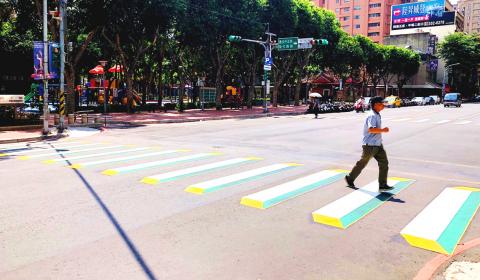
Photo: Lee Jung-ping, Taipei Times
The city found that the rate of drivers braking as they came to road crossings rose only slightly, from 80 percent of the time with the old markings to 85 percent with the 3D markings, before returning to 80 percent several weeks after the 3D markings were installed, the office said.
A survey of drivers found that half admitted they would not take any special action when encountering 3D markings, and would be unlikely to slow down, it said.
Given the ineffectiveness of the 3D markings, they would be painted over, with the original markings restored, within the next few months, the office said.
Nantou City introduced 3D markings on Huayang and Zucih roads in 2016, but while drivers slowed down initially, once the novelty wore off drivers resumed their old habits, the Nantou County Public Works Department said.
As the markings proved ineffective, the city would not expand their use, and the existing markings would disappear after future road work on the two roads, the department said.
The Taoyuan Department of Transportation also began using 3D markings — some in bright colors — in 2016 in areas with schools or heavy pedestrian traffic, and it said it was still analyzing their effectiveness.
The special markings used in school areas, where white lines are painted over a green crossing, have received a positive response from teachers and parents, who say they are effective in getting drivers to stop, so the city would continue to use such markings in school areas, department Director Liu Ching-feng (劉慶豐) said.
It also began using “zipper style” crosswalks last year in Zhongshan District (中山), which are crosswalks divided down the middle with the white lines skewed, designed to separate foot traffic moving in each direction, with arrows telling pedestrians which side they should be walking on, Liu said.
They are designed to boost the efficiency of crosswalks, Liu said.
Additional reporting by Wei Chin-yun

Considering that most countries issue more than five denominations of banknotes, the central bank has decided to redesign all five denominations, the bank said as it prepares for the first major overhaul of the banknotes in more than 24 years. Central bank Governor Yang Chin-lung (楊金龍) is expected to report to the Legislative Yuan today on the bank’s operations and the redesign’s progress. The bank in a report sent to the legislature ahead of today’s meeting said it had commissioned a survey on the public’s preferences. Survey results showed that NT$100 and NT$1,000 banknotes are the most commonly used, while NT$200 and NT$2,000

The Centers for Disease Control (CDC) yesterday reported the first case of a new COVID-19 subvariant — BA.3.2 — in a 10-year-old Singaporean girl who had a fever upon arrival in Taiwan and tested positive for the disease. The girl left Taiwan on March 20 and the case did not have a direct impact on the local community, it said. The WHO added the BA.3.2 strain to its list of Variants Under Monitoring in December last year, but this was the first imported case of the COVID-19 variant in Taiwan, CDC Deputy Director-General Lin Ming-cheng (林明誠) said. The girl arrived in Taiwan on

South Korea is planning to revise its controversial electronic arrival card, a step Taiwanese officials said prompted them to hold off on planned retaliatory measures, a South Korean media report said yesterday. A Yonhap News Agency report said that the South Korean Ministry of Foreign Affairs is planning to remove the “previous departure place” and “next destination” fields from its e-arrival card system. The plan, reached after interagency consultations, is under review and aims to simplify entry procedures and align the electronic form with the paper version, a South Korean ministry official said. The fields — which appeared only on the electronic form

The Ministry of Foreign Affairs (MOFA) is suspending retaliation measures against South Korea that were set to take effect tomorrow, after Seoul said it is updating its e-arrival system, MOFA said today. The measures were to be a new round of retaliation after Taiwan on March 1 changed South Korea's designation on government-issued alien resident certificates held by South Korean nationals to "South Korea” from the "Republic of Korea," the country’s official name. The move came after months of protests to Seoul over its listing of Taiwan as "China (Taiwan)" in dropdown menus on its new online immigration entry system. MOFA last week


 RSS
RSS