


Taichung residents in seven districts are being exposed to higher concentrations of eight first-level carcinogenic air pollutants, and the government should be treating the city’s pollution as a national security crisis, an academic told a public hearing on Saturday.
The hearing held by the Taichung Environmental Protection Bureau at Chung Shan Medical University focused on the bureau’s latest report on the city’s air pollution and its effect on health.
People living in districts near the state-run Taichung Power Plant, which has 10 coal-fired units and four oil-fired units, the Dragon Steel Corp plant and the Central Taiwan Science Park are exposed to eight first-level airborne carcinogenic pollutants, including arsenic, dioxin, cadmium and nickel, said Liaw Yung-po (廖勇柏), a professor at the university.
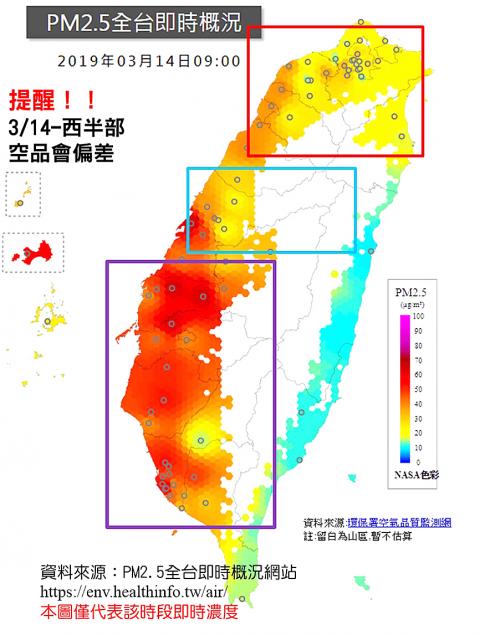
Photo: CNA
The concentrations of carcinogenic pollutants are higher in Longjing (龍井), Situn (西屯), Dadu (大肚), Daya (大雅), Cingshuei (清水), Houli (后里) and Wuci (梧棲) than the city’s other districts, Liaw said his research had found.
People who inhale such pollutants, regardless of the amount, face certain health risks, Liaw said.
The concentrations of the pollutants are related to the level of PM2.5 — fine particulate matter measuring 2.5 micrometers or less in diameter, he said.
The air pollutants interact with other environmental factors as well as viruses, and pose a greater danger to pregnant women, the elderly and children, he added.
The government must tackle the pollution problem by monitoring the first-level carcinogenic pollutants and work to curtail or eliminate their concentrations in the air, Liaw added.
The government should allocate more funding to research on diseases caused by air pollution, said Shang Chun-hsi (尚君璽), an assistant professor at Tunghai University.
Taichung-based physician Lai Yi-chun (賴怡均) called on environmental authorities not to “beautify” air pollution data, so that people can be aware of the dangers.
The bureau’s report proves that the city’s air pollution is related to the power station and the steel plant, and the government should force them to reduce their emissions, Homemakers United Foundation member Hsu Hsin-hsin (許心欣) said.
The bureau said it would take into account the opinions as it works to improve its pollution control efforts, adding that three other public hearings would be held later this month.
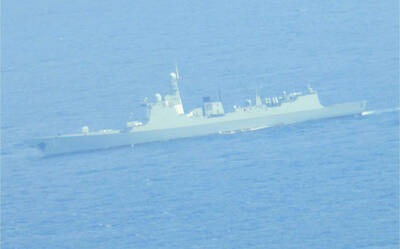
The military has spotted two Chinese warships operating in waters near Penghu County in the Taiwan Strait and sent its own naval and air forces to monitor the vessels, the Ministry of National Defense (MND) said. Beijing sends warships and warplanes into the waters and skies around Taiwan on an almost daily basis, drawing condemnation from Taipei. While the ministry offers daily updates on the locations of Chinese military aircraft, it only rarely gives details of where Chinese warships are operating, generally only when it detects aircraft carriers, as happened last week. A Chinese destroyer and a frigate entered waters to the southwest
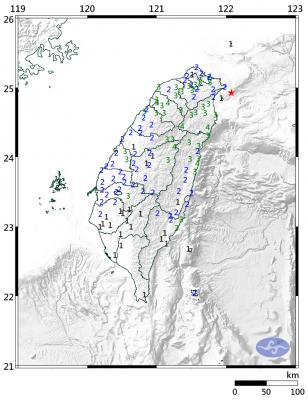
A magnitude 6.1 earthquake struck off the coast of Yilan County at 8:39pm tonight, the Central Weather Administration (CWA) said, with no immediate reports of damage or injuries. The epicenter was 38.7km east-northeast of Yilan County Hall at a focal depth of 98.3km, the CWA’s Seismological Center said. The quake’s maximum intensity, which gauges the actual physical effect of a seismic event, was a level 4 on Taiwan’s 7-tier intensity scale, the center said. That intensity level was recorded in Yilan County’s Nanao Township (南澳), Hsinchu County’s Guansi Township (關西), Nantou County’s Hehuanshan (合歡山) and Hualien County’s Yanliao (鹽寮). An intensity of 3 was
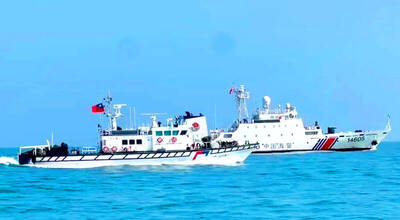
Instead of focusing solely on the threat of a full-scale military invasion, the US and its allies must prepare for a potential Chinese “quarantine” of Taiwan enforced through customs inspections, Stanford University Hoover fellow Eyck Freymann said in a Foreign Affairs article published on Wednesday. China could use various “gray zone” tactics in “reconfiguring the regional and ultimately the global economic order without a war,” said Freymann, who is also a nonresident research fellow at the US Naval War College. China might seize control of Taiwan’s links to the outside world by requiring all flights and ships entering or leaving Taiwan
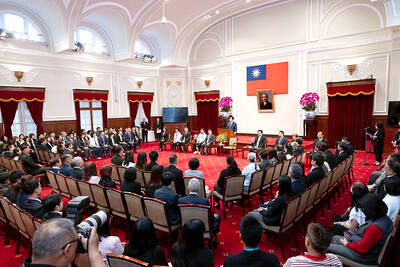
The next minimum wage hike is expected to exceed NT$30,000, President William Lai (賴清德) said yesterday during an award ceremony honoring “model workers,” including migrant workers, at the Presidential Office ahead of Workers’ Day today. Lai said he wished to thank the awardees on behalf of the nation and extend his most sincere respect for their hard work, on which Taiwan’s prosperity has been built. Lai specifically thanked 10 migrant workers selected for the award, saying that although they left their home countries to further their own goals, their efforts have benefited Taiwan as well. The nation’s industrial sector and small businesses lay


 RSS
RSS