


The Supreme Court yesterday upheld a guilty conviction against Zhou Hongxu (周泓旭) and handed him a 14-month sentence for breaching the National Security Act (國家安全法), which has been criticized as too lenient.
It was the final verdict in the case.
In 2017, the Taipei District Court found Zhou, now 32, guilty of espionage, for recruiting people to develop a Chinese spy network in Taiwan. The High Court upheld the verdict in April last year, and both courts handed him the same 14-month sentence.

Photo: Liu Hsin-de, Taipei Times
Zhou first came to Taiwan in 2009 to study at Tamkang University in New Taipei City’s Tamsui District (淡水) and later returned to study for a graduate degree in management at Chengchi University from 2012 to 2016.
After graduating, Zhou returned to Taiwan in February 2017 to work at Taiwan Yong Ming International, a company registered in Taipei, but funded by a Hong Kong firm.
The case began when Zhou met with Chinese official Li Bin (李彬) in Shanghai, investigators said.
Li is the liaison officer in Shanghai for the Taiwan Democratic Self-Government League, which is run by the Chinese Communist Party.
Li instructed Zhou to carry out certain tasks, specifically focusing on befriending Taiwanese politicians, as well as people working in the military, police, intelligence and foreign affairs agencies, investigators said.
Investigators found that Zhou had joined numerous social networks and attended functions to make friends in Taiwan.
He became acquainted with a Ministry of Foreign Affairs junior official in 2016, and promised them a payment of at least US$10,000 per quarter in exchange for classified information, they found.
Investigators said that Zhou had also been in contact with members of the New Party, including Wang Ping-chung (王炳忠), Hou Han-ting (侯漢廷), Lin Ming-cheng (林明正) and Chen Ssu-chun (陳斯俊), members of its youth wing.
Zhou and the New Party members were involved in an operation codenamed “Star Fire T Project,” which offered financial rewards depending on the value and level of the contacts they gained, investigators said.
Zhou also funded Wang’s Web site, Fire News, which had its registered address as the New Party’s Taipei headquarters, they said.
Meanwhile, Democratic Progressive Party Legislator Wang Ting-yu (王定宇) said that he echoed many people’s view that Zhou’s sentence was too lenient, because it was a serious case of China working to destabilize Taiwan and subvert national security.
“Our courts chose to prosecute based on the National Security Act, which has the most lenient punishment for espionage,” Wang Ting-yu said.
There is a gray area in the laws governing Taiwanese and Chinese, he said, adding that he has been pushing for amendments to be more specific regarding spying by “persons from another country, or an enemy state.”

Fast food chain McDonald's is to raise prices by up to NT$5 on some products at its restaurants across Taiwan, starting on Wednesday next week, the company announced today. The prices of all extra value meals and sharing boxes are to increase by NT$5, while breakfast combos and creamy corn soup would go up by NT$3, the company said in a statement. The price of the main items of those meals, if ordered individually, would remain the same. Meanwhile, the price of a medium-sized lemon iced tea and hot cappuccino would rise by NT$3, extra dipping sauces for chicken nuggets would go up
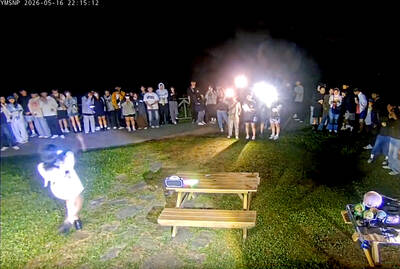
Yangmingshan National Park’s Qingtiangang (擎天崗) nature area has gone viral after a park livestream camera observed a couple in the throes of intimate congress, which was broadcast live on YouTube, drawing large late-night crowds and sparking a backlash over noise, bright lights and disruption to wildlife habitat. The area’s livestream footage appeared to show a couple engaging in sexual activity on a picnic table in the park on Friday last week, with the uncensored footage streamed publicly online. The footage quickly spread across social media, prompting a tide of visitors to travel to the site to “check in” and recreate the

Minister of Digital Affairs Lin Yi-ching (林宜敬) yesterday cited regulatory issues and national security concerns as an expert said that Taiwan is among the few Asian regions without Starlink. Lin made the remarks on Facebook after funP Innovation Group chief executive officer Nathan Chiu (邱繼弘) on Friday said Taiwan and four other countries in Asia — China, North Korea, Afghanistan and Syria — have no access to Starlink. Starlink has become available in 166 countries worldwide, including Ukraine, Malaysia, the Philippines and Vietnam, in the six years since it became commercial, he said. While China and North Korea block Starlink, Syria is not

GROUNDED: A KMT lawmaker proposed eliminating drone development programs and freezing funding for counterdrone systems, despite China’s adoption of the technology China has deployed attack drones at air bases near the Taiwan Strait in a strategy aimed at overwhelming Taiwan’s air defense systems through saturation attacks, the Mainland Affairs Council (MAC) said. The council’s latest quarterly report on China said that satellite imagery and open-source intelligence indicate that the Chinese People’s Liberation Army (PLA) had converted retired J-6 fighter jets into J-6W drones, which the PLA has stationed at six air bases near Taiwan, five in China’s Fujian Province and one in Guangdong Province. The report cited J. Michael Dahm, a senior fellow at the US-based Mitchell Institute, as saying that China has


 RSS
RSS