


The Ministry of Transportation and Communications is to expand a test program to deliver packages to remote communities using uncrewed aerial vehicles (UAV), ministry officials said.
The program’s initial test in October last year delivered a package from Tainan’s Zuojhen District (左鎮) to the office of National Development Council Minister Chen Mei-ling (陳美伶) in Taipei in two days, Department of Post and Telecommunications officials said.
The improved speed and cost-effectiveness of drones in delivering mail and agricultural goods could be a boon to the economies of remote communities, they said.
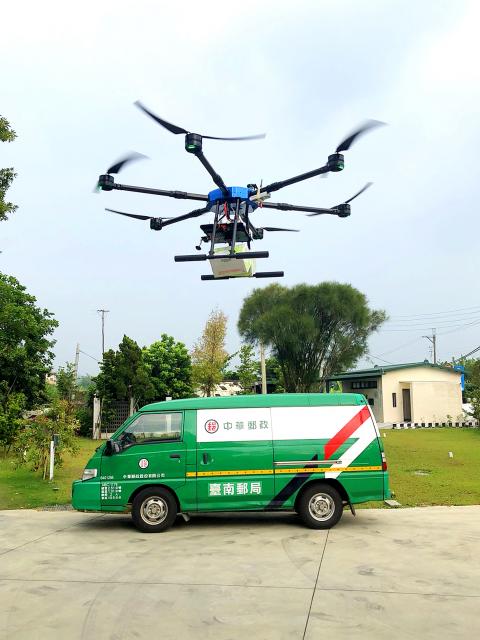
Photo courtesy of the Ministry of Transportation and Communications
The ministry’s plan for this year is to open more routes for drone mail delivery, study the commercial viability of using drones to move goods and use a fleet of drones for serum deliveries, they said.
The ministry early this month is to begin charting and drafting flight paths for mail delivery in Chiayi County’s Alishan (阿里山), they said.
The experiment in Zuojhen and Alishan is to determine whether agricultural produce — such as Alishan’s famed tea — could be transported by drones at a reasonable cost, Department Director Hsiao Chia-an (蕭家安) said.
“We need to learn from the experience of foreign countries before the program could be expanded into a regular service,” he said, adding that based on “the department’s initial assessment, the program is viable.”
Delivery precision and insurance are the most significant challenges at the moment, Hsiao said.
Aside from mail, the ministry’s drones are to airlift serums to mountain villages and townships enrolled in the program in cooperation with the Centers for Disease Control, department technician Wu Kun-yen (吳昆諺) said.
Depending on Chunghwa Post’s cost-benefit analysis, either Taichung’s Lishan (梨山) or Hsinchu County’s Jianshi Township (尖石) would be selected as the new location for drone mail delivery this year, with the trial being held for at least one year, Wu said.
The company is observing remote rural communities’ demand for postal deliveries, Chunghwa Post associate manager Kuo Chun-yang (郭純陽) said.
Most regions in the nation have robust transportation networks and fully replacing land mail with air mail has yet to be proven to be feasible, in terms of management and economies of scale, he said.
With the Civil Aeronautics Administration (CAA) poised to announce new regulations for UAVs in July, the agency’s Flight Standards Director Clark Lin (林俊良) said that government agencies and other public institutions should expect to follow more stringent standards than private citizens.
Government organizations would have to register the dimensions, weight and other specifications of the drones they employ for air pollution detection, pesticide spraying, and emergency relief and rescue, he said.
Private individuals are forbidden to operate drones above 400 feet (122m) or at night, but corporations can apply for exemptions, except for the restriction on flights over large crowds, he said.
Although the new regulations have yet to take effect, flight plans and routes over towns or cities still have to be approved by the CAA for safety reasons, Lin said.

Considering that most countries issue more than five denominations of banknotes, the central bank has decided to redesign all five denominations, the bank said as it prepares for the first major overhaul of the banknotes in more than 24 years. Central bank Governor Yang Chin-lung (楊金龍) is expected to report to the Legislative Yuan today on the bank’s operations and the redesign’s progress. The bank in a report sent to the legislature ahead of today’s meeting said it had commissioned a survey on the public’s preferences. Survey results showed that NT$100 and NT$1,000 banknotes are the most commonly used, while NT$200 and NT$2,000

The Centers for Disease Control (CDC) yesterday reported the first case of a new COVID-19 subvariant — BA.3.2 — in a 10-year-old Singaporean girl who had a fever upon arrival in Taiwan and tested positive for the disease. The girl left Taiwan on March 20 and the case did not have a direct impact on the local community, it said. The WHO added the BA.3.2 strain to its list of Variants Under Monitoring in December last year, but this was the first imported case of the COVID-19 variant in Taiwan, CDC Deputy Director-General Lin Ming-cheng (林明誠) said. The girl arrived in Taiwan on

South Korea is planning to revise its controversial electronic arrival card, a step Taiwanese officials said prompted them to hold off on planned retaliatory measures, a South Korean media report said yesterday. A Yonhap News Agency report said that the South Korean Ministry of Foreign Affairs is planning to remove the “previous departure place” and “next destination” fields from its e-arrival card system. The plan, reached after interagency consultations, is under review and aims to simplify entry procedures and align the electronic form with the paper version, a South Korean ministry official said. The fields — which appeared only on the electronic form

The Ministry of Foreign Affairs (MOFA) is suspending retaliation measures against South Korea that were set to take effect tomorrow, after Seoul said it is updating its e-arrival system, MOFA said today. The measures were to be a new round of retaliation after Taiwan on March 1 changed South Korea's designation on government-issued alien resident certificates held by South Korean nationals to "South Korea” from the "Republic of Korea," the country’s official name. The move came after months of protests to Seoul over its listing of Taiwan as "China (Taiwan)" in dropdown menus on its new online immigration entry system. MOFA last week


 RSS
RSS