


The Freeway Bureau yesterday said that it is formulating a pricing scheme for towing away supercars from the nation’s freeways.
The bureau is obligated to remove any motor vehicle blocking traffic on freeways and works with 1, 500 certified towing firms to move vehicles that have broken down or were involved in traffic accidents to the shoulder or to auto repair shops, bureau Deputy Director-General Wu Mu-fu (吳木富) said.
“However, supercar owners sometimes refuse to have their cars towed by the firms working with the bureau for fear that the cars’ chassis or other parts might be damaged during the towing process, and insist that their cars be handled directly by the dealers,” Wu said.
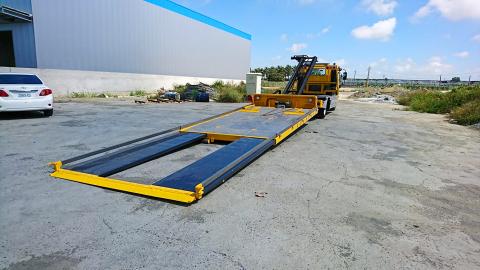
Photo courtesy of the Freeway Bureau, MOTC
“This has prevented the bureau from quickly moving the cars, which worsens congestion. The cars are also at risk of being rear-ended by other vehicles” as they wait for specialized tow trucks, he said.
The bureau cited as an example an incident from August last year, when a McLaren MP4-12C and multiple other cars were involved in an accident on the Formosa Freeway (Freeway No. 3). Regular tow trucks were unable to tow the car as is chassis was severely damaged and the owner found a towing firm specializing in towing sports cars.
However, the delay in moving the car caused traffic to back up for about 5km, the bureau said.
The bureau aims to implement a new pricing scheme by June after discussing the issue with contractors, Wu said.
Towing fees for supercars would be higher than those for regular cars, as the towing firms would have to use special tow trucks to ensure that they do not further damage the vehicles, he said.
Contractors working with the bureau have about 180 tow trucks that can tow sports cars, he added.
Article 25 of the Freeway and Expressway Traffic Control Regulations (高速公路及快速公路交通管制規) authorizes the bureau to remove motor vehicles that are damaged in traffic accidents and disrupt the flow of traffic.
The bureau is also entitled to handle vehicles left on the shoulder of a freeway for more than one hour.
The price of towing supercars ranges from NT$4,000 to NT$8,000, Wu said, as some towing companies calculate costs based on the height of the chassis from the ground, while others set their fees based on the price of the vehicle being towed.
The bureau would set across-the-board rates that would apply to all supercars, he said, adding that it can implement the new rules without amending regulations.
In related news, starting on Friday next week, motorists whose cars break down while driving through the Hsuehshan Tunnel on the Chiang Wei-Shui Freeway (Freeway No. 5) would need to pay more to have their vehicles towed, the bureau said.
The towing fee for small passenger vehicles is to be raised by NT$1,500 to NT$3,000, it said.
Towing fees for large buses weighing less than 8 tonnes and those weighing more would also be raised by NT$1,500 to NT$5,700 and NT$6,750 respectively, it added.
Motorists are advised to check their vehicles before driving on Freeway No. 5, the bureau said.

Considering that most countries issue more than five denominations of banknotes, the central bank has decided to redesign all five denominations, the bank said as it prepares for the first major overhaul of the banknotes in more than 24 years. Central bank Governor Yang Chin-lung (楊金龍) is expected to report to the Legislative Yuan today on the bank’s operations and the redesign’s progress. The bank in a report sent to the legislature ahead of today’s meeting said it had commissioned a survey on the public’s preferences. Survey results showed that NT$100 and NT$1,000 banknotes are the most commonly used, while NT$200 and NT$2,000

The Centers for Disease Control (CDC) yesterday reported the first case of a new COVID-19 subvariant — BA.3.2 — in a 10-year-old Singaporean girl who had a fever upon arrival in Taiwan and tested positive for the disease. The girl left Taiwan on March 20 and the case did not have a direct impact on the local community, it said. The WHO added the BA.3.2 strain to its list of Variants Under Monitoring in December last year, but this was the first imported case of the COVID-19 variant in Taiwan, CDC Deputy Director-General Lin Ming-cheng (林明誠) said. The girl arrived in Taiwan on

South Korea is planning to revise its controversial electronic arrival card, a step Taiwanese officials said prompted them to hold off on planned retaliatory measures, a South Korean media report said yesterday. A Yonhap News Agency report said that the South Korean Ministry of Foreign Affairs is planning to remove the “previous departure place” and “next destination” fields from its e-arrival card system. The plan, reached after interagency consultations, is under review and aims to simplify entry procedures and align the electronic form with the paper version, a South Korean ministry official said. The fields — which appeared only on the electronic form

The Ministry of Foreign Affairs (MOFA) is suspending retaliation measures against South Korea that were set to take effect tomorrow, after Seoul said it is updating its e-arrival system, MOFA said today. The measures were to be a new round of retaliation after Taiwan on March 1 changed South Korea's designation on government-issued alien resident certificates held by South Korean nationals to "South Korea” from the "Republic of Korea," the country’s official name. The move came after months of protests to Seoul over its listing of Taiwan as "China (Taiwan)" in dropdown menus on its new online immigration entry system. MOFA last week


 RSS
RSS