


Opposition lawmakers yesterday grilled Premier Su Tseng-chang (蘇貞昌) over accusations that the Cabinet had been indifferent to a strike by China Airlines (CAL) pilots, which ended on Thursday.
Some ministers who did not participate in the negotiations tried to “pick low-hanging fruit” and unfairly take credit, Chinese Nationalist Party (KMT) Legislator Johnny Chiang (江啟臣) said.
Most of the mediation was done by Deputy Minister of Transportation and Communications Wang Kwo-tsai (王國材), who often stayed up late to facilitate negotiations between the airline and pilots, Chiang said.
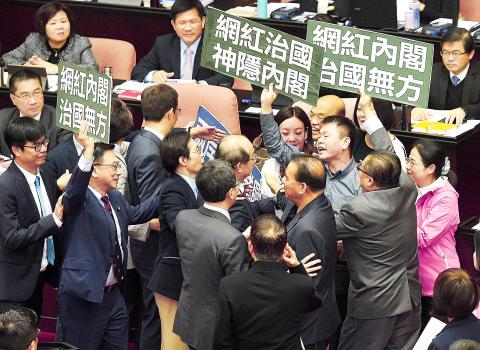
Photo: Huang Yao-cheng, Taipei Times
However, some ministers who had not taken part in the negotiations suddenly appeared after an agreement was reached and took a group photograph with Taoyuan Union of Pilots members, he said, apparently referring to Minister of Transportation and Communications Lin Chia-lung (林佳龍) and Minister of Labor Hsu Ming-chun (許銘春).
The Executive Yuan has a 49 percent stake in CAL, Chiang said, adding that the Cabinet must hold officials accountable for the strike, which affected more than 30,000 passengers.
Lin said that the airline had agreed to issue compensation of up to US$250 per affected passenger, but he and Su both said that no airline or government officials had offered to resign over the incident.
Later, KMT Legislator John Wu (吳志揚) said that Su’s ambivalence in handling the strike contrasted with his gusto when he went to the airport to inspect African swine fever prevention measures and the empathy he showed in a video posted online earlier this month responding to public outrage over a spate of deadly accidents caused by drunk drivers.
He raised doubts over the Cabinet’s efficiency in handling the pilots’ strike, saying that it lasted seven days, whereas a strike staged by flight attendants in 2016 was called off after two days.
The work stoppage highlighted two problems: conflicts in the airline’s management and the government’s tardy response, Wu said.
The Cabinet should have responded to the union’s repeated warnings that it could go on strike over the past few months and prevented the strike from happening, he said.
Wu asked the premier why he had “shied away” from the incident, to which Su replied that he did not want to escalate conflicts between CAL and the union.
An ad hoc task force arranged by Lin was already in place to respond to the situation, Su said.
The strike occurred despite the union’s warning because the airline’s top management held the mistaken belief that it had one year to negotiate with its pilots after the two sides in August last year reached a preliminary agreement to initiate talks, Lin said.
Asked by Wu if he would fire CAL chairman Ho Nuan-hsuan (何煖軒) — who reportedly has close ties to the Democratic Progressive Party’s former “New Tide” faction — Lin did not give a direct answer, but praised Ho’s performance in the negotiations.
New Power Party Legislator Hung Tzu-yung (洪慈庸) also asked Su which officials should be held responsible for the strike.
Su said that although the strike had inconvenienced many passengers, it ended in a satisfactory way that ensured passenger safety and improved working conditions without hurting the airline’s competitiveness.
Earlier, Su said in response to media queries that many issues remain after the strike, so it is not a suitable time to discuss a personnel reshuffle.
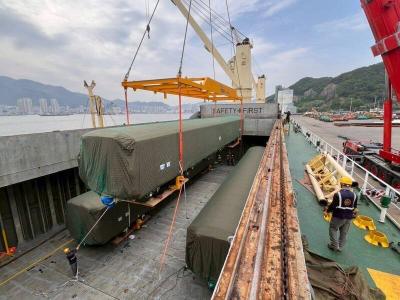
The first of 10 new high-capacity trains purchased from South Korea’s Hyundai Rotem arrived at the Port of Taipei yesterday to meet the demands of an expanding metro network, Taipei Rapid Transit Corp (TRTC) said yesterday. The train completed a three-day, 1,200km voyage from the Port of Masan in South Korea, the company said. Costing NT$590 million (US$18.79 million) each, the new six-carriage trains feature a redesigned interior based on "human-centric" transportation concepts, TRTC said. The design utilizes continuous longitudinal seating to widen the aisles and optimize passenger flow, while also upgrading passenger information displays and driving control systems for a more comfortable
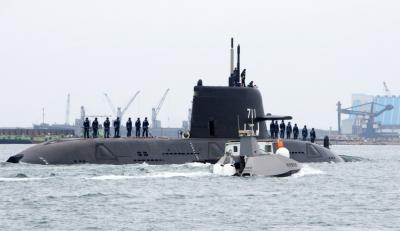
Taiwan's first indigenous defense submarine, the SS-711 Hai Kun (海鯤, or Narwhal), departed for its 13th sea trial at 7am today, marking its seventh submerged test, with delivery to the navy scheduled for July. The outing also marked its first sea deployment since President William Lai (賴清德) boarded the submarine for an inspection on March 19, drawing a crowd of military enthusiasts who gathered to show support. The submarine this morning departed port accompanied by CSBC Corp’s Endeavor Manta (奮進魔鬼魚號) uncrewed surface vessel and a navy M109 assault boat. Amid public interest in key milestones such as torpedo-launching operations and overnight submerged trials,
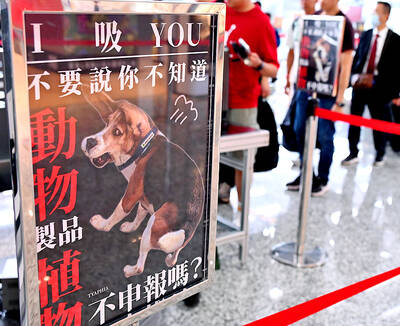
Quarantine awareness posters at Taiwan Taoyuan International Airport have gone viral for their use of wordplay. Issued by the airport branch of the Animal and Plant Health Inspection Agency, the posters feature sniffer dogs making a range of facial expressions, paired with advisory messages built around homophones. “We update the messages for holidays and campaign needs, periodically refreshing materials to attract people’s attention,” quarantine officials said. “The aim is to use the dogs’ appeal to draw focus to quarantine regulations.” A Japanese traveler visiting Taiwan has posted a photo on X of a poster showing a quarantine dog with a
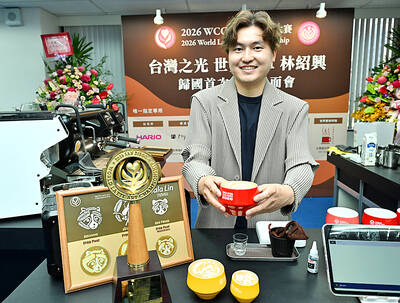
Taiwan’s coffee community has launched a “one-person-one-e-mail” campaign, calling for people to send a protest-e-mail to the World Coffee Championships (WCC) urging it to redesignate Taiwanese competitors as from “Taiwan,” rather than “Chinese Taipei.” The call followed sudden action last week after the WCC changed all references to Taiwanese competitors from “Taiwan” to “Chinese Taipei,” including recent World Latte Art champion Bala (林紹興), who won the World Latte Art Championship in San Diego earlier this month. When Bala received the trophy, he was referred to as representing Taiwan, as well as in the announcement on the WCC’s Web site, until it


 RSS
RSS