


Chunghwa Post has issued a set of stamps to mark the Year of the Pig, which starts today.
The state-run company has been issuing Lunar New Year stamps since 1968, starting with a collection featuring the chicken from the Chinese zodiac.
The first set of Year of the Pig stamps was issued in 1970, Chunghwa Post stamp collection division director Chen Yueh-tao (陳月桃) said.
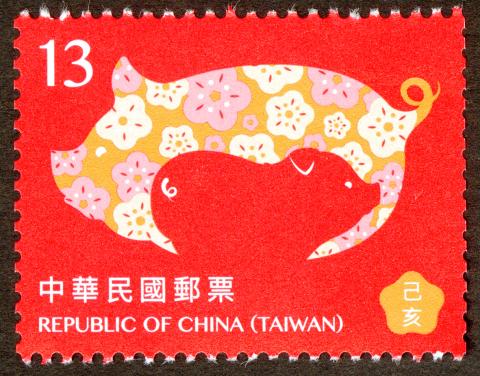
Photo courtesy of Chunghwa Post
Designed by Yan Chi-shih (顏奇石), it featured a piggy bank, in line with a government policy encouraging the public to save and keep their money in the bank, Chen said.
The second set, issued in 1982, was created by Chung Chu-mei (莊珠妹), featuring a rotund pig symbolizing the traditional Lunar New Year wish for the family to get together and wishes for prosperity.
The third set, released in 1994, was designed by Tsao Chun-yan (曹俊彥), showcasing a pig in different geometric shapes.
Both the second and third sets of Year of the Pig stamps had two stamps and one miniature sheet, which featured two sets of stamps identical to the two single stamps.
The designers of the fourth set were Wu Jen-feng (巫人鳳) and Chen Yu-wen (陳俞文), with a NT$3.50 stamp featuring a pig running and facing the words “The Year Ding Hai (丁亥),” as if eager to greet the coming new year.
The old Chinese calendar system counted the years using a combination of the 10 heavenly branches and 12 earthly stems, with every 60 years considered one complete cycle.
Ding hai symbolizes the 24th year in the cycle and corresponds to the year 2007.
The second stamp in the fourth set, valued at NT$13, did not feature a pig, but a scene with drums and small gongs, evoking a sense of festive cheer and merriment during the Lunar New Year.
The souvenir sheet, featuring NT$12 stamps, showcases two smiling pigs facing each other, symbolizing seasonal joy and an abundance of good, while a child holding a lotus in one hand and a fish in the other symbolize wishes for continued abundance throughout the year.
The Chinese character for lotus (lian, 蓮), is a homophone for the word link (lian, 連), symbolizing continuity or consecutiveness, while the Chinese character for fish (yu, 魚), is homonymous with the word surplus or abundance (yu, 餘).
This year’s collection, the fifth set, was designed by Up Creative Co and printed by French national postal service La Poste, Chen Yueh-tao said.
The design for the NT$6 stamp features a red pig nursing several golden pigs with plum flowers in full bloom in the background, while the NT$13 stamp features pigs decorated with plum blossoms. A NT$15 stamp shows two pigs smiling at each other, with plum blossoms and clouds in the background.
This year’s collection features a winning design from a public contest, Chen Yueh-tao said, adding that Chunghwa Post would issue a collector’s set featuring two panes each with 20 stamps, and nine miniature sheets along with a Chunghwa Post certificate certifying the stamps’ authenticity.
The trend of using zodiac signs as the base design concept for stamps is catching on in France, Canada and the US, she said, adding that Taiwanese stamps can easily compete with those from countries influenced by the Chinese zodiac signs, including Singapore, South Korea, Japan and Vietnam,
Chunghwa Post’s Lunar New Year stamps are greatly favored by stamp collectors and the general public likes to use them on Lunar New Year greeting cards, she said.
An average of more than 93 percent of the Lunar New Year stamps issued are sold, or about 6 million stamps, she said.
She added that she was confident this year’s set would be well-received, because of its design and the Year of the Pig being favored by Taiwanese.

The first of 10 new high-capacity trains purchased from South Korea’s Hyundai Rotem arrived at the Port of Taipei yesterday to meet the demands of an expanding metro network, Taipei Rapid Transit Corp (TRTC) said yesterday. The train completed a three-day, 1,200km voyage from the Port of Masan in South Korea, the company said. Costing NT$590 million (US$18.79 million) each, the new six-carriage trains feature a redesigned interior based on "human-centric" transportation concepts, TRTC said. The design utilizes continuous longitudinal seating to widen the aisles and optimize passenger flow, while also upgrading passenger information displays and driving control systems for a more comfortable
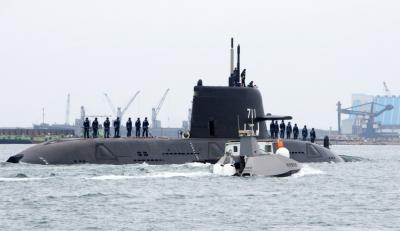
Taiwan's first indigenous defense submarine, the SS-711 Hai Kun (海鯤, or Narwhal), departed for its 13th sea trial at 7am today, marking its seventh submerged test, with delivery to the navy scheduled for July. The outing also marked its first sea deployment since President William Lai (賴清德) boarded the submarine for an inspection on March 19, drawing a crowd of military enthusiasts who gathered to show support. The submarine this morning departed port accompanied by CSBC Corp’s Endeavor Manta (奮進魔鬼魚號) uncrewed surface vessel and a navy M109 assault boat. Amid public interest in key milestones such as torpedo-launching operations and overnight submerged trials,
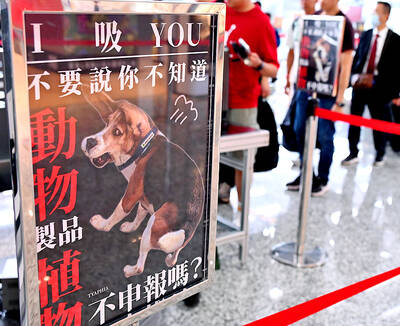
Quarantine awareness posters at Taiwan Taoyuan International Airport have gone viral for their use of wordplay. Issued by the airport branch of the Animal and Plant Health Inspection Agency, the posters feature sniffer dogs making a range of facial expressions, paired with advisory messages built around homophones. “We update the messages for holidays and campaign needs, periodically refreshing materials to attract people’s attention,” quarantine officials said. “The aim is to use the dogs’ appeal to draw focus to quarantine regulations.” A Japanese traveler visiting Taiwan has posted a photo on X of a poster showing a quarantine dog with a
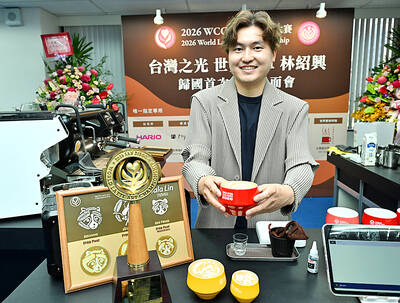
Taiwan’s coffee community has launched a “one-person-one-e-mail” campaign, calling for people to send a protest-e-mail to the World Coffee Championships (WCC) urging it to redesignate Taiwanese competitors as from “Taiwan,” rather than “Chinese Taipei.” The call followed sudden action last week after the WCC changed all references to Taiwanese competitors from “Taiwan” to “Chinese Taipei,” including recent World Latte Art champion Bala (林紹興), who won the World Latte Art Championship in San Diego earlier this month. When Bala received the trophy, he was referred to as representing Taiwan, as well as in the announcement on the WCC’s Web site, until it


 RSS
RSS