


Veteran entertainer Lisa Cheng (鄭惠中) yesterday said that several false claims have been made about her after she slapped Minister of Culture Cheng Li-chiun (鄭麗君) in the face at a lunar year-end banquet in Taipei on Tuesday.
For one, the Confederation of Entertainment Unions has said it is considering revoking her membership, but she is not a member of the group, Lisa Cheng said at a news conference with members of the New Party in Taipei
While she has sincerely apologized to the minister and to the public for her “impulsive” behavior, her position remains unchanged, she said, referring to her disapproval of government efforts to remove symbols of Chiang Kai-shek (蔣介石) and his son, former president Chiang Ching-kuo (蔣經國),
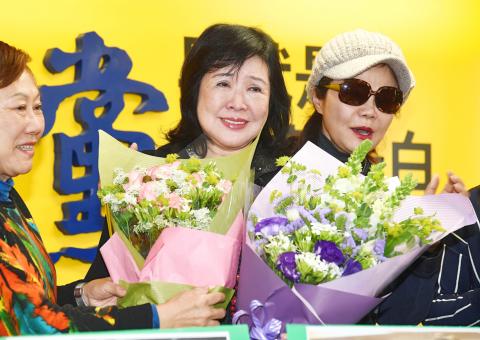
Photo: Huang Yao-cheng, Taipei Times
She personally refers to the government’s transitional justice efforts as “transitional injustice,” she said.
The New Party believes people should stop condemning Lisa Cheng because she has bravely accepted responsibility for her action, apologized and explained her action to prosecutors and police on her own accord, spokesman Wang Ping-chung (王炳忠) said.
The Democratic Progressive Party (DPP) says Lisa Cheng has hurt Taiwan’s democracy by slapping the minister in the face, “but let us look at what means DPP legislators have used to demonstrate the democracy they speak of,” he said, holding a photograph of what appears to be DPP Legislator Wang Ting-yu (王定宇) engaging in a physical confrontation with a fellow lawmaker at the Legislative Yuan.
Wang Ping-chung urged the DPP to ask its legislators who have “set the worst example for Taiwan’s democracy” to apologize to the public.
Lisa Cheng’s attorney, Chen Li-ling (陳麗玲), questioned a decision by the Taipei District Prosecutors’ Office to place her under house arrest.
As the minister of culture of the Republic of China (ROC), instead of promoting “zhonghua culture” (中華文化, Chinese culture), Cheng Li-chiun wants to engage in desinicization efforts and remove symbols of Chiang Kai-shek and Chiang Ching-kuo, New Party member Lin Ming-cheng (林明正) said, calling the minister an incompetent official.
It was only natural that her efforts would incite anger, he said.
Lisa Cheng told him that she is most concerned about young people being guided by an incorrect historical perspective, he said.
He urged Lisa Cheng’s supporters to back a referendum proposal by National Chiayi University professor Wu Quen-tsai (吳昆財) to reintroduce Chinese history to school curriculums, he said.

Considering that most countries issue more than five denominations of banknotes, the central bank has decided to redesign all five denominations, the bank said as it prepares for the first major overhaul of the banknotes in more than 24 years. Central bank Governor Yang Chin-lung (楊金龍) is expected to report to the Legislative Yuan today on the bank’s operations and the redesign’s progress. The bank in a report sent to the legislature ahead of today’s meeting said it had commissioned a survey on the public’s preferences. Survey results showed that NT$100 and NT$1,000 banknotes are the most commonly used, while NT$200 and NT$2,000

The Centers for Disease Control (CDC) yesterday reported the first case of a new COVID-19 subvariant — BA.3.2 — in a 10-year-old Singaporean girl who had a fever upon arrival in Taiwan and tested positive for the disease. The girl left Taiwan on March 20 and the case did not have a direct impact on the local community, it said. The WHO added the BA.3.2 strain to its list of Variants Under Monitoring in December last year, but this was the first imported case of the COVID-19 variant in Taiwan, CDC Deputy Director-General Lin Ming-cheng (林明誠) said. The girl arrived in Taiwan on

South Korea is planning to revise its controversial electronic arrival card, a step Taiwanese officials said prompted them to hold off on planned retaliatory measures, a South Korean media report said yesterday. A Yonhap News Agency report said that the South Korean Ministry of Foreign Affairs is planning to remove the “previous departure place” and “next destination” fields from its e-arrival card system. The plan, reached after interagency consultations, is under review and aims to simplify entry procedures and align the electronic form with the paper version, a South Korean ministry official said. The fields — which appeared only on the electronic form

The Ministry of Foreign Affairs (MOFA) is suspending retaliation measures against South Korea that were set to take effect tomorrow, after Seoul said it is updating its e-arrival system, MOFA said today. The measures were to be a new round of retaliation after Taiwan on March 1 changed South Korea's designation on government-issued alien resident certificates held by South Korean nationals to "South Korea” from the "Republic of Korea," the country’s official name. The move came after months of protests to Seoul over its listing of Taiwan as "China (Taiwan)" in dropdown menus on its new online immigration entry system. MOFA last week


 RSS
RSS