


Farmers who raise black pigs in Pingtung County have formed a self-help group as fears about the effects of African swine fever have resulted in sales coming to a standstill and increased scrutiny of farms that use food waste as feed.
Unlike their lighter-skinned counterparts, black pigs are raised in two stages, Pingtung hog farmers said on Wednesday.
Upstream farmers raise sows and piglets, then one to two months after the piglets have stopped nursing, they are sent to downstream farmers, who raise them until they are mature, they said.
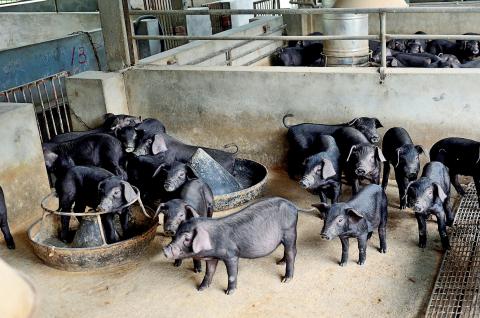
Photo: Chiu Chih-jou, Taipei Times
This partnership between upstream and downstream farmers has existed for more than a decade, but since the government started subsidizing farmers who switch from using food waste as pig feed or give up farming altogether, downstream farmers have stopped placing orders, said Chiu Hsiu-chin (邱秀琴), a black pig farmer in Pingtung.
In the past, all piglets would be sold by the time they reached 50 jin (30kg), but now piglets weighing 70 jin (42kg) are still being kept in upstream farms, she said.
Upstream farms mainly use commercial feed, she said, adding that food waste is only fed to pigs in downstream farms as they are older.
Upstream farms have not received any subsidies and sales are slowing, she said, adding that the black pig industry is suffering even though African swine fever has not entered Taiwan proper.
Black pig farmers used to be called the “pride of Taiwan,” but people now say feeding food waste to pigs is unhygienic, said Chen Chin-chu (陳金助), a black pig farmer in Neipu Township (內埔).
All pig farmers — whether they raise lighter-skinned or black pigs — stand with the government when it comes to preventing African swine fever, but the government’s policy should not be imposed in a blanket fashion, Chen said.
There are unique aspects to the black pig industry and the use of food scraps as feed should not be stigmatized, Chen added.
Aside from food waste, black pigs in Pingtung are also fed distillers grains, soybean meal and other agricultural byproducts, black pig farmer Hsieh Hsu-chung (謝旭忠) said.
If pigs are no longer fed food scraps, the unique flavor of Taiwanese black pigs might also disappear, Hsieh said.
The practice of using food scraps as feed in Taiwan is rooted in history, self-help group member Tseng Jen-te (曾仁德) said, adding that this has helped resolve environmental problems associated with food waste.
If a complete ban is placed on the use of food scraps as feed, the increased cost of handling food waste would be passed on to consumers, black pig farmer Chung Wen-feng (鍾文丰) said.
Equipment to heat food waste is available, Chung said, adding that government policies should consider all of the different aspects of the situation.
About 12 percent of domestically raised pigs are fed food waste, according to data from the Council of Agriculture.
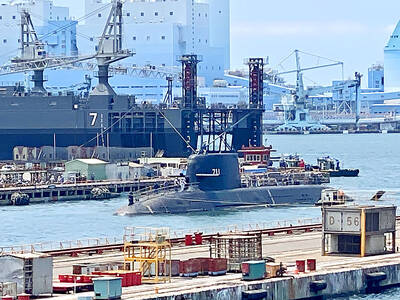
AGING: While Japan has 22 submarines, Taiwan only operates four, two of which were commissioned by the US in 1945 and 1946, and transferred to Taiwan in 1973 Taiwan would need at least 12 submarines to reach modern fleet capabilities, CSBC Corp, Taiwan chairman Chen Cheng-hung (陳政宏) said in an interview broadcast on Friday, citing a US assessment. CSBC is testing the nation’s first indigenous defense submarine, the Hai Kun (海鯤, Narwhal), which is scheduled to be delivered to the navy next month or in July. The Hai Kun has completed torpedo-firing tests and is scheduled to undergo overnight sea trials, Chen said on an SET TV military affairs program. Taiwan would require at least 12 submarines to establish a modern submarine force after assessing the nation’s operational environment and defense

A white king snake that frightened passengers and caused a stir on a Taipei MRT train on Friday evening has been claimed by its owner, who would be fined, Taipei Rapid Transit Corp (TRTC) said yesterday. A person on Threads posted that he thought he was lucky to find an empty row of seats on Friday after boarding a train on the Bannan (Blue) Line, only to spot a white snake with black stripes after sitting down. Startled, he jumped up, he wrote, describing the encounter as “terrifying.” “Taipei’s rat control plan: Release snakes on the metro,” one person wrote in reply, referring
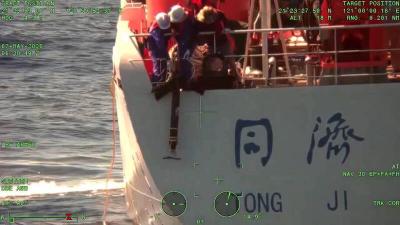
The coast guard today said that it had disrupted "illegal" operations by a Chinese research ship in waters close to the nation and driven it away, part of what Taipei sees a provocative pattern of China's stepped up maritime activities. The coast guard said that it on Thursday last week detected the Chinese ship Tongji (同濟號), which was commissioned only last year, 29 nautical miles (54km) southeast of the southern tip of Taiwan, although just outside restricted waters. The ship was observed lowering ropes into the water, suspected to be the deployment of scientific instruments for "illegal" survey operations, and the coast

Taiwan’s two cases of hantavirus so far this year are on par with previous years’ case numbers, and the government is coordinating rat extermination work, so there should not be any outbreaks, Centers for Disease Control (CDC) Director-General Philip Lo (羅一鈞) said today in an interview with the Liberty Times (the Taipei Times’ sister newspaper). An increase in rat sightings in Taipei and New Taipei City has raised concerns about the spread of hantavirus, as rats can carry the disease. In January, a man in his 70s who lived in Taipei’s Daan District (大安) tested positive posthumously for hantavirus, Taiwan’s


 RSS
RSS