


The Taipei Beimen Post Office is to host a series of events to celebrate the 90th anniversary of its establishment, Chunghwa Post said yesterday.
Construction of the post office’s building began in 1929 after the previous building on Beimen Street was destroyed in a fire, office director Susan Lan (藍淑貞) said at a ceremony, adding that its baroque architecture was designed by Japanese architect Shunichi Kuriyama.
In addition to the ceremony, the post office hosted a guided tour of the four-story building’s history and architecture, as well as nearby historic sites, such as the North Gate (北門) west of Taipei Railway Station.
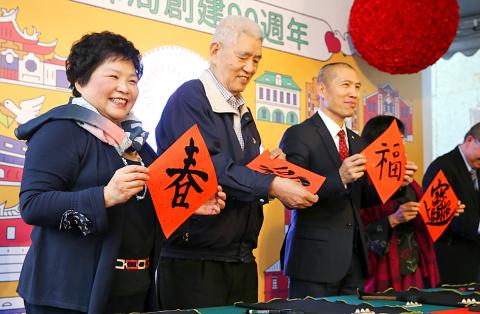
Photo: CNA
The post office is to host a series of events this year to celebrate its 90th anniversary, including a photography competition and an exhibition on the history of the office, which is the subject of a book it is to publish.
The building’s main entrances, which in 1970 were converted from five arched doorways to three marble square entrances to facilitate the entry and exit of postal vehicles, are to be restored this year, Lan said, adding that construction is scheduled to begin in the next few days and completed in 10 months.
The completion of the renovation of the arched doorways — which were called carriage porches during the Japanese colonial era — would also mark the end of the celebrations, she said.
The office’s festive events this year are also the beginning of celebrations for Chunghwa Post’s 123rd anniversary, she said.
The company was established in 1896, when the Qing Dynasty founded the Imperial Postal Service.
Based on the company’s historical records, postal services were first offered in Taiwan when Qing Dynasty Taiwan governor Liu Ming-chuan (劉銘傳) enacted the Taiwan Post Act in 1888, eight years before post services were officially launched in China.
Liu later that year established the Directorate-General of the Post, which was headquartered on what was then Jianchang Street in Taipei’s Dadaocheng (大稻埕) area.
He also established a postal station in Taipei and another in Tainan to deliver mail, issue postage stamps and collect personal letters, marking the beginning of the modern postal service in Taiwan.
After Taiwan was ceded to Japan in 1895 following the first Sino-Japanese War, the local postal service went through several changes and the Beimen Post Office was renamed repeatedly, including to the 2nd Field Command Postal Bureau, the Taipei First Class Postal and Telegraph Office and in 1930 the Taipei Post Office.
It also began offering remittance and postal savings services, in addition to postal services.
After the end of World War II, the government renamed the Taipei Post Office to the Postal and Telegraph Office, as it was in charge of postal and telegraphic businesses.
In 1949, the Ministry of Transportation and Communications established two separate administrative bodies to supervise postal and telegraphic businesses.
The Postal and Telegraph Office was renamed the Taipei First Class Post Office, which began to operate mail and parcel businesses. It also provided savings, remittance and insurance services.
A plan by Chunghwa Post to demolish the Beimen Post Office was met with strong opposition by the public.
The dispute ended after the Ministry of the Interior designated the building as a category three historic site.

UPGRADE: The Kang Ding-class frigate is replacing its Chaparall missiles with Tien Chien II and Hua Yang VLS, which would provide it with long-range, 360° air defense Taiwan plans to produce 1,200 to 1,376 Hai Chien II missiles (海劍二, Sea Sword II) — also known as TC-2N — to serve as the standard air defense system of the navy’s surface combatant fleet, a source said yesterday. Last week, the Hai Chien II, the naval version of the Tien Kung II missile (天劍二, Sky Sword II), completed a live-fire test in waters off the National Chungshan Institute of Science and Technology’s Jiupeng facility (九鵬) in Pingtung County’s Manjhou Township (滿州). The MIM72 Chaparral and other dated air defense missiles that currently arm Taiwanese ships have inadequate range to combat Chinese

REASONS FOR TRAVEL: An assistant professor said that proposed amendments to penalize drivers if they used drugs overseas would not deter people from traveling People who operate a motor vehicle under the influence of marijuana would have their driver’s license revoked, even if they used the substance while overseas, the Ministry of Transportation and Communications said yesterday, citing proposed amendments to the Road Traffic Management and Penalty Act (道路交通管理處罰條例). The amendments would also authorize the government to revoke the licenses of people determined to have used Category 1 or Category 2 narcotics, even if they were not operating a vehicle while under the influence of drugs, as well as ban them from taking the license test for three years, the ministry said. People aged 18 or

HEAVY WEATHER: Typhoon Jangmi is due to crash straight into the Ryukyus as airlines look to shift flights to larger aircraft or cancel flights to Okinawa entirely Taiwan’s international air carriers announced flight adjustments over the weekend as Typhoon Jangmi is forecast to hit the Ryukyu Islands today and tomorrow. The Central Weather Administration (CWA) upgraded Jangmi from a tropical storm to a typhoon at 8am yesterday, with the eye located 580km south of Naha city. It was moving north at 19kph. Today, China Airlines’ CI-120, CI-121, CI-122 and CI-123 flights between Taoyuan and Naha, Okinawa, have been canceled as well as CI-132 and CI-133 between Kaohsiung and Naha. EVA Air’s BR-112, BR-113, BR-186 and BR-185 flights between Taoyuan and Naha are also canceled. Low-cost carrier Tigerair Taiwan canceled IT-230,
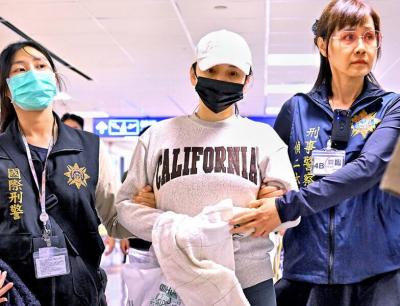
Johanne Liou (劉喬安), a Taiwanese woman who shot to unwanted fame during the Sunflower movement protests in 2014, returned to Taiwan last night after being deported from the US. She is to stand trial in Taiwan for charges involving embezzlement, fraud and drug crimes. The Criminal Investigation Bureau (CIB) said it took her into custody at Taiwan Taoyuan International Airport and would first question her before transferring her to the New Taipei District Prosecutors’ Office. She was arrested upon disembarking a flight from San Francisco that landed shortly before 7pm. Liou absconded to the US in 2019 after jumping bail


 RSS
RSS