


The Transitional Justice Commission on Saturday held a seminar at the Chiang Kai-shek Memorial Hall in Taipei on the issue of eliminating symbols of the authoritarian era.
Fu Jen Catholic University history professor Chen Chun-kai (陳君愷) and urban planning researcher Chang Wei-hsui (張維修) spoke at the seminar, where the issue of whether to dismantle Chiang Kai-shek’s (蔣介石) statue at the hall was discussed.
Chen Chung-tung (陳中統), a political prisoner who was jailed for 10 years at the former Jingmei Military Detention Center, as well as Taiwan 228 Incident Care Association director-general Pan Hsin-hsing (潘信行) and Lan Yun-jo (藍芸若), the daughter of White Terror victim Lan Ming-ku (藍明谷), also attended the seminar and expressed their views on the issue.
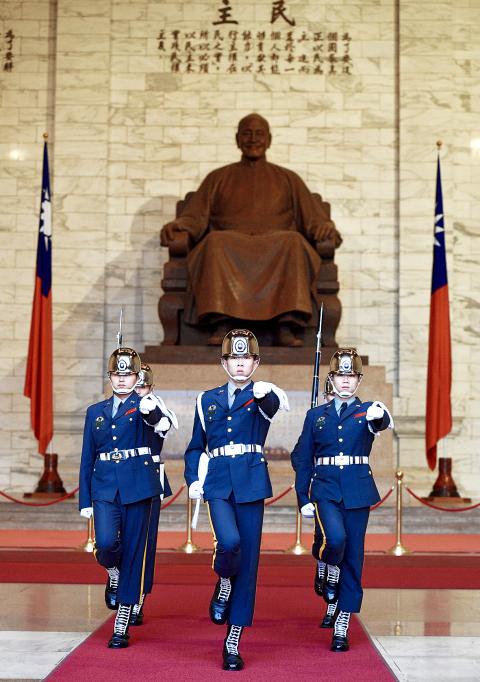
Photo: Peter Lo, Taipei Times
Commission Acting Chairwoman Yang Tsui (楊翠) listened from the sidelines, but did not speak.
As a symbol of authoritarianism, the statue must be removed, but other aspects of the memorial hall can be left to discussion, Pan said.
The buildings and the space at the hall are public assets and there is room to discuss what to do with them, he said.
“I was brainwashed by the Chinese Nationalist Party [KMT], and it was not until I was 44 years old that I truly understood Taiwan’s history,” Lan said, adding that she feels emotionally distressed whenever she sees a statue of Chiang.
The statue should be removed or modified in a way that it would no longer be a symbol of worship, she said.
A teacher attending the seminar said the hall is out of place with its location at the end of the path leading from Liberty Square Arch, Liberty Square and Democracy Boulevard.
“The one who is responsible for injuring others looks down upon this path from high above, with his back to the victims of the Martial Law era buried in the mountains in Liuzhangli (六張犁) cemetery,” said the teacher, who requested anonymity. “There is not even a plaque to commemorate those the victims buried there.”
Another attendee who also requested anonymity said the first step should be to move the change-of-guard ceremony to Liberty Square.
“Whenever I see foreign or local tourists happily taking pictures of the ceremony in front of Chiang’s statue, it fills me with pain,” the person said, adding that if the statue could not be removed, it should be converted into a monument akin to the Western Wall in Jerusalem.
When dealing with the statue, the government must consider what national values it wants the site to represent, Chang said.
The hall should express Taiwan’s commitment to transitional justice, human rights and other issues that form the nation’s core values, he said.
The site could be converted into a human rights museum, he added.
Commission member Peng Jen-yu (彭仁郁) said that the commission does not have the authority to instruct other government agencies to carry out its suggestions or proposals, but she hopes the public will continue to participate in discussions related to transitional justice, so that everyone could reach a consensus on relevant issues.
The commission last year defined its goals as the removal of symbols of authoritarianism; the recording and commemoration of the historical struggle of Taiwanese to overcome authoritarianism; the promotion of education and research on the issues of human rights, democracy and the rule of law; the development of a plan to implement these goals; and draw up measures to prevent abuse of authority during the implementation of transitional justice.

Considering that most countries issue more than five denominations of banknotes, the central bank has decided to redesign all five denominations, the bank said as it prepares for the first major overhaul of the banknotes in more than 24 years. Central bank Governor Yang Chin-lung (楊金龍) is expected to report to the Legislative Yuan today on the bank’s operations and the redesign’s progress. The bank in a report sent to the legislature ahead of today’s meeting said it had commissioned a survey on the public’s preferences. Survey results showed that NT$100 and NT$1,000 banknotes are the most commonly used, while NT$200 and NT$2,000

The Centers for Disease Control (CDC) yesterday reported the first case of a new COVID-19 subvariant — BA.3.2 — in a 10-year-old Singaporean girl who had a fever upon arrival in Taiwan and tested positive for the disease. The girl left Taiwan on March 20 and the case did not have a direct impact on the local community, it said. The WHO added the BA.3.2 strain to its list of Variants Under Monitoring in December last year, but this was the first imported case of the COVID-19 variant in Taiwan, CDC Deputy Director-General Lin Ming-cheng (林明誠) said. The girl arrived in Taiwan on

ANNUAL EVENT: Two massive Pokemon balloons are to be set up in Daan Park, with an event zone operating from 10am to 6pm This year’s Taipei Floral Picnic is to be held at Daan Park today and tomorrow, featuring an exclusive Pokemon Go event, a themed food market, a coffee rave picnic area and stage performances, the Taipei Department of Information and Tourism said yesterday. Two massive Pokemon balloons are to be set up in the park as attractions, with an exclusive event zone operating from 10am to 6pm, it said. Participants who complete designated tasks on-site would have a chance to receive limited-edition souvenirs, it added. People could also try the newly launched game Pokemon Pokopia in the trial area, the department said. Three PokeStops are

South Korea is planning to revise its controversial electronic arrival card, a step Taiwanese officials said prompted them to hold off on planned retaliatory measures, a South Korean media report said yesterday. A Yonhap News Agency report said that the South Korean Ministry of Foreign Affairs is planning to remove the “previous departure place” and “next destination” fields from its e-arrival card system. The plan, reached after interagency consultations, is under review and aims to simplify entry procedures and align the electronic form with the paper version, a South Korean ministry official said. The fields — which appeared only on the electronic form


 RSS
RSS