


The mayors of the nation’s six special municipalities have responded positively to premier-to-be Su Tseng-chang (蘇貞昌) and his team.
New Taipei City Mayor Hou You-yi (侯友宜), who beat Su in last year’s New Taipei City mayoral election, on Friday said that it was as if fate wanted to link him and Su, a former commissioner of what was then Taipei County.
“It is good to be able to pick up where we left off,” said Hou, a Chinese Nationalist Party (KMT) member.
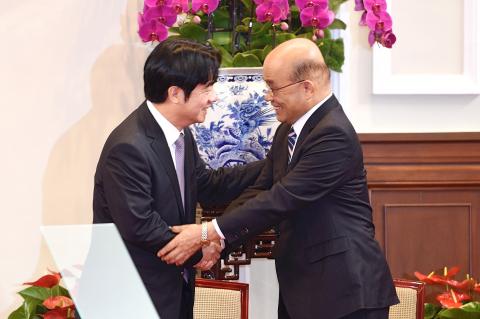
Photo: George Tsorng, Taipei Times
Su knows the development needs of New Taipei City and the needs of its residents “like the back of his hand,” Hou said, adding that the excellent platform Su put forward during his campaign was a valuable reference for him that would hopefully benefit residents.
“Su is a safe bet. He is a seasoned politician,” Taipei Mayor Ko Wen-je (柯文哲), an independent, said in response to requests for comment.
Asked about Su’s “comeback” as premier after his loss in New Taipei City, Ko said that one setback should not prevent someone from taking up a task.
“That would not make sense,” he said.
Asked how he expected Su to perform in his second stint as premier, Ko said: “Let’s wait until after he is inaugurated,” adding that it would be “what he does, not what he says” that counts.
Taoyan Mayor Cheng Wen-tsan (鄭文燦) of the Democratic Progressive Party, who was Government Information Office director when Su was previously premier, described his former boss as “a pragmatic man of integrity.”
Su has the decisiveness required of a top official, as well as the vision necessary for policymaking to ensure sustainable development, Cheng said.
Su has the qualities necessary to translate his governance into something people can see and feel, which would bring the government in sync with public opinion, Cheng said, adding that he believes Su’s performance would top that of outgoing Premier William Lai (賴清德).
“I have high expectations of Su and hope he has many days of glory ahead of him,” said Tainan Mayor Huang Wei-che (黃偉哲), a Democratic Progressive Party member.
Judging by Su’s boldness and ability to get things done when he was previously premier, he would move the nation forward “full throttle,” Huang said.
Su is from the south and knows the development gap between northern and southern Taiwan well, as well as each city’s and county’s features, Huang said, adding that he hopes Su would place an emphasis on Tainan’s development.
Taichung Mayor Lu Shiow-yen (盧秀燕) of the KMT said he had two expectations for Su: Focus on the economy rather than politicking and swiftly allocate the funds Lai promised for Taichung’s development.
Kaohsiung Mayor Han Kuo-yu (韓國瑜) of the KMT said that he has higher expectations for vice premier-designate Chen Chi-mai (陳其邁) — his main campaign rival in the Nov. 24 Kaohsiung mayoral election — than he does for Su.
“Chen is from Kaohsiung, so I believe that he cares deeply about Kaohsiung and would offer it more assistance,” Han said.
Kaohsiung is in desperate need of the Cabinet’s help in terms of development, Han said.
Hopefully, Su would look past partisan politics and fulfill the promises made by Lai, he said.
Additional reporting by Wei Chin-yun, Hung Chung-chin, Huang Chung-shan and Wang Jung-hsiang

Considering that most countries issue more than five denominations of banknotes, the central bank has decided to redesign all five denominations, the bank said as it prepares for the first major overhaul of the banknotes in more than 24 years. Central bank Governor Yang Chin-lung (楊金龍) is expected to report to the Legislative Yuan today on the bank’s operations and the redesign’s progress. The bank in a report sent to the legislature ahead of today’s meeting said it had commissioned a survey on the public’s preferences. Survey results showed that NT$100 and NT$1,000 banknotes are the most commonly used, while NT$200 and NT$2,000

The Centers for Disease Control (CDC) yesterday reported the first case of a new COVID-19 subvariant — BA.3.2 — in a 10-year-old Singaporean girl who had a fever upon arrival in Taiwan and tested positive for the disease. The girl left Taiwan on March 20 and the case did not have a direct impact on the local community, it said. The WHO added the BA.3.2 strain to its list of Variants Under Monitoring in December last year, but this was the first imported case of the COVID-19 variant in Taiwan, CDC Deputy Director-General Lin Ming-cheng (林明誠) said. The girl arrived in Taiwan on

South Korea is planning to revise its controversial electronic arrival card, a step Taiwanese officials said prompted them to hold off on planned retaliatory measures, a South Korean media report said yesterday. A Yonhap News Agency report said that the South Korean Ministry of Foreign Affairs is planning to remove the “previous departure place” and “next destination” fields from its e-arrival card system. The plan, reached after interagency consultations, is under review and aims to simplify entry procedures and align the electronic form with the paper version, a South Korean ministry official said. The fields — which appeared only on the electronic form

The Ministry of Foreign Affairs (MOFA) is suspending retaliation measures against South Korea that were set to take effect tomorrow, after Seoul said it is updating its e-arrival system, MOFA said today. The measures were to be a new round of retaliation after Taiwan on March 1 changed South Korea's designation on government-issued alien resident certificates held by South Korean nationals to "South Korea” from the "Republic of Korea," the country’s official name. The move came after months of protests to Seoul over its listing of Taiwan as "China (Taiwan)" in dropdown menus on its new online immigration entry system. MOFA last week


 RSS
RSS