


Prosecutors have launched an investigation into two Taipei City Hospital executives over allegations of siphoning off about NT$3 million (US$97,399) of public funds while procuring medicine.
The hospital is administered by the Taipei City Government.
The Taipei Shilin District Prosecutors’ Office and the Ministry of Justice’s Agency Against Corruption on Tuesday raided the hospital’s offices and several other locations, and brought in 15 people for questioning.
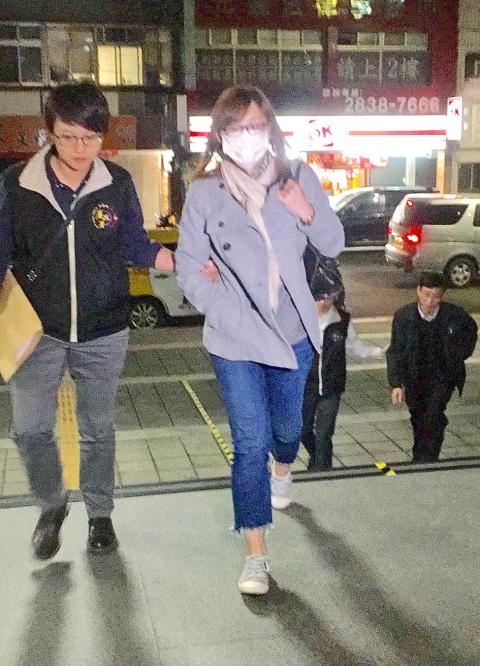
Photo: Chen En-hui, Taipei Times
Prosecutors have named five suspects, including Chen Li-chi (陳立奇), head of the hospital’s department of pharmacy; a woman also surnamed Chen (陳), who is head of the department’s inventory control section; and a person surnamed Lee (李), who works at the Taiwan Society of Health-System Pharmacists.
Prosecutors yesterday asked a court to detain Chen Li-chi, while the woman surnamed Chen was released on NT$200,000 bail and Lee on NT$50,000 bail.
Prosecutors said that the two Chens as society members from 2015 to 2016 helped the society secure three tender contracts from the Taipei Department of Health to provide long-term care to senior citizens, which included procuring medication and delivering to home-care patients.
The five suspects allegedly produced falsified documents and bogus receipts to claim extra medication and other expenses in collusion with medication suppliers, and placed the illegal gains in bank accounts of society members, prosecutors said.
The suspects would be charged with forgery and breaches of the Anti-Corruption Act (貪汙治罪條例), prosecutors said, adding that evidence pointed to Chen Li-chi as the ringleader, which was why they requested he be detained.
The city government is “a group of more than 80,000 people, so you cannot expect everyone to be a saint,” Taipei Mayor Ko Wen-je (柯文哲) said yesterday.
There might even be some Taipei police officers who still take bribes, but at least the administrative team — especially department heads — are not involved in any major corruption cases, he said.
The scandal involving the hospital is being handled by prosecutors, Ko added.
Ko during his re-election campaign last year often said that his team was “open, transparent, honest and upright.”

Considering that most countries issue more than five denominations of banknotes, the central bank has decided to redesign all five denominations, the bank said as it prepares for the first major overhaul of the banknotes in more than 24 years. Central bank Governor Yang Chin-lung (楊金龍) is expected to report to the Legislative Yuan today on the bank’s operations and the redesign’s progress. The bank in a report sent to the legislature ahead of today’s meeting said it had commissioned a survey on the public’s preferences. Survey results showed that NT$100 and NT$1,000 banknotes are the most commonly used, while NT$200 and NT$2,000

The Centers for Disease Control (CDC) yesterday reported the first case of a new COVID-19 subvariant — BA.3.2 — in a 10-year-old Singaporean girl who had a fever upon arrival in Taiwan and tested positive for the disease. The girl left Taiwan on March 20 and the case did not have a direct impact on the local community, it said. The WHO added the BA.3.2 strain to its list of Variants Under Monitoring in December last year, but this was the first imported case of the COVID-19 variant in Taiwan, CDC Deputy Director-General Lin Ming-cheng (林明誠) said. The girl arrived in Taiwan on

South Korea is planning to revise its controversial electronic arrival card, a step Taiwanese officials said prompted them to hold off on planned retaliatory measures, a South Korean media report said yesterday. A Yonhap News Agency report said that the South Korean Ministry of Foreign Affairs is planning to remove the “previous departure place” and “next destination” fields from its e-arrival card system. The plan, reached after interagency consultations, is under review and aims to simplify entry procedures and align the electronic form with the paper version, a South Korean ministry official said. The fields — which appeared only on the electronic form

The Ministry of Foreign Affairs (MOFA) is suspending retaliation measures against South Korea that were set to take effect tomorrow, after Seoul said it is updating its e-arrival system, MOFA said today. The measures were to be a new round of retaliation after Taiwan on March 1 changed South Korea's designation on government-issued alien resident certificates held by South Korean nationals to "South Korea” from the "Republic of Korea," the country’s official name. The move came after months of protests to Seoul over its listing of Taiwan as "China (Taiwan)" in dropdown menus on its new online immigration entry system. MOFA last week


 RSS
RSS