


Enrollment at nine of the nation’s higher-education institutes this year was less than 60 percent of regular enrollment, which might force closures, the Ministry of Education said on Friday.
The low enrollment rates are likely due to a declining birthrate that is beginning to affect the age group now attending universities, the ministry said.
The nine institutes were: Christ’s College Taipei (46.81 percent enrollment), Fortune Institute of Technology (47.46 percent), Kao Yuan University (47.48 percent), Ming Dao University (51.61 percent), Chungyu University of Film and Arts (51.89 percent), Chung Chou University of Science and Technology (53.42 percent), Hsuan Chuang University (54.58 percent), Huafan University (56.18 percent) and Nan Jeon University of Science and Technology (56.41 percent).
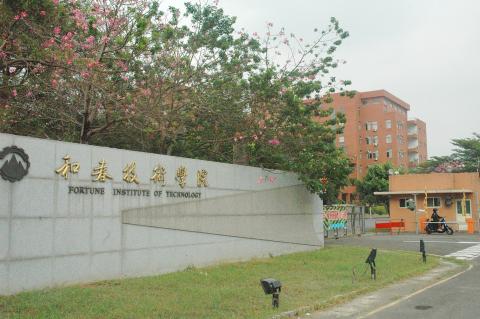
Photo: Fang Chih-hsien, Taipei Times
Three of those — Huafan, Nan Jeon and Fortune — also had an enrollment rate of below 60 percent last year, the ministry said, adding that they have fewer than 3,000 students each.
Department of Higher Education Director-General Chu Hung-chang (朱俊彰) said that in accordance with regulations, the ministry would help the three institutes reform and would set a time limit for them to improve their enrollment situation.
The ministry would take all factors into consideration, such as their financial situations, Chu said, adding that Huafan has had the stable backing of church groups for many years.
Huafan could be a good institute even with low enrollment numbers, he added.
Taiwan Shoufu University had an enrollment rate of below 60 percent last year, but this year its situation improved, he said.
Lan Yang Institute of Technology and the Culinary Institute of Taiwan had low enrollment numbers last year, but have improved, while Kao Mei Junior College of Healthcare and Management, which also had low enrollment last year, has now stopped accepting students, he said, adding that three institutes closed this year.
Meanwhile, the ministry this year began providing data on student retention rates at higher-education institutes.
Institutes with rates of 95 percent or higher this year include National Chengchi University, National Taiwan University, National Sun Yat-sen University, National Tsing Hua University, National Chiao Tung University, National Taipei University of Education and National Changhua University of Education, the data showed.
The ministry said that it cross-referenced enrollment data from last year for first-year students with the number of second-year students this year to generate retention rates.
Deputy Minister of Education Yao Leeh-ter (姚立德) said that the data provided an important metric for determining an institute’s quality.
Union of Private Educators president Yu Jung-hui (尤榮輝) said that the information allowed prospective students and parents to make more informed decisions about where to apply.
The quality of higher education in Taiwan would benefit from making the retention rates public, Yu said.
National Federation of Teachers’ Unions chief executive Lin Chin-tsai (林金財) said that the information is important to students and their families, and would help them avoid applying to the wrong school.
Additional reporting by Yu Chao-fu


UPGRADE: The Kang Ding-class frigate is replacing its Chaparall missiles with Tien Chien II and Hua Yang VLS, which would provide it with long-range, 360° air defense Taiwan plans to produce 1,200 to 1,376 Hai Chien II missiles (海劍二, Sea Sword II) — also known as TC-2N — to serve as the standard air defense system of the navy’s surface combatant fleet, a source said yesterday. Last week, the Hai Chien II, the naval version of the Tien Kung II missile (天劍二, Sky Sword II), completed a live-fire test in waters off the National Chungshan Institute of Science and Technology’s Jiupeng facility (九鵬) in Pingtung County’s Manjhou Township (滿州). The MIM72 Chaparral and other dated air defense missiles that currently arm Taiwanese ships have inadequate range to combat Chinese

REASONS FOR TRAVEL: An assistant professor said that proposed amendments to penalize drivers if they used drugs overseas would not deter people from traveling People who operate a motor vehicle under the influence of marijuana would have their driver’s license revoked, even if they used the substance while overseas, the Ministry of Transportation and Communications said yesterday, citing proposed amendments to the Road Traffic Management and Penalty Act (道路交通管理處罰條例). The amendments would also authorize the government to revoke the licenses of people determined to have used Category 1 or Category 2 narcotics, even if they were not operating a vehicle while under the influence of drugs, as well as ban them from taking the license test for three years, the ministry said. People aged 18 or
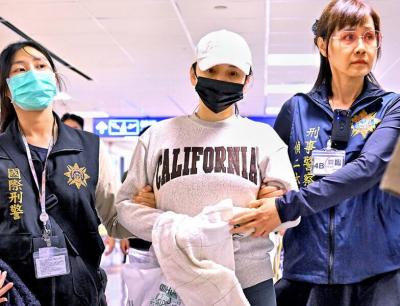
Johanne Liou (劉喬安), a Taiwanese woman who shot to unwanted fame during the Sunflower movement protests in 2014, returned to Taiwan last night after being deported from the US. She is to stand trial in Taiwan for charges involving embezzlement, fraud and drug crimes. The Criminal Investigation Bureau (CIB) said it took her into custody at Taiwan Taoyuan International Airport and would first question her before transferring her to the New Taipei District Prosecutors’ Office. She was arrested upon disembarking a flight from San Francisco that landed shortly before 7pm. Liou absconded to the US in 2019 after jumping bail
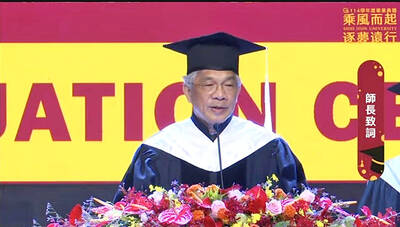
Shih Hsin University President Chen Ching-he (陳清河) yesterday issued a public apology for comments made in his commencement speech last week, stating that he has asked the school to suspend his duties and halt his wages for two months as a show of contrition. At the commencement ceremony on May 30, Chen said, “If you don’t manage your time well, or your own emotions, or your health, then I am telling every one of you — put a quick end to ‘you,’ because the world has no need for ‘you.’” The comments have sparked significant controversy online, and Chen through an open


 RSS
RSS