


Democratic Progressive Party (DPP) Legislator Yeh Yi-jin (葉宜津) yesterday said that the Ministry of Transportation and Communications should within one week submit a report on how to deter people on tourist visas from overstaying.
Yeh made the remarks at a meeting of the legislature’s Transportation Committee after the Tourism Bureau on Tuesday said that 152 of 153 Vietnamese passport holders went missing soon after they arrived in Kaohsiung on tours last week. It later revised the number of those missing to 148 and 11 of those had been found as of yesterday.
The incident has triggered calls for the government to revisit the Kuan Hung Pilot Project, an electronic visa program launched in 2015 to boost the number of “quality tour groups” visiting from India, Indonesia, Vietnam, Myanmar, Cambodia, Laos and India — nations named in the government’s New Southbound Policy.
The government only began to sense that it was a serious matter after last week’s incident, Yeh said.
However, prior to last week, 348 Vietnamese had overstayed while visiting on tourist visas this year, she said.
The project does not require the government to check entry and exit records, nor do visitors who arrive as part of the program need to present financial statements, Yeh said, adding that the government did not seem to care whether they had purchased return tickets before it granted them visas.
“The government has practically opened the door wide open, but it punished travel agencies instead of the missing tourists,” Yeh said, adding that the government’s error was greater than that of the travel agencies.
Yeh denied a ministry request to have one month to hand in a report on the incident, which would include measures to prevent similar situations.
Deputy Minister of Transportation and Communications Chi Wen-chung (祁文中) said that the bureau, the Ministry of Foreign Affairs and the National Immigration Agency would study the problem and find ways to address them.
Nevertheless, Minister Without Portfolio Chang Ching-sen (張景森), who is supervising tourism affairs, said on Facebook that runaway tourists were as inevitable as people dropping a few sesame seeds on the floor when they eat Chinese flatbread for breakfast.
In the past few years, about 226,000 visitors from Southeast Asian nations have visited Taiwan through the program, but only 414 contravened the regulations, “but Chinese Nationalist Party [KMT] lawmakers and the media in the past few days have pummeled the government for implementing the New Southbound Policy, as if the Kuan Hung Pilot Project has filled the streets with fugitives and hookers,” Chang said.
The government needs to revisit how it grants visas to Southeast Asian visitors, he said, adding that it would not shrink from enforcing a policy that would reduce the nation’s reliance on Chinese tourists.

LOUD AND PROUD Taiwan might have taken a drubbing against Australia and Japan, but you might not know it from the enthusiasm and numbers of the fans Taiwan might not be expected to win the World Baseball Classic (WBC) but their fans are making their presence felt in Tokyo, with tens of thousands decked out in the team’s blue, blowing horns and singing songs. Taiwanese fans have packed out the Tokyo Dome for all three of their games so far and even threatened to drown out home team supporters when their team played Japan on Friday. They blew trumpets, chanted for their favorite players and had their own cheerleading squad who dance on a stage during the game. The team struggled to match that exuberance on the field, with
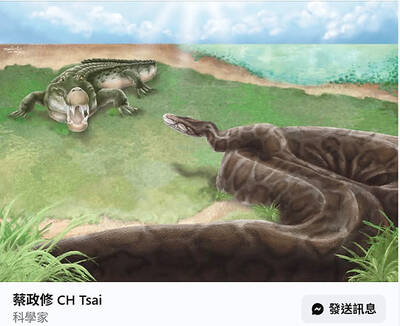
Taiwanese paleontologists have discovered fossil evidence that pythons up to 4m long inhabited Taiwan during the Pleistocene epoch, reporting their findings in the international scientific journal Historical Biology. National Taiwan University (NTU) Institute of Ecology and Evolutionary Biology associate professor Tsai Cheng-hsiu (蔡政修) led the team that discovered the largest snake fossil ever found in Taiwan. The single trunk vertebra was discovered in Tainan at the Chiting Formation, dated to between 400,000 and 800,000 years ago in the Middle Pleistocene, the paper said. The area also produced Taiwan’s first avian fossil, as well as crocodile, mammoth, saber-toothed cat and rhinoceros fossils, it said. Discoveries

Taiwanese paleontologists have discovered fossil evidence that pythons up to 4m long inhabited Taiwan during the Pleistocene epoch, reporting their findings in the international scientific journal Historical Biology. National Taiwan University (NTU) Institute of Ecology and Evolutionary Biology associate professor Tsai Cheng-hsiu (蔡政修) led the team that discovered the largest snake fossil ever found in Taiwan. A single trunk vertebra was discovered in Tainan at the Chiting Formation, dated to between 800,000 to 400,000 years ago in the Middle Pleistocene, the paper said. The area also produced Taiwan’s first avian fossil, as well as crocodile, mammoth, sabre-toothed cat and rhinoceros fossils, it said. Discoveries

Whether Japan would help defend Taiwan in case of a cross-strait conflict would depend on the US and the extent to which Japan would be allowed to act under the US-Japan Security Treaty, former Japanese minister of defense Satoshi Morimoto said. As China has not given up on the idea of invading Taiwan by force, to what extent Japan could support US military action would hinge on Washington’s intention and its negotiation with Tokyo, Morimoto said in an interview with the Liberty Times (sister paper of the Taipei Times) yesterday. There has to be sufficient mutual recognition of how Japan could provide


 RSS
RSS