


President Tsai Ing-wen (蔡英文) yesterday presented this year’s Asia Democracy and Human Rights Award to Gusdurian Network Indonesia (GNI), a non-governmental organization that promotes pluralism and works to protect minority rights against religious and racial intolerance.
In her speech, Tsai praised GNI for its efforts to engage different social groups in dialogue to deepen democracy.
At a time when extremism poses a challenge to many democracies by exacerbating divisions across society, the values that GNI embraces — moderation, tolerance for differences, and interreligious and interethnic dialogue — are commendable, Tsai said.
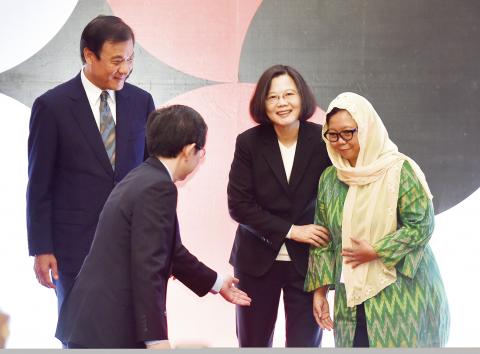
Photo: Huang Yao-cheng, Taipei Times
“To receive this award is our second-greatest honor. Not because the award is less important, but because we believe our greatest honor is serving the people, fighting injustices,” GNI national coordinator Alissa Wahid said at the ceremony.
“The award is a recognition of our work, but also serves as a reminder of our commitment to work harder. It will be the bar we set for ourselves,” said Wahid, the daughter of late Indonesian president Abdurrahman Wahid, popularly known as Gus Dur.
Gus Dur served as the nation’s first freely elected president from 1999 to 2001.
Established in 2010, GNI was named after Gus Dur to “encourage interaction and consolidation” among those who share his beliefs and vision, said the Taiwan Foundation for Democracy (TFD), which founded the award.
The Jakarta-based group engages thousands of people across Indonesia — from Muslim clerics, leaders of other religions, activists and professionals to students — by hosting thousands of grassroots activities focusing on promoting tolerance, multiculturalism, the spread of peaceful Islam and substantive democracy in more than 100 cities, the foundation said.
Some of its endeavors include calling for a judicial review of laws that discriminate against people who practice a religion other than the six officially recognized faiths in Indonesia, and protecting the rights of minority Muslim groups, such as Shiite Ahmadi Muslims, it said.
GNI’s intervention after church attacks in Aceh last year brought about a peace declaration from the parties in the conflict, while the dialogue it promoted among Christians, Muslims and Buddhists after church bombings in Surabaya, East Java, in May helped restore trust and reduce potential conflict, the foundation said.
In her acceptance speech, Wahid said that GNI is guided by nine principles, based on the core values pursued by Gus Dur throughout his life, “most importantly humanity and justice.”
“Gus Dur had a very famous slogan: ‘Humanity is more important than politics,’” Wahid said.
Discussing challenges, Wahid said that religious populism, “hate spin” and extremism have become prevalent in Indonesia, as in other countries.
“Gus Dur used to say: ‘God needs no defense,’ but now we see how God and religion are used as tools to gain political power, to discriminate against others and to do injustice,” Wahid said. “And when done in the name of god, how powerful. This is where we currently focus our work.”
Despite these challenges, GNI activists would never be beaten down, she said.
“Some people in the past paid the price for what we have today and never enjoyed the fruits of their struggle, which we enjoy today; so we owe it to future generations. We have to fight for them, at least to hand them the torch of the struggle, a light, for them,” she said.
Foundation chairman and legislative speaker Su Jia-chyuan (蘇嘉全) said he hoped that the award and Taiwan’s experience could help the world envision a future where all vulnerable groups are treated equally, irrespective of gender, race or religion.
The foundation was created by the Ministry of Foreign Affairs and established as a foundation by the Legislative Yuan.
The award was launched in 2006 to support people and organizations that have made significant contributions to the advancement of democracy and human rights in Asia.
The award consists of a trophy and a US$100,000 grant to support the ongoing work of the recipient.


UPGRADE: The Kang Ding-class frigate is replacing its Chaparall missiles with Tien Chien II and Hua Yang VLS, which would provide it with long-range, 360° air defense Taiwan plans to produce 1,200 to 1,376 Hai Chien II missiles (海劍二, Sea Sword II) — also known as TC-2N — to serve as the standard air defense system of the navy’s surface combatant fleet, a source said yesterday. Last week, the Hai Chien II, the naval version of the Tien Kung II missile (天劍二, Sky Sword II), completed a live-fire test in waters off the National Chungshan Institute of Science and Technology’s Jiupeng facility (九鵬) in Pingtung County’s Manjhou Township (滿州). The MIM72 Chaparral and other dated air defense missiles that currently arm Taiwanese ships have inadequate range to combat Chinese

REASONS FOR TRAVEL: An assistant professor said that proposed amendments to penalize drivers if they used drugs overseas would not deter people from traveling People who operate a motor vehicle under the influence of marijuana would have their driver’s license revoked, even if they used the substance while overseas, the Ministry of Transportation and Communications said yesterday, citing proposed amendments to the Road Traffic Management and Penalty Act (道路交通管理處罰條例). The amendments would also authorize the government to revoke the licenses of people determined to have used Category 1 or Category 2 narcotics, even if they were not operating a vehicle while under the influence of drugs, as well as ban them from taking the license test for three years, the ministry said. People aged 18 or
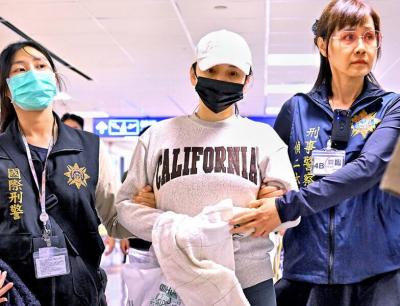
Johanne Liou (劉喬安), a Taiwanese woman who shot to unwanted fame during the Sunflower movement protests in 2014, returned to Taiwan last night after being deported from the US. She is to stand trial in Taiwan for charges involving embezzlement, fraud and drug crimes. The Criminal Investigation Bureau (CIB) said it took her into custody at Taiwan Taoyuan International Airport and would first question her before transferring her to the New Taipei District Prosecutors’ Office. She was arrested upon disembarking a flight from San Francisco that landed shortly before 7pm. Liou absconded to the US in 2019 after jumping bail
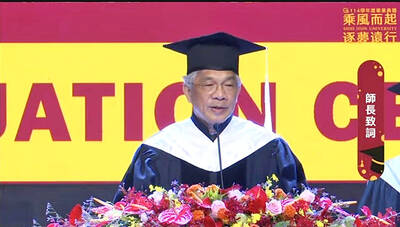
Shih Hsin University President Chen Ching-he (陳清河) yesterday issued a public apology for comments made in his commencement speech last week, stating that he has asked the school to suspend his duties and halt his wages for two months as a show of contrition. At the commencement ceremony on May 30, Chen said, “If you don’t manage your time well, or your own emotions, or your health, then I am telling every one of you — put a quick end to ‘you,’ because the world has no need for ‘you.’” The comments have sparked significant controversy online, and Chen through an open


 RSS
RSS