


A referendum to request a name change for the national team from “Chinese Taipei” to “Taiwan” for the 2020 Tokyo Olympics would not affect athletes’ right to compete in the Games, a coalition of civic groups that launched the referendum said yesterday.
“Our proposed referendum is in line with the Olympic Charter, as well as the Lausanne Agreement, so it would not cause the Chinese Taipei Olympic Committee [CTOC] to be suspended or lose membership, or anything that could affect our athletes’ rights,” said George Chang (張燦鍙), one of the campaigners for the referendum.
The referendum, one of 10 to be held on Saturday alongside the nine-in-one elections, has drawn repeated warnings from the International Olympic Committee (IOC) since May, allegedly due to pressure from China.
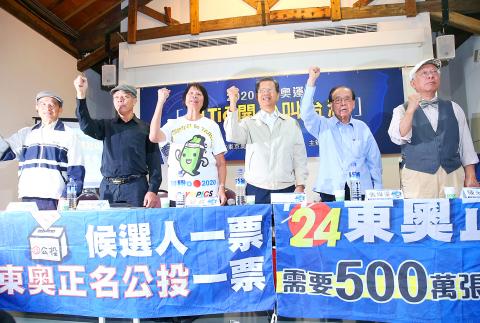
Photo: CNA
The IOC said that it would not approve the name change due to the Lausanne Agreement, an arrangement it signed with the CTOC in 1981 that requires Taiwan to compete under the name “Chinese Taipei” and fly the CTOC flag at international sports events.
In a letter sent to the CTOC and the Sports Administration on Friday, the IOC reiterated that the team’s name is determined by the 1981 agreement, saying that: “Any attempt to exercise undue pressure on the CTOC to breach the 1981 agreement and/or to act against the decision of the IOC Executive Board would be considered as external interference, which might expose the CTOC to the protective measures set out in the Olympic Charter.”
While the letter raised concerns that the referendum could lead to athletes being banned from competing in the Games, Chang said that would be against the charter.
The IOC’s letter should be understood as “an expression of opinion, rather than a formal ruling on the matter,” he said.
“According to the Olympic Charter, they do not have the power to reject an application before it is submitted and we have the right to apply for a name change,” he added.
Campaign convener Yang Chung-ho (楊忠和), former director-general of the Sports Administration, said that he has “read the entire Olympic Charter and did not find any rule on any page that bans a name change.”
“There is no way submitting an application would affect the rights of athletes. Unless the CTOC pretends to be the victim and asks the IOC to suspend it, the referendum would not lead to its suspension,” he added.
Online news outlet Taiwan People News chairman Chen Yung-hsing (陳永興) said that past instances have shown that the IOC prioritizes athletes’ rights over their national Olympic committee.
When former Brazilian Olympic Committee president Carlos Nuzman was charged with corruption, the IOC suspended the body, but the right of Brazilian athletes to compete in events was unaffected, Chen said, adding: “Taiwanese athletes would absolutely not be banned from competing in the Games.”
“We are promoting the referendum to protect the dignity of Taiwanese athletes,” he said. “When we travel abroad, who would identify themselves as coming from ‘Chinese Taipei?’ The answer is always Taiwan.”

PROCEDURE: Although there is already a cross-strait agreement in place for the extradition of criminals, ample notice is meant to be given to the other side first Ten Taiwanese who were involved in fraud-related crimes in China were extradited back to Taiwan via Kinmen County on Wednesday, four of whom are convicted fraudsters in Taiwan. The 10 people arrived via a ferry operating between Xiamen and Kinmen, also known as the “small three links.” The Kinmen County Prosecutors’ Office yesterday said that four of the 10 extradited people were convicted in Taiwan for committing fraud and contravening the Money Laundering Control Act (洗錢防制法), and were on the wanted list. They were immediately arrested upon arrival and sent to Kinmen Prison to serve their sentences following brief questioning, the office said.

Taipei and Kaohsiung have extended an open invitation to Japanese pop star Ayumi Hamasaki after Chinese authorities abruptly canceled her scheduled concert in Shanghai. Hamasaki, 47, had been slated to perform on Saturday before organizers pulled the show at the last minute, citing “force majeure,” a move widely viewed as retaliation for Japanese Prime Minister Sanae Takaichi’s recent remark that a Chinese attack on Taiwan could draw a military response from Tokyo. Taipei Mayor Chiang Wan-an (蔣萬安) yesterday said the city “very much welcomes” Hamasaki’s return and would continue to “surprise” her. Hamasaki, who has a large global fan base, including
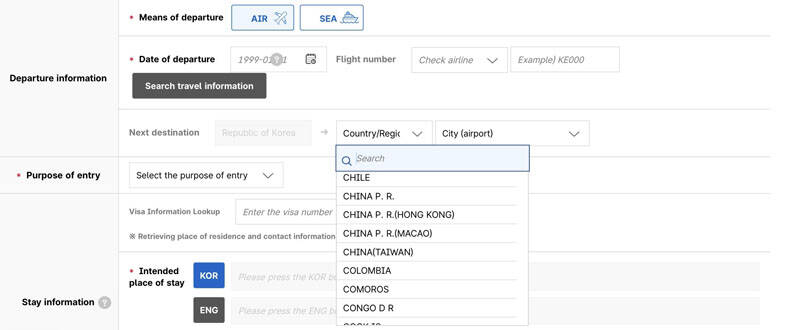
‘REGRETTABLE’: Travelers reported that Seoul’s online arrival card system lists Taiwan as ‘China (Taiwan),’ the Ministry of Foreign Affairs said The Ministry of Foreign Affairs yesterday urged South Korea to correct the way Taiwan is listed in its newly launched e-Arrival card system, saying the current designation downgrades the nation’s status. South Korea rolled out the online system on Feb. 24 to gradually replace paper arrival cards, which it plans to phase out by next year. Travelers must complete the electronic form up to 72 hours before entering the country. The ministry said it has received multiple complaints from Taiwanese travelers saying that the system lists Taiwan as “China (Taiwan)” in dropdown menus for both “place of departure” and “next

VIGILANT: Enterovirus activity remains in the epidemic phase, with the CDC urging caregivers of infected children to be on the lookout for signs of severe illness Influenza activity is rising in neighboring countries, and, with temperatures forecast to drop this week, flu cases are expected to increase in the next two weeks, the Centers for Disease Control (CDC) said yesterday. Hospitals reported 87,162 visits for flu-like illnesses between Nov. 23 and Saturday, which remained about the same level as the previous week, but nine deaths and 24 cases with serious flu complications were also confirmed last week, CDC Epidemic Intelligence Center Director Guo Hung-wei (郭宏偉) said. Flu activity reached a peak in late September before declining for eight consecutive weeks, CDC Deputy Director-General and spokesman Lin Min-cheng (林明誠)


 RSS
RSS