


Domestically produced supercomputer Taiwania 2 is the world’s 20th-most powerful computer according to the TOP500 List, a significant improvement from the original Taiwania’s ranking last year, the Ministry of Science and Technology said yesterday.
It is the best ranking that a Taiwanese supercomputer has ever captured, marking a milestone for the nation’s technological progress, the ministry said in a news release.
The supercomputer is expected to become operational in the first half of next year, it said, adding that it would be offered for use in government-managed robotics, autonomous vehicle experiments, artificial intelligence research and private innovative industries.
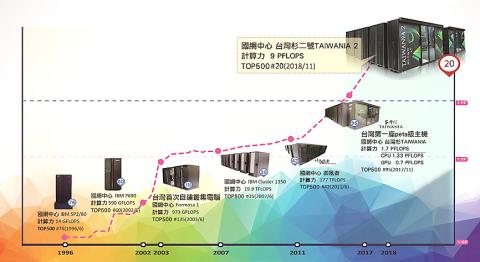
Photo: CNA
Installed at the ministry’s Central Taiwan Science Park in Taichung, Taiwania 2 is part of a cloud computing platform built by the ministry’s National Center for High-Performance Computing, Quanta Computer Inc, Asustek Computer Inc and Taiwan Fixed Network Co, the ministry said.
Quanta is mainly responsible for Taiwania 2’s computing nodes, while Asustek aids with its cloud service system and Taiwan Fixed Network maintains its information security, the center’s Infrastructure Service Division deputy director Lu Hung-fu (盧鴻復) said.
It is part of the Executive Yuan’s Forward-looking Infrastructure Development Program and has been allocated funding of NT$5 billion (US$161.8 million) over four years, starting from last year, Lu said.
Taiwania 2 has a computing capacity of 9 quadrillion floating-point operations per second (9 petaFLOPS) and is also energy-efficient, capturing 10th place on the Green500 List, he said.
The ranking shows Taiwan’s leap in high-performance computing, as the supercomputer’s predecessor, Taiwania, was ranked 95th on last year’s TOP500 List, Lu said.
The US claimed five of the top 10 spots, with its Summit and Sierra supercomputers taking first and second, followed by China’s Sunway TaihuLight and Tianhe-2A systems in third and fourth respectively, the TOP500 List’s Web site showed.
The list is complied by Erich Strohmaier and Horst Simon of Lawrence Berkeley National Laboratory in the US, Jack Dongarra of the University of Tennessee and Martin Meuer, cochair of the International Supercomputing Conference, who in 2014 took over as coauthor from his father, Hans Meuer, according to the TOP500 List.

Considering that most countries issue more than five denominations of banknotes, the central bank has decided to redesign all five denominations, the bank said as it prepares for the first major overhaul of the banknotes in more than 24 years. Central bank Governor Yang Chin-lung (楊金龍) is expected to report to the Legislative Yuan today on the bank’s operations and the redesign’s progress. The bank in a report sent to the legislature ahead of today’s meeting said it had commissioned a survey on the public’s preferences. Survey results showed that NT$100 and NT$1,000 banknotes are the most commonly used, while NT$200 and NT$2,000

The Centers for Disease Control (CDC) yesterday reported the first case of a new COVID-19 subvariant — BA.3.2 — in a 10-year-old Singaporean girl who had a fever upon arrival in Taiwan and tested positive for the disease. The girl left Taiwan on March 20 and the case did not have a direct impact on the local community, it said. The WHO added the BA.3.2 strain to its list of Variants Under Monitoring in December last year, but this was the first imported case of the COVID-19 variant in Taiwan, CDC Deputy Director-General Lin Ming-cheng (林明誠) said. The girl arrived in Taiwan on

South Korea is planning to revise its controversial electronic arrival card, a step Taiwanese officials said prompted them to hold off on planned retaliatory measures, a South Korean media report said yesterday. A Yonhap News Agency report said that the South Korean Ministry of Foreign Affairs is planning to remove the “previous departure place” and “next destination” fields from its e-arrival card system. The plan, reached after interagency consultations, is under review and aims to simplify entry procedures and align the electronic form with the paper version, a South Korean ministry official said. The fields — which appeared only on the electronic form

The Ministry of Foreign Affairs (MOFA) is suspending retaliation measures against South Korea that were set to take effect tomorrow, after Seoul said it is updating its e-arrival system, MOFA said today. The measures were to be a new round of retaliation after Taiwan on March 1 changed South Korea's designation on government-issued alien resident certificates held by South Korean nationals to "South Korea” from the "Republic of Korea," the country’s official name. The move came after months of protests to Seoul over its listing of Taiwan as "China (Taiwan)" in dropdown menus on its new online immigration entry system. MOFA last week


 RSS
RSS