


Q: There have been concerns that Guatemala’s failure to speak up for Taiwan at the UN General Assembly for three years in a row could be a sign of unstable ties. What are your views on this?
Aguja: Every year, several meetings are carried out in international forums. Among the most important is the high-level segment of the General Assembly of the UN. The leaders [of member states] have the opportunity to present the advances and challenges of their own countries at this global scenario. Due to the limited assigned time, Guatemala has concentrated every year on presenting its national priorities.
It is necessary to clarify that not being able to include a reference about Taiwan’s situation in our speeches in this forum does not mean we do not support Taiwan, nor do we think [it is needed] to make such mentions a condition.
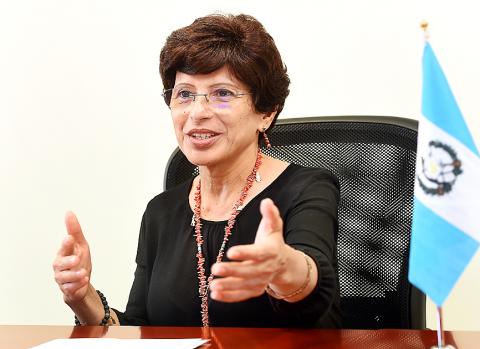
Photo: Chu Pei-hsiung, Taipei Times
We are an ally of Taiwan and we have strong diplomatic relations. Nevertheless, Guatemala is a sovereign country which has the prerogative to decide whether to include or not in its speeches the issues that at the moment are of immediate priority to its government.
The international policy of the government of Guatemala has been to support in different ways actions that favor the cause of Taiwan at international organizations. For example, this year, Guatemala spoke in favor of Taiwan’s cause at the World Health Assembly, where we joined the representatives of the “allied” countries in meetings with officials of international organizations.
Q: What are your views on China’s expanding financial presence in Central America? Do you see it as an opportunity for the area, or do you harbor concerns?
Aguja: The People’s Republic of China has diplomatic relations, and large investments and trade with most countries of the American continent. Its presence has been increasing.
For example, at the beginning of this year, China held the second ministerial meeting of the forum of the Community of Latin American and Caribbean States, in which they talked about economic growth, and the sustainable and integral development of Latin America and China.
Countries that have diplomatic ties with China evaluate their interests and priorities, but this is not the case for Guatemala, so this issue does not concern us. Our country maintains its diplomatic ties with the Republic of China and in recent months the Guatemalan government has ratified it to the government of Taiwan.
The global geopolitics of recent years have been modified and we cannot anticipate the facts. The important thing is to continue working as we have been doing and work together to concentrate on the fundamental points of cooperation that benefit both countries.
Q: After El Salvador cut ties with Taiwan in August, the US recalled its ambassadors to El Salvador, as well as from two other Central American countries that had also switched recognition to Beijing. How do you feel about the move by the US?
Aguja: Central America is a small region, but with a strategic geographical position, so each one must be responsible for their own decisions, and we are respectful of them, whether [they are the decisions of] El Salvador or other countries.
In the case of Guatemala, the government is an ally of Taiwan by decision and we have made it public knowledge. The important thing is that we focus on advancing the relationship and do not lose our strength in speculations.
Taiwan is a highly developed country that can contribute much more by sharing its scientific and technological knowledge. It can support us more in our national development plan and invest more in Guatemala, which would be mutually beneficial to both countries.
Q: What is the general feeling of the Guatemalan people about bilateral ties? Are there any areas where you would like to see improvement?
Aguja: The people and government of Guatemala feel very good about the relationship with Taiwan. If you go to Guatemala, in any corner of the country, you will hear people speak well of Taiwan. The general population knows about Taiwan and values the cooperation you provide. Also, Taiwan’s ambassador to Guatemala is able to talk to our president directly, friendly and openly. We do not have any problems with Taiwan. We love Taiwan.
The areas in which we can improve cooperation are also the priorities of the Guatemalan government and are in accordance with the global challenges we face to conserve our planet, which are the UN’s 17 Sustainable Development Goals (SDGs). The goals have been linked to Guatemala’s national development plan for 2032.
We hope cooperation will be further strengthened to generate resilience in all areas of sustainable development.
An important topic of the national plan is the integral development of rural areas, particularly in infrastructure; eradication of poverty; healthcare; the fight against malnutrition; reducing maternal and infant mortality; and education.
Another important topic is cooperation in science and technology applied to the SDGs, where Taiwan has much to contribute. Taiwan’s experience with cleaning up rivers, lakes and watersheds, and its solid-waste management are also very valuable.
However, we have a bit of a problem with Taiwan in trade. We signed a free-trade agreement in 2005 and we need to negotiate the products, because some still have taxes. If they have taxes, we cannot export products like avocadoes, lemons and the beautiful flowers we produce to Taiwan, because they will be too expensive. We are now trying to get all concerned parties, including Taiwan’s Ministry of Economic Affairs, to sit down and put more effort into this.
Q: In many cases, ambassadors of Taiwan’s former diplomatic allies were the last to know of their governments’ decision to switch recognition to China. Are you worried about this?
Aguja: No. I think we have a very strong relationship now, even though I know the current geopolitical situation concerning Taiwan and China is different and that in Guatemala and Central America, your position with other countries is very difficult.
I have maybe heard about the positions of Panama, the Dominican Republic and El Salvador. These countries are our friends. We are in the same area and we have a very good relationship with them, but we have a clear idea of what our position is [regarding Taiwan].
We are clear about what Guatemala needs, what Guatemala wants and we want to be a continued ally to Taiwan.

Considering that most countries issue more than five denominations of banknotes, the central bank has decided to redesign all five denominations, the bank said as it prepares for the first major overhaul of the banknotes in more than 24 years. Central bank Governor Yang Chin-lung (楊金龍) is expected to report to the Legislative Yuan today on the bank’s operations and the redesign’s progress. The bank in a report sent to the legislature ahead of today’s meeting said it had commissioned a survey on the public’s preferences. Survey results showed that NT$100 and NT$1,000 banknotes are the most commonly used, while NT$200 and NT$2,000

The Centers for Disease Control (CDC) yesterday reported the first case of a new COVID-19 subvariant — BA.3.2 — in a 10-year-old Singaporean girl who had a fever upon arrival in Taiwan and tested positive for the disease. The girl left Taiwan on March 20 and the case did not have a direct impact on the local community, it said. The WHO added the BA.3.2 strain to its list of Variants Under Monitoring in December last year, but this was the first imported case of the COVID-19 variant in Taiwan, CDC Deputy Director-General Lin Ming-cheng (林明誠) said. The girl arrived in Taiwan on

South Korea is planning to revise its controversial electronic arrival card, a step Taiwanese officials said prompted them to hold off on planned retaliatory measures, a South Korean media report said yesterday. A Yonhap News Agency report said that the South Korean Ministry of Foreign Affairs is planning to remove the “previous departure place” and “next destination” fields from its e-arrival card system. The plan, reached after interagency consultations, is under review and aims to simplify entry procedures and align the electronic form with the paper version, a South Korean ministry official said. The fields — which appeared only on the electronic form

The Ministry of Foreign Affairs (MOFA) is suspending retaliation measures against South Korea that were set to take effect tomorrow, after Seoul said it is updating its e-arrival system, MOFA said today. The measures were to be a new round of retaliation after Taiwan on March 1 changed South Korea's designation on government-issued alien resident certificates held by South Korean nationals to "South Korea” from the "Republic of Korea," the country’s official name. The move came after months of protests to Seoul over its listing of Taiwan as "China (Taiwan)" in dropdown menus on its new online immigration entry system. MOFA last week


 RSS
RSS