


Transitional Justice Commission member Yang Tsui (楊翠) on Wednesday delivered historical documents to Li Su-hui (李素慧), the daughter of Li Tsang-chiang (李蒼降), who was executed during the White Terror era.
Li Su-hui was given photographs of her father, his diploma and other certificates, and was told that he was exonerated of all criminal convictions this month.
The White Terror era refers to the suppression of political dissidents following the 228 Incident, an uprising that began on Feb. 27, 1947, which was brutally suppressed by the then-Chinese Nationalist Pary (KMT) regime. The government subsequently imposed martial law, which was lifted on July 15, 1987.
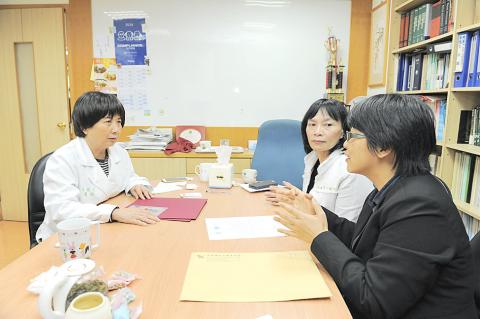
Photo courtesy of the Transitional Justice Commission
Li Su-hui, a physician, was born in a prison hospital and never met her father, who was accused of being a communist, Yang said.
The commission, which is familiar with Li Su-hui’s case, raised the prospect of finding photos of her father at a meeting at the National Human Rights Museum, it said.
The commission sifted through 7,000 files to find Li Tsang-chiang’s diploma and certificates from his time studying in Hangzhou, China — which at the time was under Republic of China control — and made copies of photographs of him to give to his daughter, it said.
Li Tsang-chiang was the nephew of Li Yu-pang (李友邦), who ran the Three Principles Youth Group. Li Yu-pang, who was involved in anti-Japanese activities during the colonial period, was accused of being a communist and imprisoned by the KMT during the White Terror.
In April, 1949 Li Tsang-chiang married Tseng Pi-li (曾碧麗), a nurse, joined the Chinese Communist Party’s (CPP) Keelung Work Committee and began writing for leftist publication The Light (光明報).
The following month the KMT announced the imposition of martial law and that it would be cracking down on suspected communists, which resulted in the arrest of roughly 1,000 people associated with The Light, the commission said.
Li Tsang-chiang and Tseng were both arrested and their daughter was born a month later, it said.
The Song of the Windowed Carriage (幌馬車之歌續曲) — an account of the White Terror period by Lan Bo-chow (藍博洲) published in 2016 — describes Tseng’s torture in prison while heavily pregnant.
Li Su-hui was born prematurely and Tseng lost a lot of blood during delivery, Lan wrote.
As Tseng could not produce milk, she relied on the kindness of others in the prison to get milk powder and bran, Lan wrote.
“My mother said my father had looked through the metal bars [of his cell] to see me. At the time his fingernails had all been pulled out, and his face was ghostly white and covered in lacerations,” Li Su-hui said.
Li Tsang-chiang was executed by firing squad in October 1950 at the age of 26.
Tseng was released from prison shortly afterward.
Li Su-hui said she was often mocked by teachers as being “the child of communist bandits.”
Despite this, she excelled in her studies and was admitted to National Taiwan University to study medicine, she said.
The commission said documents showed that Li Tsang-chiang in 1946 received a certificate for classes and in 1947 received a graduation diploma from Zhejiang Hangzhou Senior High School.
Both documents have then-principal Fang Yu-yuan’s (房宇園) name and stamp on them, the commission said.
Li Tsang-chiang and 1,269 others charged with White Terror-related crimes were exonerated this month.
Chung Hao-tung (鍾浩東), a school principal who was executed after being accused of communist activities, was among them, the commission said.
Members of the public affected by political persecution can contact a service center set up by the National Development Council for assistance to obtain documents.
The center can be reached on (02) 8995-3623 or (02) 8995-3624.
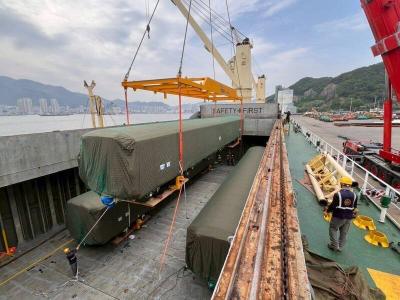
The first of 10 new high-capacity trains purchased from South Korea’s Hyundai Rotem arrived at the Port of Taipei yesterday to meet the demands of an expanding metro network, Taipei Rapid Transit Corp (TRTC) said yesterday. The train completed a three-day, 1,200km voyage from the Port of Masan in South Korea, the company said. Costing NT$590 million (US$18.79 million) each, the new six-carriage trains feature a redesigned interior based on "human-centric" transportation concepts, TRTC said. The design utilizes continuous longitudinal seating to widen the aisles and optimize passenger flow, while also upgrading passenger information displays and driving control systems for a more comfortable
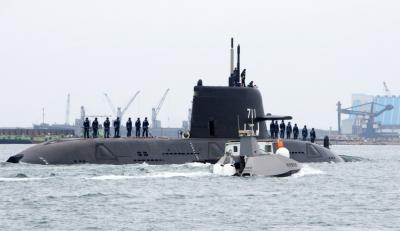
Taiwan's first indigenous defense submarine, the SS-711 Hai Kun (海鯤, or Narwhal), departed for its 13th sea trial at 7am today, marking its seventh submerged test, with delivery to the navy scheduled for July. The outing also marked its first sea deployment since President William Lai (賴清德) boarded the submarine for an inspection on March 19, drawing a crowd of military enthusiasts who gathered to show support. The submarine this morning departed port accompanied by CSBC Corp’s Endeavor Manta (奮進魔鬼魚號) uncrewed surface vessel and a navy M109 assault boat. Amid public interest in key milestones such as torpedo-launching operations and overnight submerged trials,
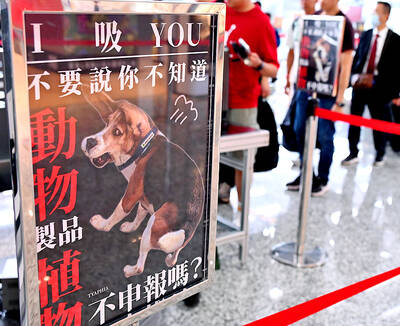
Quarantine awareness posters at Taiwan Taoyuan International Airport have gone viral for their use of wordplay. Issued by the airport branch of the Animal and Plant Health Inspection Agency, the posters feature sniffer dogs making a range of facial expressions, paired with advisory messages built around homophones. “We update the messages for holidays and campaign needs, periodically refreshing materials to attract people’s attention,” quarantine officials said. “The aim is to use the dogs’ appeal to draw focus to quarantine regulations.” A Japanese traveler visiting Taiwan has posted a photo on X of a poster showing a quarantine dog with a
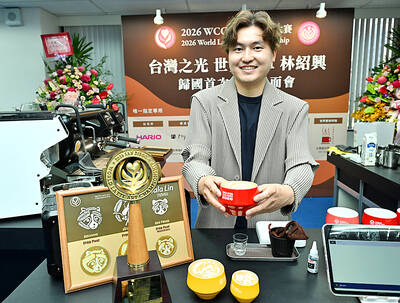
Taiwan’s coffee community has launched a “one-person-one-e-mail” campaign, calling for people to send a protest-e-mail to the World Coffee Championships (WCC) urging it to redesignate Taiwanese competitors as from “Taiwan,” rather than “Chinese Taipei.” The call followed sudden action last week after the WCC changed all references to Taiwanese competitors from “Taiwan” to “Chinese Taipei,” including recent World Latte Art champion Bala (林紹興), who won the World Latte Art Championship in San Diego earlier this month. When Bala received the trophy, he was referred to as representing Taiwan, as well as in the announcement on the WCC’s Web site, until it


 RSS
RSS