


The Supreme Court yesterday convicted two prominent Chinese Nationalist Party (KMT) politicians of graft and corruption, and sentenced them to prison.
Former Nantou County commissioner Lee Chao-ching (李朝卿) faces 30 years in jail after the court upheld an earlier guilty ruling that he breached provisions of the Anti-Corruption Act (貪污治罪條例) and the Government Procurement Act (政府採購法).
Lee, 68, was elected Nantou County commissioner in 2005 and won re-election in 2009.
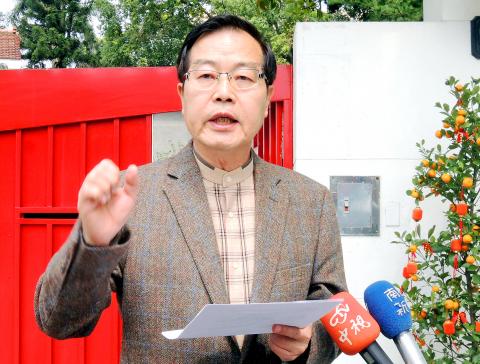
Photo: Hsieh Chieh-yu, Taipei Times
Investigators found that Lee had received bribes and kickbacks totaling NT$9.49 million (US$306,376 at the current exchange rate).
The court sent 103 other corruption charges against Lee back to the Taiwan High Court for a retrial, leaving open the possibility of further convictions.
The judges imposed a 14-year prison term for one conviction and a 12-year term for each of the other seven convictions for a total of 98 years.
They agreed to prosecutors’ request to combine punishment, meaning that Lee would have to serve at most 30 years, the maximum time permitted for concurrent sentences.
“I am very surprised at this verdict. The justice system did not give me a fair chance to explain... I will discuss with my lawyers to decide my next move,” Lee said.
The court also upheld a conviction against former KMT legislator Chung Shao-ho (鍾紹和) for taking bribes from and applying political pressure on behalf of a marine shipping business.
He was handed a term of seven-and-a-half years, his illicit gains are to be confiscated and he is to be deprived of his civil rights for five years.
Investigators found that Chung, 62, in April 2011 had taken a NT$3 million bribe to approve a business project at Kaohsiung Port.
The money was paid by Tung Hsin-yao (董欣耀), head of the Taiwanese subsidiary of Singapore-based Winson Group, the probe found.
The subsidiary, which is engaged in petroleum trading and oil tanker transportation, applied for a license to transfer petroleum between ships at the port, but the application was not initially approved.
Tung paid Chung to expedite the application process, which required reviews by the Environmental Protection Administration (EPA) and the Ministry of Transportation and Communications, the investigation found.
Chung in subsequent months requested meetings with the EPA and other ministries, as license approval and petroleum industry review falls under the Ministry of Foreign Affairs.
Chung discussed the issue with officials and initiated amendments to the Petroleum Administration Act (石油管理法) to expand its jurisdiction to include offshore waters, which would facilitate approval of the license, investigators said, adding that Chung then pushed the amendment through a legislative committee.
Except for 2000 to 2007, when he represented the People First Party, Chung spent most of his political career with the KMT.
The verdicts were final and notices are to be sent to Lee and Chung to begin their terms.

Considering that most countries issue more than five denominations of banknotes, the central bank has decided to redesign all five denominations, the bank said as it prepares for the first major overhaul of the banknotes in more than 24 years. Central bank Governor Yang Chin-lung (楊金龍) is expected to report to the Legislative Yuan today on the bank’s operations and the redesign’s progress. The bank in a report sent to the legislature ahead of today’s meeting said it had commissioned a survey on the public’s preferences. Survey results showed that NT$100 and NT$1,000 banknotes are the most commonly used, while NT$200 and NT$2,000

The Centers for Disease Control (CDC) yesterday reported the first case of a new COVID-19 subvariant — BA.3.2 — in a 10-year-old Singaporean girl who had a fever upon arrival in Taiwan and tested positive for the disease. The girl left Taiwan on March 20 and the case did not have a direct impact on the local community, it said. The WHO added the BA.3.2 strain to its list of Variants Under Monitoring in December last year, but this was the first imported case of the COVID-19 variant in Taiwan, CDC Deputy Director-General Lin Ming-cheng (林明誠) said. The girl arrived in Taiwan on

South Korea is planning to revise its controversial electronic arrival card, a step Taiwanese officials said prompted them to hold off on planned retaliatory measures, a South Korean media report said yesterday. A Yonhap News Agency report said that the South Korean Ministry of Foreign Affairs is planning to remove the “previous departure place” and “next destination” fields from its e-arrival card system. The plan, reached after interagency consultations, is under review and aims to simplify entry procedures and align the electronic form with the paper version, a South Korean ministry official said. The fields — which appeared only on the electronic form

The Ministry of Foreign Affairs (MOFA) is suspending retaliation measures against South Korea that were set to take effect tomorrow, after Seoul said it is updating its e-arrival system, MOFA said today. The measures were to be a new round of retaliation after Taiwan on March 1 changed South Korea's designation on government-issued alien resident certificates held by South Korean nationals to "South Korea” from the "Republic of Korea," the country’s official name. The move came after months of protests to Seoul over its listing of Taiwan as "China (Taiwan)" in dropdown menus on its new online immigration entry system. MOFA last week


 RSS
RSS