


About 2,500 plant species are to be featured at the Taichung World Flora Exposition, more than 60 percent of which are from Taiwan, the Taichung Agriculture Bureau said on Monday.
The exhibition opens on Nov. 3 and runs through April 24 next year, with displays spread across venues in Houli (后里), Fengyuan (豐原) and Waipu (外埔) districts on 60.88 hectares.
Organizers have installed about 6.6 million plants so far, including ornamental plants, cut flowers, shrubs and ground cover plants, bureau director Wang Jiun-shong (王俊雄) said.
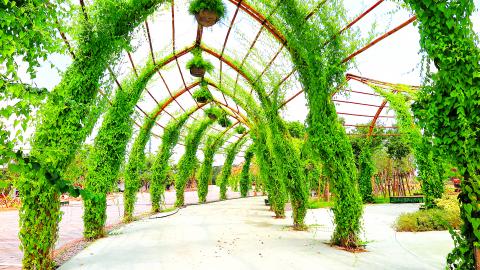
Photo courtesy of the Taichung City Government
The exposition is to highlight locally grown plants and domestic agricultural technology, and each of the three venues features unique installations, he said.
The Houli venue is divided into a “forest park” area and a “horse ranch” area, he said.
The forest area would include plants from different altitudes to form a microcosm of the nation’s landscape, he said.
It would also include a section showcasing plants that are representative of Aboriginal culture, such as the Mexican marigold (Tagetes erecta) — which which traditionally only Rukai warriors were allowed to wear — pigeon pea, taro plant, lilac tasselflower — also known as Cupid’s shaving brush — foxtail millet and djulis — often called “Taiwanese quinoa,” he added.
The ranch area has been planted with species whose Chinese names are related to the character for “horse,” including common purslane, bayhops and the slender Dutchman’s pipe (Aristolochia debilis), all named in Chinese for their resemblance to different parts of a horse, he said.
The Fengyuan Huludun Park (葫蘆墩公園) is to include a 213m “romantic floral corridor” with differently colored plants and climbing plants, and a “vine tunnel” of about 30m made of sandpaper vine, he said.
The Fengyuan venue would also feature a tree rose garden with 36 types of roses, he said.
All the trees in the Waipu Park would be native to Taiwan, he said, adding that a Chinese soapberry forest originally on the site would be preserved and there is to be a 6m-high, 210m-long “green bamboo corridor” made up of princess vines, great bougainvillea and other climbing plants.
The organizers have spent NT$2.2 billion (US$70.73 million) on landscaping, including the cost of plants, soil, fertilizer and installation, as well as the costs of maintenance, personnel and machinery for the exposition period, he added.

Considering that most countries issue more than five denominations of banknotes, the central bank has decided to redesign all five denominations, the bank said as it prepares for the first major overhaul of the banknotes in more than 24 years. Central bank Governor Yang Chin-lung (楊金龍) is expected to report to the Legislative Yuan today on the bank’s operations and the redesign’s progress. The bank in a report sent to the legislature ahead of today’s meeting said it had commissioned a survey on the public’s preferences. Survey results showed that NT$100 and NT$1,000 banknotes are the most commonly used, while NT$200 and NT$2,000

The Centers for Disease Control (CDC) yesterday reported the first case of a new COVID-19 subvariant — BA.3.2 — in a 10-year-old Singaporean girl who had a fever upon arrival in Taiwan and tested positive for the disease. The girl left Taiwan on March 20 and the case did not have a direct impact on the local community, it said. The WHO added the BA.3.2 strain to its list of Variants Under Monitoring in December last year, but this was the first imported case of the COVID-19 variant in Taiwan, CDC Deputy Director-General Lin Ming-cheng (林明誠) said. The girl arrived in Taiwan on

South Korea is planning to revise its controversial electronic arrival card, a step Taiwanese officials said prompted them to hold off on planned retaliatory measures, a South Korean media report said yesterday. A Yonhap News Agency report said that the South Korean Ministry of Foreign Affairs is planning to remove the “previous departure place” and “next destination” fields from its e-arrival card system. The plan, reached after interagency consultations, is under review and aims to simplify entry procedures and align the electronic form with the paper version, a South Korean ministry official said. The fields — which appeared only on the electronic form

The Ministry of Foreign Affairs (MOFA) is suspending retaliation measures against South Korea that were set to take effect tomorrow, after Seoul said it is updating its e-arrival system, MOFA said today. The measures were to be a new round of retaliation after Taiwan on March 1 changed South Korea's designation on government-issued alien resident certificates held by South Korean nationals to "South Korea” from the "Republic of Korea," the country’s official name. The move came after months of protests to Seoul over its listing of Taiwan as "China (Taiwan)" in dropdown menus on its new online immigration entry system. MOFA last week


 RSS
RSS