

Chinese Nationalist Party (KMT) supporters yesterday braved the rain to attend the party’s version of the Double Ten National Day celebration, which was designed to stir up Republic of China (ROC) patriotism and was peppered with election campaign rhetoric.
The supporters, some clad in ROC-themed clothes, while others passionately waved the national flag, gathered in front of National Sun Yat-sen Memorial Hall in Taipei yesterday afternoon to join several KMT heavyweights in celebrating the 107th anniversary of the founding of the ROC.
“Under the leadership of ROC founding father Sun Yat-sen (孫逸仙), the KMT was able to overthrow the Qing Dynasty and put an end to thousands of years of monarchy. It was also the party’s eight-year war of resistance against Japan that ensured the recovery of Taiwan, Penghu, Kinmen and Matsu as its base,” KMT Chairman Wu Den-yih (吳敦義) said.
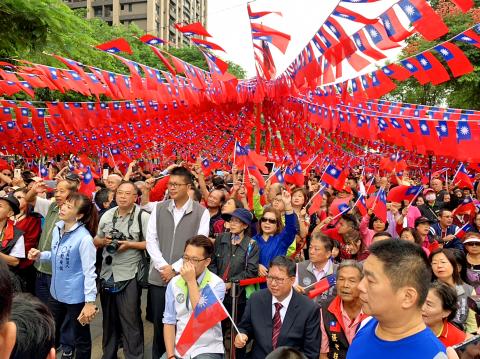
Photo: Hsu Chuo-hsun, Taipei Times
To prevent the nation’s ruin at the hands of President Tsai Ing-wen (蔡英文), it requires the concerted effort of all those opposed to Taiwanese independence, regardless of their ethnicity, gender or occupation, to act in solidarity in the Nov. 24 nine-in-one elections, Wu said.
Former president Ma Ying-jeou (馬英九) said many of the fishers and farmers whom he met in different parts of the nation after he handed over to Tsai in May 2016 complained to him about how difficult their lives had become and expressed their hope of seeing the KMT back in power.
“The Democratic Progressive Party [DPP] administration has touted what it calls the nation’s stellar economic growth under its leadership, but the fact is the country’s full-year GDP growth of 2.85 percent last year fell far short of the global growth rate of 3.7 percent,” Ma said.
Cross-strait relations have entered a state of “cold peace and cold confrontation” under the Tsai administration, Ma said, which has taken a toll on the nation’s tourism industry and foreign relations.
“There is nothing particularly extraordinary about the KMT. We merely know how to listen to people’s voices and solve their problems,” the former president said, accusing Tsai of turning Taiwan into an illiberal democracy.
Former KMT chairwoman Hung Hsiu-chu (洪秀柱) said she was marking Double Ten National Day with a heavy heart, after seeing how a president who deems the ROC as a government-in-exile, and refuses to wave the national flag and sing the national anthem, tears the nation apart.
“We should all remember that unification is our ultimate goal and we must act accordingly with our ballots on Nov. 24,” Hung said.
Elsewhere, New Party Taipei City councilor candidates criticized Tsai’s administration for not allowing them to fly a “real Double Ten National Day balloon.”
Criticizing the official symbol picked by the National Day Celebrations Organization Committee as lacking a clear design and message, party members Hou Han-ting (侯漢廷) and Lin Ming-cheng (林明正) wanted to fly a “real” national day balloon next to the Chiang Kai-shek Memorial Hall in Taipei.
Their plan was thwarted by the police, who cited item 9 of the National Day Preparation Committee’s announcement, which stated that no devices should take off, or hover in the air, to maintain flight safety of all aircraft participating in National Day events.
It was a safety concern, as the Presidential Office Building and Bo Ai Special District are subject to traffic and air restrictions during National Day celebrations, the police said.
The New Party members criticized the Presidential Office’s National Day celebrations as a “fake celebration to promote the concept of Taiwanese independence.”
The police had no right to ban them from flying the balloon outside the no-flight zone designated for the official celebrations, they said, criticizing the government for becoming increasingly authoritarian.
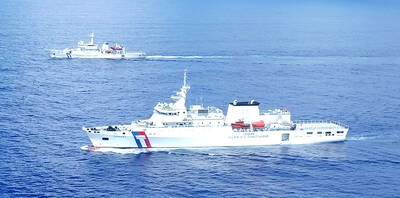
‘FRIENDSHIP FLEET’: A CGA official is scheduled to meet with the president of the Pacific nation, while one of the ships is to host a banquet and National Day event Two Coast Guard Administration (CGA) patrol vessels have docked at Malakal Harbor in Palau as part of an expedition exercise and diplomatic visit, during which a senior official is expected to meet with Palauan President Surangel Whipps Jr, the agency said yesterday. The two vessels, the 4,000-tonne-class Chiayi and the 1,000-tonne-class Penghu, set sail for Palau from Taiwan last week and arrived on Tuesday at Malakal Harbor, the CGA’s Fleet Branch said in a statement. The journey marks the second time the CGA has dispatched a “friendship fleet” to another country, after it sent its first-ever goodwill fleet, comprising the Hualien and
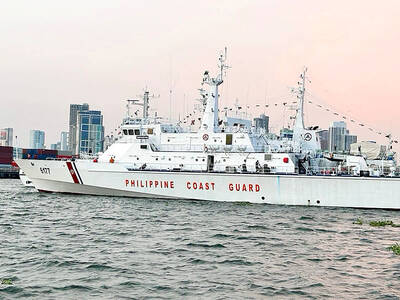
A patrol vessel donated by the Coast Guard Administration (CGA) to the Philippines was commissioned into the Philippine Coast Guard (PCG) on Friday, a Philippine non-governmental organization said. The CGA on Sept. 16 confirmed media reports that Taiwan had donated a retired 500-tonne patrol vessel to the Philippines. The Manila-based We Protect Our Seas (WPS) foundation, which served as an intermediary in the transfer, said that the vessel was formerly the CGA’s 500-tonne petrol vessel Kinmen (CG123). The WPS, in a statement issued on Friday, said the vessel, renamed as the BRP Sarangani, had been commissioned into the PCG the
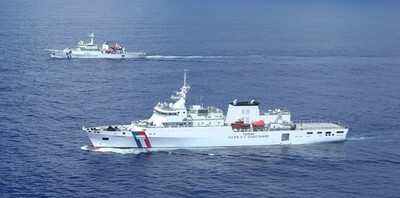
The Coast Guard Administration (CGA) today said that two of its patrol vessels have docked at Palau's Malakal Harbor as part of an expedition exercise and diplomatic visit, during which a senior official is expected to meet with the Palauan president. The two vessels, the 4,000-tonne-class Chiayi (嘉義) and the 1,000-tonne-class Penghu (澎湖), set sail for Palau from Taiwan last week and arrived at Malakal Harbor yesterday, the CGA's Fleet Branch said in a statement. The journey marked the second time the CGA has dispatched a "Friendship Fleet" to another country, after it sent its first-ever goodwill fleet, comprising the Hualien (花蓮)
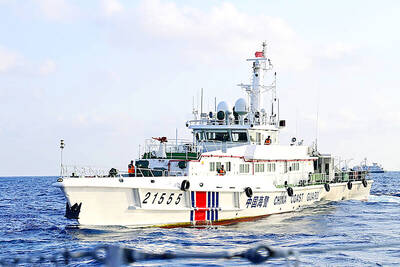
‘GRAY ZONE’ TACTICS: Beijing sent two China Coast Guard vessels to escort a ‘supposedly private research ship,’ a Philippine Coast Guard spokesman said The Coast Guard Administration (CGA) yesterday confirmed that it had recently deployed three patrol vessels to waters in Taiwan’s overlapping exclusive economic zone with the Philippines to monitor three Chinese vessels. CGA Deputy Director-General Hsieh Ching-chin (謝慶欽) said the agency regularly monitors Chinese vessels around Taiwan, and that the deployment south of Oluanpi (鵝鑾鼻), Taiwan proper’s southernmost point, was carried out in accordance with standard procedures. He added that the waters fall within the overlapping exclusive economic zones of Taiwan and the Philippines, which extend 200 nautical miles (370km) from their coastlines. Hsieh made the comments when asked about a


 RSS
RSS