


Researcher Li Jheng-jhang (李政璋) has discovered two tree-dwelling crab species in the Hengchun Peninsula (恆春半島) and named them after two of his friends, the Kenting National Park said on Monday.
Li, a doctoral candidate at National Sun Yat-sen University, discovered the Parasesarma kui near Gangkou Creek (港口溪) and the Parasesarma macaco near Baoli Creek (保力溪), the park said, adding that Li’s initial findings were last month published in a co-authored paper in Zootaxa.
The Parasesarma genus of land crabs, which Li and his co-authors have given the common name “tree-spider crabs,” are distinguished by hook-like legs with short digits and small, flat bodies, which facilitate tree climbing, the paper said.
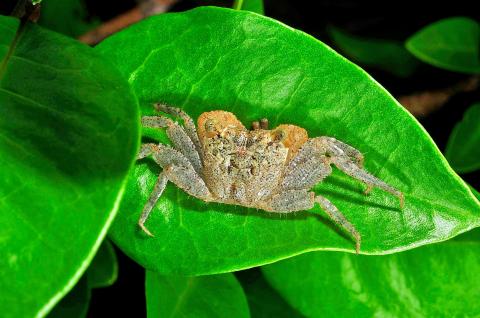
Photo: Chen Yen-ting, Taipei Times
Li and two other taxonomists from the National University of Singapore and the Indonesian Academy of Sciences over the past three years surveyed Southeast Asia and the coast of East Africa for similar crabs, documenting multiple live specimens, it said.
The study identified seven previously unknown species of tree-spider crabs in the Indo-West Pacific, including the two in Hengchun, doubling Taiwan’s number of indigenous tree-dwelling crab species, the park said.
The Parasesarma kui was named after Ku Ching-fang (古清芳) of Gangkou Village, a long-time park volunteer who has taken part in numerous land crab conservation and research projects, the park said.
The Parasesarma macaco’s name refers to its agile, monkey-like gait and is a tribute to Li’s late friend nicknamed Lin Laohou (“Lin the Old Monkey,” 林老猴), a fellow researcher who drowned at sea near Orchid Island (Lanyu, 蘭嶼) during the writing of the paper, it said.
The two crabs are highly dependent on riverside brushes for habitat, part of which near the Baoli Creek was cut down to build a concrete revetment shortly after the crabs’ discovery, with only a small area north of the creek’s mouth remaining untouched, the park said.
Despite the partial loss of habitat, there are still large numbers of both crab species living by the mouths of the creeks, who venture into the waters during high tide to feed and spawn, the park added.
Kenting is the sole habitat for many rare species and a mecca for biologists around the world, it said, adding that any diminution of biodiversity in the area would be a loss to Taiwan and the world.
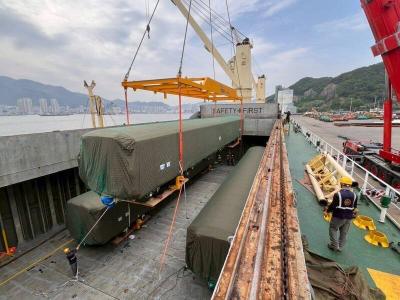
The first of 10 new high-capacity trains purchased from South Korea’s Hyundai Rotem arrived at the Port of Taipei yesterday to meet the demands of an expanding metro network, Taipei Rapid Transit Corp (TRTC) said yesterday. The train completed a three-day, 1,200km voyage from the Port of Masan in South Korea, the company said. Costing NT$590 million (US$18.79 million) each, the new six-carriage trains feature a redesigned interior based on "human-centric" transportation concepts, TRTC said. The design utilizes continuous longitudinal seating to widen the aisles and optimize passenger flow, while also upgrading passenger information displays and driving control systems for a more comfortable
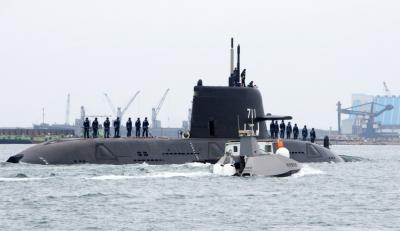
Taiwan's first indigenous defense submarine, the SS-711 Hai Kun (海鯤, or Narwhal), departed for its 13th sea trial at 7am today, marking its seventh submerged test, with delivery to the navy scheduled for July. The outing also marked its first sea deployment since President William Lai (賴清德) boarded the submarine for an inspection on March 19, drawing a crowd of military enthusiasts who gathered to show support. The submarine this morning departed port accompanied by CSBC Corp’s Endeavor Manta (奮進魔鬼魚號) uncrewed surface vessel and a navy M109 assault boat. Amid public interest in key milestones such as torpedo-launching operations and overnight submerged trials,
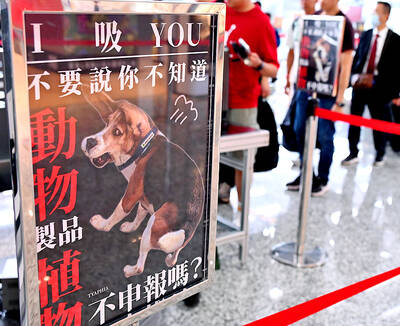
Quarantine awareness posters at Taiwan Taoyuan International Airport have gone viral for their use of wordplay. Issued by the airport branch of the Animal and Plant Health Inspection Agency, the posters feature sniffer dogs making a range of facial expressions, paired with advisory messages built around homophones. “We update the messages for holidays and campaign needs, periodically refreshing materials to attract people’s attention,” quarantine officials said. “The aim is to use the dogs’ appeal to draw focus to quarantine regulations.” A Japanese traveler visiting Taiwan has posted a photo on X of a poster showing a quarantine dog with a

Taiwan’s coffee community has launched a “one-person-one-e-mail” campaign, calling for people to send a protest-e-mail to the World Coffee Championships (WCC) urging it to redesignate Taiwanese competitors as from “Taiwan,” rather than “Chinese Taipei.” The call followed sudden action last week after the WCC changed all references to Taiwanese competitors from “Taiwan” to “Chinese Taipei,” including recent World Latte Art champion Bala (林紹興), who won the World Latte Art Championship in San Diego earlier this month. When Bala received the trophy, he was referred to as representing Taiwan, as well as in the announcement on the WCC’s Web site, until it


 RSS
RSS