


Taipei Mayor Ko Wen-je (柯文哲) yesterday accused US author Ethan Gutmann of defamation in a criminal complaint, after Gutmann called him a “liar” on Tuesday.
Gutmann, an investigative writer focusing on human rights, in 2014 published The Slaughter: Mass Killings, Organ Harvesting, and China’s Secret Solution to Its Dissident Problem, in which he describes the systematic harvesting of organs from Falun Gong followers in China.
The book cited an interview with Ko.
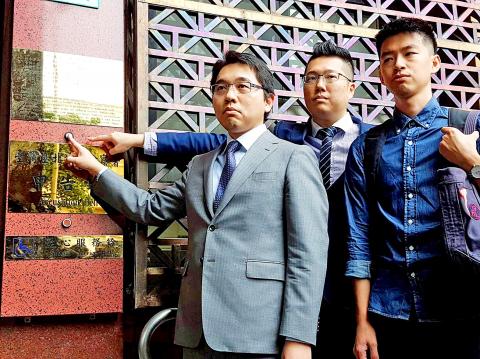
Photo: Hsieh Chun-lin, Taipei Times
At a news conference in Taipei on Tuesday, Gutmann said that Ko acted as a “middleman” for Taiwanese who went to China for organ transplants and that by teaching Chinese doctors the extracorporeal membrane oxygenation (ECMO) technique crucial for transplants, he offered a “pervasive incentive.”
When asked whether Ko is a “liar,” Gutmann replied “yes.”
It was not immediately clear to what the question was referring.
After a legal attestation letter was sent on Wednesday, Ko did not receive an apology from Gutmann within 24 hours, Ko campaign spokesperson Lin Kun-feng (林昆鋒) said yesterday, adding that lawyer Lu Cheng-yi (陸正義) would file a complaint with the Taipei District Prosecutors’ Office and sue the author for harming Ko’s reputation.
“Evidence should have been presented to back up the ‘liar’ accusation against Mayor Ko,” Lu said, adding that the comments were intended to smear Ko’s character and that the representing law firm was collecting evidence for further legal action.
Ko, as a politician, has always tolerated criticism on issues of public concern and does not file lawsuits lightly, but being called a liar poses a serious risk to his reputation and integrity, so he would not remain passive this time, Lu said.
“Mr Gutmann is an experienced independent journalist and a Nobel Peace Prize nominee, so Mayor Ko does not understand why Mr Gutmann, who has put years of hard work into investigative journalism, would call him a liar without evidence at an international news conference,” he added.
In an exclusive interview with the Chinese-language Liberty Times (sister newspaper of the Taipei Times) published yesterday, Gutmann said he was shocked earlier this year when a person — whom he could not name — sent him a photograph of Ko attending an ECMO conference in China in 2008.
Several participants in the conference were allegedly involved in organ harvesting, Gutmann said, adding that it felt like “a slap in the face.”
“ECMO is a life-saving device in democratic countries with a transparent medical system, but it is a huge problem in China,” he said.
The technique saves lives in Taiwan, the US, Japan and elsewhere, but in China, it also kills people, as it enables organ transplants, some of which go to foreign medical tourists, Gutmann said.
“You [Ko] may go into China with the best of intentions, you may want to save lives,” Gutmann said. “But when you realize your own work is being perverted … that is the time you leave China, you get away from it and wash your hands.”
“The best and sincere way to wash your hands is to talk about what you’ve seen and why you’ve left,” he added.
Gutmann said his dream is that his book would be circulated in China as samizdat, a Russian expression for copying and passing along banned literature.
Asked to comment on the issue at the Legislative Yuan yesterday, Minister of Health and Welfare Chen Shih-chung (陳時中) said: “I believe in evidence and I think there has been some speculation on the issue, but they should be supported by solid evidence, because after all, the issue touches on ethical problems.”
Questioning a person’s ethics is a serious matter and “you should not make improper inferences from speculation, but let the evidence speak for itself,” Chen said.
Chen was also asked to elaborate on remarks he made on Wednesday, when he said that hospitals would be required to complete an organ transplant registry for patients who have received organs in other countries.
The main purpose was to keep the information transparent and to make it clear where the organs are from, Chen said.
The policy would not retroactively be applied to past cases and no criminal investigations would be launched, but hospitals must fulfil the requirement before the end of the year, he said.
All hospitals in Taiwan should be capable of fully registering such information and if they fail to do so, it might give rise to human rights concerns, he said.
The ministry plans to withhold National Health Insurance funding for drugs in cases with incomplete registration to force hospitals to comply, he added.


UPGRADE: The Kang Ding-class frigate is replacing its Chaparall missiles with Tien Chien II and Hua Yang VLS, which would provide it with long-range, 360° air defense Taiwan plans to produce 1,200 to 1,376 Hai Chien II missiles (海劍二, Sea Sword II) — also known as TC-2N — to serve as the standard air defense system of the navy’s surface combatant fleet, a source said yesterday. Last week, the Hai Chien II, the naval version of the Tien Kung II missile (天劍二, Sky Sword II), completed a live-fire test in waters off the National Chungshan Institute of Science and Technology’s Jiupeng facility (九鵬) in Pingtung County’s Manjhou Township (滿州). The MIM72 Chaparral and other dated air defense missiles that currently arm Taiwanese ships have inadequate range to combat Chinese

REASONS FOR TRAVEL: An assistant professor said that proposed amendments to penalize drivers if they used drugs overseas would not deter people from traveling People who operate a motor vehicle under the influence of marijuana would have their driver’s license revoked, even if they used the substance while overseas, the Ministry of Transportation and Communications said yesterday, citing proposed amendments to the Road Traffic Management and Penalty Act (道路交通管理處罰條例). The amendments would also authorize the government to revoke the licenses of people determined to have used Category 1 or Category 2 narcotics, even if they were not operating a vehicle while under the influence of drugs, as well as ban them from taking the license test for three years, the ministry said. People aged 18 or
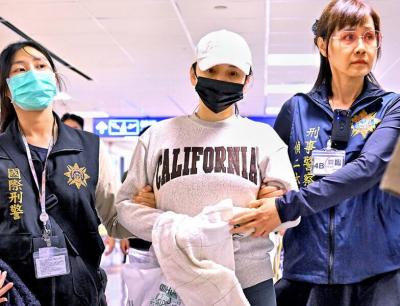
Johanne Liou (劉喬安), a Taiwanese woman who shot to unwanted fame during the Sunflower movement protests in 2014, returned to Taiwan last night after being deported from the US. She is to stand trial in Taiwan for charges involving embezzlement, fraud and drug crimes. The Criminal Investigation Bureau (CIB) said it took her into custody at Taiwan Taoyuan International Airport and would first question her before transferring her to the New Taipei District Prosecutors’ Office. She was arrested upon disembarking a flight from San Francisco that landed shortly before 7pm. Liou absconded to the US in 2019 after jumping bail
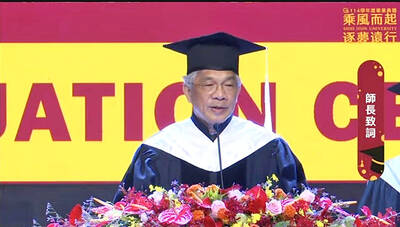
Shih Hsin University President Chen Ching-he (陳清河) yesterday issued a public apology for comments made in his commencement speech last week, stating that he has asked the school to suspend his duties and halt his wages for two months as a show of contrition. At the commencement ceremony on May 30, Chen said, “If you don’t manage your time well, or your own emotions, or your health, then I am telling every one of you — put a quick end to ‘you,’ because the world has no need for ‘you.’” The comments have sparked significant controversy online, and Chen through an open


 RSS
RSS