


The Keelung District Court yesterday convicted Liao Wei-chang (廖緯蒼), a local Bamboo Union gang boss, of smuggling firearms into Taiwan and handed him a 20-year prison term and a fine of NT$600,000 (US$19,563).
Investigators said they found that the firearms had come from the Philippines and were first shipped to Hong Kong before being transshipped to Taiwan under the guise of machinery equipment,
A task force made up of units from the prosecutors’ office, the Keelung Harbor Police Department, the Criminal Investigation Bureau and the Keelung branch of the Ministry of Justice Investigation Bureau worked on the case.
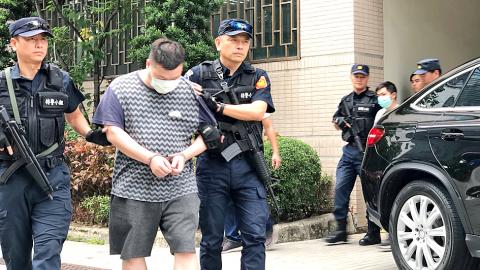
Photo: Chiu Chun-fu, Taipei Times
Investigators said it was one of the largest weapons smuggling case in recent years.
When the task force raided a warehouse in New Taipei City on May 5, they uncovered a total of 109 firearms — seven assault rifles and 102 various models of handguns along with more than 12,000 rounds of bullets.
Three other defendants were yesterday sentenced to between five and 15 years in prison for being accomplices in the crime, either by renting the warehouse, picking up the consignment at Keelung Harbor or providing other forms of assistance to Liao.
The judges convicted the defendants of contravening provisions of the Controlling Guns, Ammunition and Knives Act (槍砲彈藥刀械管制條例).
Liao’s punishment was considered heavy, albeit lighter than the prosecutors’ request for a life term, citing Liao’s refusal to divulge the source of the firearms and his foreign contacts, as well as the large number of firearms and ammunition, which posed a serious threat to public safety and social order.
After the raid on the warehouse, Liao took a flight to Malaysia the next day to avoid capture, then boarded another flight to Singapore on May 7 and stayed at a hotel, possibly to meet with other gangsters, the authorities said.
The task force asked the Ministry of Foreign Affairs to revoke Liao’s passport, and with information provided by Taiwanese authorities, Liao was arrested by Singaporean police a few days later.
In another development, Taichung police officers yesterday announced the result of their crackdown on organized crime over the past week, with 41 suspects taken in for questioning about their “violent conduct” related to loan shark operations, debt collection, blackmail, assault and other illegal activities.
Officials from the Taichung prosecutors’ office said the crackdown focused on specific local chapters of organized criminal groups and their local leaders, as part of a campaign to stop them from disrupting and destabilizing social order in the runup to the local elections next month.
The effort also resulted in the seizure of illegal items, including one assault rifle, three modified handguns, about 300 rounds of bullets and 1kg of miscellaneous types of narcotics, officials said.

Considering that most countries issue more than five denominations of banknotes, the central bank has decided to redesign all five denominations, the bank said as it prepares for the first major overhaul of the banknotes in more than 24 years. Central bank Governor Yang Chin-lung (楊金龍) is expected to report to the Legislative Yuan today on the bank’s operations and the redesign’s progress. The bank in a report sent to the legislature ahead of today’s meeting said it had commissioned a survey on the public’s preferences. Survey results showed that NT$100 and NT$1,000 banknotes are the most commonly used, while NT$200 and NT$2,000

The Centers for Disease Control (CDC) yesterday reported the first case of a new COVID-19 subvariant — BA.3.2 — in a 10-year-old Singaporean girl who had a fever upon arrival in Taiwan and tested positive for the disease. The girl left Taiwan on March 20 and the case did not have a direct impact on the local community, it said. The WHO added the BA.3.2 strain to its list of Variants Under Monitoring in December last year, but this was the first imported case of the COVID-19 variant in Taiwan, CDC Deputy Director-General Lin Ming-cheng (林明誠) said. The girl arrived in Taiwan on

South Korea is planning to revise its controversial electronic arrival card, a step Taiwanese officials said prompted them to hold off on planned retaliatory measures, a South Korean media report said yesterday. A Yonhap News Agency report said that the South Korean Ministry of Foreign Affairs is planning to remove the “previous departure place” and “next destination” fields from its e-arrival card system. The plan, reached after interagency consultations, is under review and aims to simplify entry procedures and align the electronic form with the paper version, a South Korean ministry official said. The fields — which appeared only on the electronic form

The Ministry of Foreign Affairs (MOFA) is suspending retaliation measures against South Korea that were set to take effect tomorrow, after Seoul said it is updating its e-arrival system, MOFA said today. The measures were to be a new round of retaliation after Taiwan on March 1 changed South Korea's designation on government-issued alien resident certificates held by South Korean nationals to "South Korea” from the "Republic of Korea," the country’s official name. The move came after months of protests to Seoul over its listing of Taiwan as "China (Taiwan)" in dropdown menus on its new online immigration entry system. MOFA last week


 RSS
RSS