


Public schools are invited to apply for solar panels for their rooftops, the Ministry of Education said yesterday, adding that it expects to add 12 megawatts (MW) of solar capacity with the program.
Building photovoltaic installations on rooftops would help schools reduce their carbon emissions, increase their budgets and teach students about renewable energy, the ministry said.
National Yunlin Special Education School has leased its roof to a company that installed 444 kilowatts (KW) of solar capacity, which were connected to the power grid in February, it said.
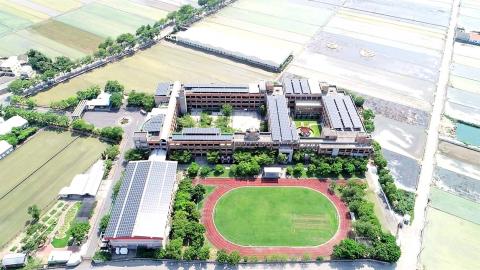
Photo courtesy of the Ministry of Education
Last month, it added 237KW in capacity, which it expects to link up by the end of the year, the ministry said.
The school stands on the northern Chianan Plain (嘉南平原) in southern Taiwan, where sunlight is abundant, school principal Lin Yi-wen (林逸文) said, adding that installing solar panels has reduced the school’s carbon footprint and represents a more efficient use of floor space.
A two-year Executive Yuan project promoting solar installations launched in 2016 aims for 44MW of photovoltaic capacity at public schools by the end of the year, about the yearly consumption of 12,763 households.
The ministry aims to install 12MW of capacity, which would add the equivalent of 3,473 households’ yearly power consumption to the grid.
In related developments, the Changhua County Government on Tuesday signed a contract with energy developer SAS Sunrise Inc (旭忠能源) to install solar-panel roofs over 110 school sports areas in the county over the next two years, county Commissioner Wei Ming-ku (魏明谷) said.
The county government stands to earn 3.5 percent of the income generated by the solar panels, while the construction costs of NT$700 million (US$22.79 million) are to be borne by the company, Wei said.
The roofs would shield students from sun and rain when exercising, he said.
The project is part of a three-stage county plan to promote renewable installations on campuses and follows a rooftop installation program under which participating schools are entitled to 24 percent of income from electricity sales.
Changhua has the best conditions in Taiwan for solar and wind power generation and its renewable energy policies could serve as an example for other municipalities, Deputy Minister of Education Fan Sun-lu (范巽綠) said.

Considering that most countries issue more than five denominations of banknotes, the central bank has decided to redesign all five denominations, the bank said as it prepares for the first major overhaul of the banknotes in more than 24 years. Central bank Governor Yang Chin-lung (楊金龍) is expected to report to the Legislative Yuan today on the bank’s operations and the redesign’s progress. The bank in a report sent to the legislature ahead of today’s meeting said it had commissioned a survey on the public’s preferences. Survey results showed that NT$100 and NT$1,000 banknotes are the most commonly used, while NT$200 and NT$2,000

The Centers for Disease Control (CDC) yesterday reported the first case of a new COVID-19 subvariant — BA.3.2 — in a 10-year-old Singaporean girl who had a fever upon arrival in Taiwan and tested positive for the disease. The girl left Taiwan on March 20 and the case did not have a direct impact on the local community, it said. The WHO added the BA.3.2 strain to its list of Variants Under Monitoring in December last year, but this was the first imported case of the COVID-19 variant in Taiwan, CDC Deputy Director-General Lin Ming-cheng (林明誠) said. The girl arrived in Taiwan on

South Korea is planning to revise its controversial electronic arrival card, a step Taiwanese officials said prompted them to hold off on planned retaliatory measures, a South Korean media report said yesterday. A Yonhap News Agency report said that the South Korean Ministry of Foreign Affairs is planning to remove the “previous departure place” and “next destination” fields from its e-arrival card system. The plan, reached after interagency consultations, is under review and aims to simplify entry procedures and align the electronic form with the paper version, a South Korean ministry official said. The fields — which appeared only on the electronic form

The Ministry of Foreign Affairs (MOFA) is suspending retaliation measures against South Korea that were set to take effect tomorrow, after Seoul said it is updating its e-arrival system, MOFA said today. The measures were to be a new round of retaliation after Taiwan on March 1 changed South Korea's designation on government-issued alien resident certificates held by South Korean nationals to "South Korea” from the "Republic of Korea," the country’s official name. The move came after months of protests to Seoul over its listing of Taiwan as "China (Taiwan)" in dropdown menus on its new online immigration entry system. MOFA last week


 RSS
RSS