


The Yunlin County Government on Monday rejected the Central Weather Bureau’s construction permit request for a weather radar station in Kouhu Township (口湖) after more than 100 protesters rallied to demand a halt to the project.
The project had long been contentious with township residents who are worried about potential radiation emissions, former Chinese Nationalist Party (KMT) lawmaker Chang Chia-chun (張嘉郡) said during the rally.
The bureau and the county government have ignored the repeated pleas that she made when she was a lawmaker to drop the plan, Chang said.
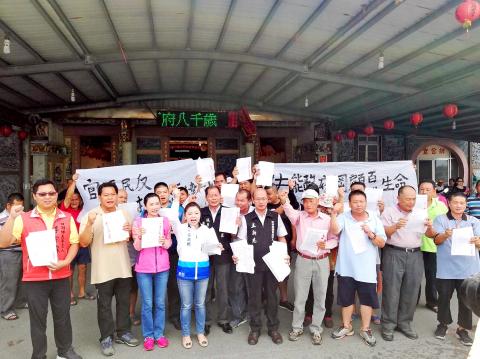
Photo: Liao Shu-ling, Taipei Times
The government needs to hold public hearings to allay residents’ concerns before making a decision, she said.
The proposed station is too close to a residential area and the bureau moved a similar station from Pingtung County to Kaohsiung after health concerns were raised about its radiation emissions, Independent Yunlin County Councilor Huang Wen-hsiang (黃文祥) said.
Local opposition to the project is not surprising, because the bureau has been not been transparent about the effect of such a station on public health, said Tsai Meng-chen (蔡孟真), another independent councilor.
“The bureau should conduct a town hall meeting to explain this as soon as possible,” she said.
Yunlin Economic Affairs Department Director Lin Chang-tsao (林長造), who arrived at the rally later, told the protesters that the proposed station was part of the bureau’s planned network of storm detection radars.
The system, which the then-KMT government approved in 2014, was supposed to reduce detection time by one to three hours, which would help mitigate losses of life and property, he said.
However, since local residents have misgivings about the project, the county government has decided to reject the bureau’s application, he said.
The department would ask the National Communications Commission, whose remit includes the regulation of magnetic wave emissions, to conduct studies on the health impact of the proposed station, Lin said.

Considering that most countries issue more than five denominations of banknotes, the central bank has decided to redesign all five denominations, the bank said as it prepares for the first major overhaul of the banknotes in more than 24 years. Central bank Governor Yang Chin-lung (楊金龍) is expected to report to the Legislative Yuan today on the bank’s operations and the redesign’s progress. The bank in a report sent to the legislature ahead of today’s meeting said it had commissioned a survey on the public’s preferences. Survey results showed that NT$100 and NT$1,000 banknotes are the most commonly used, while NT$200 and NT$2,000

The Centers for Disease Control (CDC) yesterday reported the first case of a new COVID-19 subvariant — BA.3.2 — in a 10-year-old Singaporean girl who had a fever upon arrival in Taiwan and tested positive for the disease. The girl left Taiwan on March 20 and the case did not have a direct impact on the local community, it said. The WHO added the BA.3.2 strain to its list of Variants Under Monitoring in December last year, but this was the first imported case of the COVID-19 variant in Taiwan, CDC Deputy Director-General Lin Ming-cheng (林明誠) said. The girl arrived in Taiwan on

South Korea is planning to revise its controversial electronic arrival card, a step Taiwanese officials said prompted them to hold off on planned retaliatory measures, a South Korean media report said yesterday. A Yonhap News Agency report said that the South Korean Ministry of Foreign Affairs is planning to remove the “previous departure place” and “next destination” fields from its e-arrival card system. The plan, reached after interagency consultations, is under review and aims to simplify entry procedures and align the electronic form with the paper version, a South Korean ministry official said. The fields — which appeared only on the electronic form

The Ministry of Foreign Affairs (MOFA) is suspending retaliation measures against South Korea that were set to take effect tomorrow, after Seoul said it is updating its e-arrival system, MOFA said today. The measures were to be a new round of retaliation after Taiwan on March 1 changed South Korea's designation on government-issued alien resident certificates held by South Korean nationals to "South Korea” from the "Republic of Korea," the country’s official name. The move came after months of protests to Seoul over its listing of Taiwan as "China (Taiwan)" in dropdown menus on its new online immigration entry system. MOFA last week


 RSS
RSS