


Liberty Times (LT): In 2002, you became a gymnastics coach at Gong Jheng Elementary School in Yilan County’s Luodong Township (羅東). In the 2005 documentary Jump! Boys (翻滾吧!男孩) [directed by Lin Yu-hsin’s younger brother, Lin Yu-hsien (林育賢)] you said your dream was to help the boys on your team compete in the Olympics one day. How did you achieve that dream?
Lin Yu-hsin (林育信): At the time, my younger brother was unemployed and visited me at the school. He was amazed when he saw that the seven children would leave practice every day crying from all the stretching, but still happily returned the next day. He was deeply touched by the children’s endurance and ability to continue challenging themselves after they had experienced pain and setbacks, and decided to film a documentary on the subject.
A little greedy at the time, I said the group of children would compete at the Olympics in the future. At the time, I simply wanted to encourage my younger brother to continue filming the documentary.
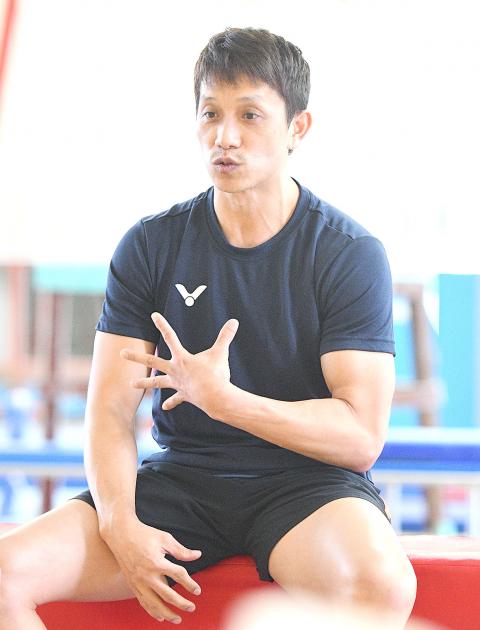
Photo: Huang Chih-yuan, Taipei Times
Fortunately, we won many medals throughout the year-long filming process, and the documentary had a happy ending. It recorded the children starting from nothing to competing and winning medals.
When the film crew interviewed the children at the time, they said they wanted to participate at the Olympics.
Over the past 10-plus years, there have been many unforgettable experiences. Four of the seven trainees in that group are still doing gymnastics.
I remember once, after the documentary had been released in 2005, we were at a competition and the seven children had lined up to perform, but there was one extra person no matter how many times I counted.
That extra person was Tang Chia-hung (唐嘉鴻). He originally lived in Taipei. After watching the documentary, he wanted to train with the boys in Jump! Boys. His mother quit her job and brought him to Yilan County to join us.
Tang is very smart and intuitive. He is comfortable in the air and does not get stage fright. He is a very special athlete.
At the time, I had a 10-year plan. After we had won medals at domestic competitions, we would prepare for international events. Coincidentally, my alma mater, National Taiwan Sport University, had invited me to teach there many times. So I left Yilan County and went to Taoyuan.
Tang, whose family lives in Taipei, came with me first, and Lee Chih-kai (李智凱) joined us a year later. I bought a new car, drove them to their high school in the morning and in the afternoon picked them up for practice at the university. They trained with the nation’s top athletes and improved very quickly.
Later, Tang enrolled at National Taiwan Normal University (NTNU). NTNU took very good care of him.
However, our participation at international competitions has not gone very smoothly due to injuries and accidents.
In 2016, we went to the Olympics [in Rio de Janeiro] to broaden our perspective and fell hard [Lee fell from a pommel horse during the qualification rounds]. At this year’s Asian Games [in Jakarta], we finally achieved a satisfactory result.
Our next aim is the 2020 Tokyo Olympics.
LT: Lee and Tang delivered nearly perfect performances at the Asian Games this year. Coincidentally, they both defeated Chinese athletes to win gold. What was going on in your mind during the medal ceremonies, when the Chinese Taipei Olympic flag was raised higher than China’s national flag?
Lin: I was extremely happy. A goal we worked toward was inspiring people after Taiwan’s diplomatic defeats, boosting national unity and confidence. I am pleased that we accomplished it. I did not imagine we could also become a strong nation when it comes to gymnastics.
Honestly speaking, after all, the majority of Taiwanese gymnastics is learned from China. It was not easy to surpass the Chinese athletes this time and it was also the first time we did so at an international competition.
Lee and Tang’s performances were truly outstanding. Shortly after they completed their performances, the Chinese coaches and athletes took the initiative to come over and shake their hands.
The Chinese coach said: “You have improved too quickly!”
LT: Lee and Tang’s performance at this year’s Asian Games is sure to make them the hypothetical opponents for other gymnasts. How would you help them maintain their advantage for Tokyo?
Lin: Lee’s qualification to compete in Rio de Janeiro was the first time in the history of gymnastics in the nation that we actually qualified for the Olympics via qualification competitions.
However, it is not so easy to make a lasting impression on the international stage, as everyone is fighting for the same medal.
At the time, Taiwan was not well known internationally for its gymnastics and Lee was not quite prepared for the event psychologically.
What we took away from the 2016 Games was the necessity and importance of establishing a name for Lee at an international level and the best way to do so was through Lee’s signature performance of the “Thomas Flair” move.
Lee’s performance and grasp of the move received second place in the first four out of five world tour competitions after the conclusion of the Taipei Summer Universiade in August last year.
It was not until the competition in Croatia early this year that the international judges said that if there were no mistakes made in the execution of the move — only 0.9 could be deducted from the score.
Through these competitions, the once-shy Lee now exudes confidence and this has been beneficial toward his overall performance, as could be seen at this year’s Asian Games.
The most important preparation for Tokyo is to be among the top 24 teams at the Artistic Gymnastics World Championships to be held in Doha next month then be included in the top 12 teams in the second stage next year.
If we achieve this goal, we would be able to attend the Olympics for the team events, as well as the individual events. Should be we unable to obtain qualifications for the team events, it would be more difficult to obtain qualifications for individual events.
All five of our athletes — Lee, Tang, Hsu Ping-chien (徐秉謙), Yu Chao-wei (游朝偉) and Hsiao Yu-jan (蕭佑然) — are attempting to qualify.
LT: What are your demands of the athletes? How do you stimulate them and develop their potential?
Lin: I am exactly the man as portrayed in the documentary: a strict coach. I demand the aesthetics of a move and the posture involved to attain the level of perfection I envisage. If it does not meet that, I keep at them.
I make such demands because that is the rule of the game. If one cannot meet the most basic elements, one will have points deducted. For example, the minute details of keeping your ankles touching when standing on the top of your toes is something that must be drilled into gymnasts from a young age.
It takes time to adjust and grow into the habit and one must start young, for it is impossible to change once you are grown. To not do so would reduce your performance to a circus act.
From another point of view, strictly enforced demands ensure that children are focused when training and this cuts the chances of injuries.
I often feel blessed to have a natural affinity for gymnastics. It allows me to see the unique traits of athletes, which helps me implement better training regimens.
LT: You and Lee have been in the spotlight because of two sequels to the documentary. Has this affected you in any way?
Lin: It is difficult for the average person to understand the processes that go into daily training and I think the documentary and its sequels’ greatest significance is that they allow the public to understand the difficulties involved in training a gymnast.
The documentaries not only portray the difficulties, but also motivate others to do the same. At the same time, they have increased people’s knowledge of gymnastics and led more people to devote themselves to the sport, which means we have more potential candidates for international competitions.
Lee has come far from his humble origins as a child of a family selling produce at a traditional market, but despite his current status, one must always keep in mind that they are just athletes.
He must not lose his grasp of reality after coming to fame, for we have no room for mistakes in the preparations for 2020.
Translated by staff writers Sherry Hsiao and Jake Chung

NATIONAL SECURITY: Authorities are working to confirm the identities of the military personnel involved and investigating possible illegal conduct and regulatory violations Authorities are probing possible national security implications after Kinmen police and immigration officers on Sunday found a Chinese woman allegedly posing as a tourist while engaging in prostitution involving more than 10 military personnel. The woman, surnamed Chen (陳), has since been deported, authorities said, adding that investigators are still working to confirm the identities of those implicated, as the records only listed code names and aliases. The case stemmed from a report received by the Kinmen District Prosecutors’ Office on Friday last week from the Jinhu Precinct of the Kinmen County Police Bureau. On Sunday, police, along with the National Immigration

REASONS FOR TRAVEL: An assistant professor said that proposed amendments to penalize drivers if they used drugs overseas would not deter people from traveling People who operate a motor vehicle under the influence of marijuana would have their driver’s license revoked, even if they used the substance while overseas, the Ministry of Transportation and Communications said yesterday, citing proposed amendments to the Road Traffic Management and Penalty Act (道路交通管理處罰條例). The amendments would also authorize the government to revoke the licenses of people determined to have used Category 1 or Category 2 narcotics, even if they were not operating a vehicle while under the influence of drugs, as well as ban them from taking the license test for three years, the ministry said. People aged 18 or

GLOBALGIVING: ‘ Caving to external pressure is not acceptable for an organization that has cultivated justice reform and human rights for 30 years,’ one NGO said A slew of non-government organizations (NGOs) have withdrawn from the GlobalGiving fundraising platform after it announced it would use “Chinese Taipei” instead of “Taiwan” from next month. The Taiwan Good Rice Association wrote on Facebook on Friday that it was informed on April 28 via a teleconference call of the change, which was made because the platform wanted to operate in China. Taiwan Good Rice is to terminate all cooperative relationships with GlobalGiving in response to the platform’s “unilateral and non-negotiable” decision to remove references to Taiwan, the NGO said. “Taiwan is in the official name of Taiwan Good Rice Association and the

HEAVY WEATHER: Typhoon Jangmi is due to crash straight into the Ryukyus as airlines look to shift flights to larger aircraft or cancel flights to Okinawa entirely Taiwan’s international air carriers announced flight adjustments over the weekend as Typhoon Jangmi is forecast to hit the Ryukyu Islands today and tomorrow. The Central Weather Administration (CWA) upgraded Jangmi from a tropical storm to a typhoon at 8am yesterday, with the eye located 580km south of Naha city. It was moving north at 19kph. Today, China Airlines’ CI-120, CI-121, CI-122 and CI-123 flights between Taoyuan and Naha, Okinawa, have been canceled as well as CI-132 and CI-133 between Kaohsiung and Naha. EVA Air’s BR-112, BR-113, BR-186 and BR-185 flights between Taoyuan and Naha are also canceled. Low-cost carrier Tigerair Taiwan canceled IT-230,


 RSS
RSS