


The Chinese Nationalist Party (KMT), the Tainan Association for Comfort Women’s Rights and pro-unification groups yesterday protested outside the Japan-Taiwan Exchange Association in Taipei, requesting an apology over an “assault” on a statue of a “comfort woman” in Tainan by a Japanese nationalist last week.
The statue, which the KMT’s Tainan chapter and association erected last month, commemorates victims of sexual exploitation by the Imperial Japanese army during Word War II.
KMT Tainan City Councilor Hsieh Lung-chieh (謝龍介), who organized the protest, on Sunday posted a video on Facebook showing Mitsuhiko Fujii, who visited Taiwan reportedly representing 16 Japanese right-wing groups, allegedly kicking the statue.
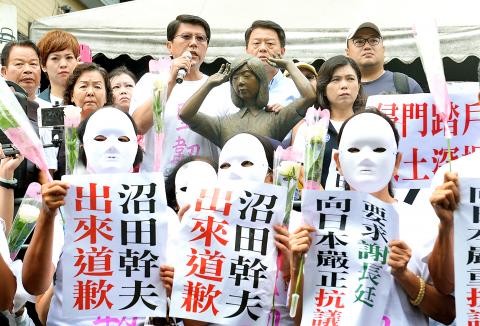
Photo: Lin Cheng-kung, Taipei Times
About 90 people, including Hsieh, KMT legislators Alicia Wang (王育敏) and Arthur Chen (陳宜民), Taipei City councilor candidates Chung Pei-chun (鍾沛君), Hsu Chiao-hsin (徐巧芯) and Yu Shu-hui (游淑慧), and Tainan City councilors Tsai Shu-hui (蔡淑惠) and Hung Yu-feng (洪玉鳳), rallied outside the Japanese representative office in Taipei, calling for an apology from Japanese Representative to Taiwan Mikio Numata and demanding that Fujii be barred from leaving the nation until he apologizes in front of the statute.
They also called on Representative to Japan Frank Hsieh (謝長廷) to lodge a formal complaint with Japanese Prime Minister Shinzo Abe.
Protesters wore white T-shirts with the word “strength” and carried white roses.
“As women, and as members of a democracy, why would we not have the right to set up a statue for comfort women? The purpose of the statue is to educate people about history and not to cause hatred and conflict,” association president Huang Shu-chen (黃淑貞) said.
Japan should face up to its own history, she said, adding that she hopes the only two known comfort women surviving today would have a chance to receive a formal apology from Japan in their lifetime.
New Party spokesman Wang Ping-chung (王炳忠) also took part in the protest, but remained in a campaign truck throughout.
Some of the protesters threw eggs at the building, but most were prevented from doing so by a net that police had set up.
After about half an hour, a Japanese official came out to receive a letter of complaint from the KMT.
When asked to comment, the exchange association said that it had no comment on the issue.
At about 6pm, China Unification Promotion Party member Lee Cheng-lung (李承龍) and three other party members allegedly splashed paint on the front of the exchange association’s offices.
The four were detained by police for questioning.
The exchange association last month in a statement responded to the erection of the comfort woman statue, saying that all matters related to comfort women are handled through the Asian Women’s Fund.
The fund, established in 1994, offers compensation and medical support to former comfort women, along with a letter of apology from the Japanese government, it said.
The Japanese government understands that the reputation and dignity of former comfort women have been hurt, it said, adding that it has been handling the issue with sincerity and would continue to do so.
This story has been corrected since it was first published.

Considering that most countries issue more than five denominations of banknotes, the central bank has decided to redesign all five denominations, the bank said as it prepares for the first major overhaul of the banknotes in more than 24 years. Central bank Governor Yang Chin-lung (楊金龍) is expected to report to the Legislative Yuan today on the bank’s operations and the redesign’s progress. The bank in a report sent to the legislature ahead of today’s meeting said it had commissioned a survey on the public’s preferences. Survey results showed that NT$100 and NT$1,000 banknotes are the most commonly used, while NT$200 and NT$2,000

The Centers for Disease Control (CDC) yesterday reported the first case of a new COVID-19 subvariant — BA.3.2 — in a 10-year-old Singaporean girl who had a fever upon arrival in Taiwan and tested positive for the disease. The girl left Taiwan on March 20 and the case did not have a direct impact on the local community, it said. The WHO added the BA.3.2 strain to its list of Variants Under Monitoring in December last year, but this was the first imported case of the COVID-19 variant in Taiwan, CDC Deputy Director-General Lin Ming-cheng (林明誠) said. The girl arrived in Taiwan on

South Korea is planning to revise its controversial electronic arrival card, a step Taiwanese officials said prompted them to hold off on planned retaliatory measures, a South Korean media report said yesterday. A Yonhap News Agency report said that the South Korean Ministry of Foreign Affairs is planning to remove the “previous departure place” and “next destination” fields from its e-arrival card system. The plan, reached after interagency consultations, is under review and aims to simplify entry procedures and align the electronic form with the paper version, a South Korean ministry official said. The fields — which appeared only on the electronic form

The Ministry of Foreign Affairs (MOFA) is suspending retaliation measures against South Korea that were set to take effect tomorrow, after Seoul said it is updating its e-arrival system, MOFA said today. The measures were to be a new round of retaliation after Taiwan on March 1 changed South Korea's designation on government-issued alien resident certificates held by South Korean nationals to "South Korea” from the "Republic of Korea," the country’s official name. The move came after months of protests to Seoul over its listing of Taiwan as "China (Taiwan)" in dropdown menus on its new online immigration entry system. MOFA last week


 RSS
RSS