


Chio Tian Folk Drums and Arts Troupe founder Hsu Chen-jung (許振榮) said he is working on a doctorate because the Executive Yuan’s Council for Cultural Affairs does not respect the troupe.
Hsu on June 9 submitted his doctoral thesis to Chaoyang University of Technology’s College of Management. He must pass his oral defense next month before he can be conferred a doctorate in Industrial Development Strategy.
Hsu said he received a great deal of support from assistant professor Lin Mao-hsien (林茂賢), who teaches Taiwanese languages and literature at National Taichung University of Education.
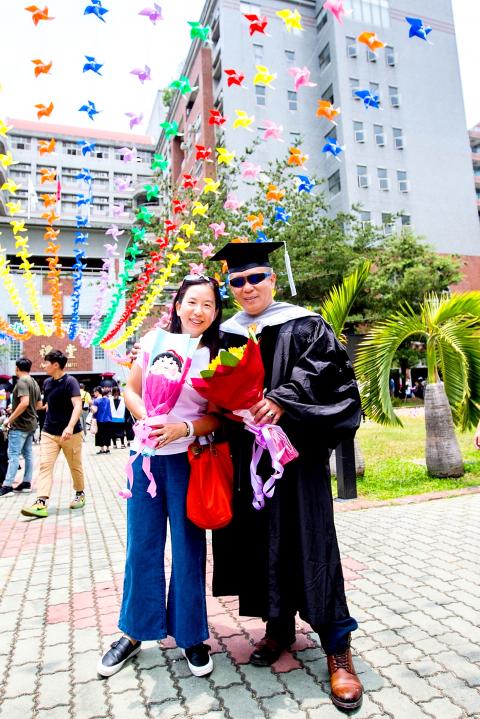
Photo courtesy of the Chio Tian Folk Drums and Arts Troupe
With Lin’s encouragement, he was determined to succeed, Hsu said, adding that his greatest hope is to change the “stubborn mindset” of professional academics and to allow young people in the performance arts to have the opportunity to stand out.
Hsu, 53, started the troupe 24 years ago, accepting troubled teenagers and those from low-income families, and teaching them to play drums as a way to release energy.
As the drummers grew more proficient, they became recognized within the performing arts sphere and started receiving invitations to perform in Taiwan and abroad.
In 2012, the story of the troupe became the subject of the 20th Century Fox film Din Tao: Leader of the Parade (陣頭) directed by Taiwanese director Feng Kai (馮凱).
However, when Hsu applied to the council 12 years ago for recognition of the troupe as one of the nation’s outstanding performance groups, the council rejected his application on the grounds that he had only a high-school education, and the majority of the troupe were junior-high school graduates.
The council viewed him as a gang leader, rather than as performance troupe leader, and used a hostile tone with him, he said, adding that he could not accept such an insult.
He spent the following 12 years completing an undergraduate program, obtaining a master’s degree and going through the doctoral program.
“Only through education can [you] change the current state of things,” Hsu quoted Lin as telling him.
Hsu required that the troupe’s main leadership all acquire at least master’s degrees, himself completing courses at Mingdao University, Ling Tung University — as well as an EMBA at Ling Tung University — and Chaoyang University of Technology.
At one point, he thought he might give up, Hsu said, citing an exhausting work and study schedule that left him with no down time.
However, realizing that he must set an example for his son, who had just been accepted to attend Taipei National University of the Arts, he persisted, Hsu said.
Assistant troupe leaders Lee Kuang-cheng (李光正) and Chen Shih-min (陳世旻), as well as Hsu’s son, who is responsible for creative direction, have all obtained master’s degrees, he said, adding that Lee is to start a doctoral program later this year.
Hsu has been accepted into the Public Construction Commission’s list of experts, and said he looks forward to assisting young people.

Considering that most countries issue more than five denominations of banknotes, the central bank has decided to redesign all five denominations, the bank said as it prepares for the first major overhaul of the banknotes in more than 24 years. Central bank Governor Yang Chin-lung (楊金龍) is expected to report to the Legislative Yuan today on the bank’s operations and the redesign’s progress. The bank in a report sent to the legislature ahead of today’s meeting said it had commissioned a survey on the public’s preferences. Survey results showed that NT$100 and NT$1,000 banknotes are the most commonly used, while NT$200 and NT$2,000

The Centers for Disease Control (CDC) yesterday reported the first case of a new COVID-19 subvariant — BA.3.2 — in a 10-year-old Singaporean girl who had a fever upon arrival in Taiwan and tested positive for the disease. The girl left Taiwan on March 20 and the case did not have a direct impact on the local community, it said. The WHO added the BA.3.2 strain to its list of Variants Under Monitoring in December last year, but this was the first imported case of the COVID-19 variant in Taiwan, CDC Deputy Director-General Lin Ming-cheng (林明誠) said. The girl arrived in Taiwan on

South Korea is planning to revise its controversial electronic arrival card, a step Taiwanese officials said prompted them to hold off on planned retaliatory measures, a South Korean media report said yesterday. A Yonhap News Agency report said that the South Korean Ministry of Foreign Affairs is planning to remove the “previous departure place” and “next destination” fields from its e-arrival card system. The plan, reached after interagency consultations, is under review and aims to simplify entry procedures and align the electronic form with the paper version, a South Korean ministry official said. The fields — which appeared only on the electronic form

The Ministry of Foreign Affairs (MOFA) is suspending retaliation measures against South Korea that were set to take effect tomorrow, after Seoul said it is updating its e-arrival system, MOFA said today. The measures were to be a new round of retaliation after Taiwan on March 1 changed South Korea's designation on government-issued alien resident certificates held by South Korean nationals to "South Korea” from the "Republic of Korea," the country’s official name. The move came after months of protests to Seoul over its listing of Taiwan as "China (Taiwan)" in dropdown menus on its new online immigration entry system. MOFA last week


 RSS
RSS