


As President Tsai Ing-wen (蔡英文) reaches the half-way mark in her first term tomorrow, she is under growing pressure from a public tired of economic stagnation, but critical of her reform efforts.
An increasingly aggressive Beijing is tightening the screws on Taiwan diplomatically and saber rattling with military drills, but the biggest protests in Taipei in recent months have not been about China relations, which have triggered mass rallies in the past.
Instead, thousands of military veterans and other civil servants have regularly gathered outside parliament in emotional displays against pension cuts. The rallies have seen physical attacks on journalists and the death of a retired colonel, who fell from a wall during a protest.
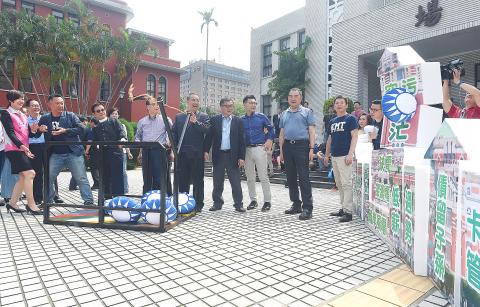
Photo: Liao Chen-huei, Taipei Times
Tsai has labeled the cuts “painful, but necessary” to prevent public-sector pension schemes from collapsing and dragging down government finances.
Some pension funds could go bankrupt as early as 2020 if the system is not overhauled, the government has said.
Tsai has said she will press ahead with reforms, arguing that the public will see benefits over time.
Her moves to revise labor laws, including scaling back public holidays, have also touched a nerve in Taiwan, where salaries have risen little since the 1990s.
“The government has many loud slogans, but the policies and reforms have not been well-executed and that lowers public confidence in them,” non-governmental organization worker Wu Cheng-cheng (吳澄澄), 28, said.
When Tsai took office in May 2016, her approval rating stood at 70 percent, with wage hikes and improved working conditions part of her election pledge. Her popularity has since waned, with the economy topping the list of public gripes.
A recent poll by TVBS put her approval rating as low as 26 percent, although other surveys found it to be more than 50 percent.
Andie Huang, a 36-year-old office worker, said she believes that Tsai should “stick to what she’s doing,” but hopes for better treatment of workers.
“Our salaries are low and commodity prices are high. We can’t afford to buy houses,” she told reporters.
Taiwan’s economy is estimated to have grown 3.04 percent year-on-year in the first quarter this year, but analysts said the data mean little to regular people, who are struggling to make ends meet as the cost of living soars.
Labor groups blame companies for being unwilling to raise salaries and share profits.
The legal minimum monthly wage stands at NT$22,000 (US$735.49) compared with NT$15,840 20 years ago.
Young voters like Carter Chen, 21, questioned whether Tsai can fulfill her promises to boost the economy for ordinary people.
He said his own daily life issues far outweigh any concern over Taiwan’s political relations with China, which have deteriorated under the Beijing-sceptic government and often grab headlines.
“Right now many young people can’t even make a decent living,” Chen said, referring to the NT$25,000 starting monthly salary for college graduates, which has remained flat for about two decades. “I don’t have the time and energy to worry about unification, independence or sovereignty issues.”
However, some still believe that better China ties are key to prosperity, as Taiwan’s export-driven economy relies on Chinese business.
“The most important thing is to boost the economy and to do that we have to be on friendly terms with China,” said Chen Bo-lin, 41, who works for a state-owned company.
The Chinese Nationalist Party (KMT) is still on the back foot after a disastrous election in 2016, which saw it lose both the presidency and its majority in parliament, but observers said that Tsai needs to be careful that economic woes do not spark a resurgence.
The main challenge in the remainder of her term will be to “deliver measurable improvements to the economy and ease public discontent” so as not to give fuel to the KMT, National Cheng Kung University associate professor of political science Meng Chih-cheng (蒙志成) said.
Local elections in November will be a major test.
If Tsai’s Democratic Progressive Party fails to perform well, some analysts said the party might consider fielding a different candidate for the 2020 presidential election.
However, moves such as pension reform have been a brave step that previous governments failed to tackle, said Dafydd Fell, director of the Centre of Taiwan Studies at the University of London’s School of Oriental and African Studies.
He described Tsai’s performance as “mixed,” but said she was not at risk of becoming a lame duck president.
“Her key challenge for 2020 will be to complete many of the reforms she has started or promised, so that she can make the argument [that] she deserves re-election,” Fell said.


UPGRADE: The Kang Ding-class frigate is replacing its Chaparall missiles with Tien Chien II and Hua Yang VLS, which would provide it with long-range, 360° air defense Taiwan plans to produce 1,200 to 1,376 Hai Chien II missiles (海劍二, Sea Sword II) — also known as TC-2N — to serve as the standard air defense system of the navy’s surface combatant fleet, a source said yesterday. Last week, the Hai Chien II, the naval version of the Tien Kung II missile (天劍二, Sky Sword II), completed a live-fire test in waters off the National Chungshan Institute of Science and Technology’s Jiupeng facility (九鵬) in Pingtung County’s Manjhou Township (滿州). The MIM72 Chaparral and other dated air defense missiles that currently arm Taiwanese ships have inadequate range to combat Chinese

REASONS FOR TRAVEL: An assistant professor said that proposed amendments to penalize drivers if they used drugs overseas would not deter people from traveling People who operate a motor vehicle under the influence of marijuana would have their driver’s license revoked, even if they used the substance while overseas, the Ministry of Transportation and Communications said yesterday, citing proposed amendments to the Road Traffic Management and Penalty Act (道路交通管理處罰條例). The amendments would also authorize the government to revoke the licenses of people determined to have used Category 1 or Category 2 narcotics, even if they were not operating a vehicle while under the influence of drugs, as well as ban them from taking the license test for three years, the ministry said. People aged 18 or
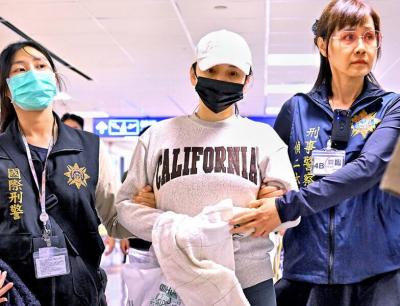
Johanne Liou (劉喬安), a Taiwanese woman who shot to unwanted fame during the Sunflower movement protests in 2014, returned to Taiwan last night after being deported from the US. She is to stand trial in Taiwan for charges involving embezzlement, fraud and drug crimes. The Criminal Investigation Bureau (CIB) said it took her into custody at Taiwan Taoyuan International Airport and would first question her before transferring her to the New Taipei District Prosecutors’ Office. She was arrested upon disembarking a flight from San Francisco that landed shortly before 7pm. Liou absconded to the US in 2019 after jumping bail
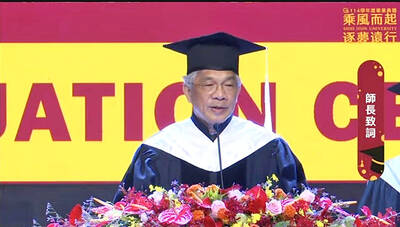
Shih Hsin University President Chen Ching-he (陳清河) yesterday issued a public apology for comments made in his commencement speech last week, stating that he has asked the school to suspend his duties and halt his wages for two months as a show of contrition. At the commencement ceremony on May 30, Chen said, “If you don’t manage your time well, or your own emotions, or your health, then I am telling every one of you — put a quick end to ‘you,’ because the world has no need for ‘you.’” The comments have sparked significant controversy online, and Chen through an open


 RSS
RSS