


Over-consumption of processed meats could increase children’s risk of malignant tumors and their chances of contracting leukemia, a Cancer Care foundation survey on elementary-school children’s dietary habits said on Thursday.
More than 94 percent of students questioned were in the habit of consuming drinks with a high sugar content, and 91 percent habitually have deep-dried food, the survey said.
Of those students drinking sugary drinks, 83 percent said their parents prepared the drinks for them, the questionnaire found.
The foundation said that of greater concern was that 85 percent of students ate processed meats more than once a week.
Foundation president Chen Yueh-ching (陳月卿) said that sugary drinks tend to make it harder for school children to concentrate and consumption of deep-fried foods is directly linked to increased weight in children.
Chen said that parents should lead by example when establishing proper dietary habits for children, adding that parents should not give children sugary drinks as it fosters unhealthy habits.
Processed meat has been classified by the WHO as Group 1 — carcinogenic to humans — Chen said, adding that many Taiwanese parents are unaware that pork floss, ham and burger patties are considered process meats.
While Group 1 carcinogens also include tobacco, a WHO question-and-answer article on the carcinogenicity of the consumption of red meat and processed meat published on its Web site in October 2015 states that: “This does not mean that they are all equally dangerous. The IARC [International Agency for Research on Cancer] classifications describe the strength of the scientific evidence about an agent being a cause of cancer, rather than assessing the level of risk.”
Nutritionist Lin Yu-ting (林郁婷) cited the results of a Kaohsiung Medical University research paper stating that consumption of processed meats more than once per week is liable to increase an individual’s risk of developing leukemia by 74 percent.
Children should avoid processed meats to reduce their risk of becoming afflicted with cancer, Lin said.
A healthy meal for children should include 30 percent whole grains, 30 percent vegetables, 20 percent good protein and 20 percent fruits, Lin said, adding that sugary drinks should be substituted with fruit juice.
Lin encouraged families to buy fresh food when making meals and avoid dining out, adding that such practices reduce the risk of developing cancer.
The questionnaire, given to parents and children from third to sixth grade in Taipei, New Taipei City, Taichung and Kaohsiung, began in February last year and was concluded in January, the foundation said, adding that it received 30,164 valid questionnaires.


An essay competition jointly organized by a local writing society and a publisher affiliated with the Chinese Communist Party (CCP) might have contravened the Act Governing Relations Between the People of the Taiwan Area and the Mainland Area (臺灣地區與大陸地區人民關係條例), the Mainland Affairs Council (MAC) said on Thursday. “In this case, the partner organization is clearly an agency under the CCP’s Fujian Provincial Committee,” MAC Deputy Minister and spokesperson Liang Wen-chieh (梁文傑) said at a news briefing in Taipei. “It also involves bringing Taiwanese students to China with all-expenses-paid arrangements to attend award ceremonies and camps,” Liang said. Those two “characteristics” are typically sufficient
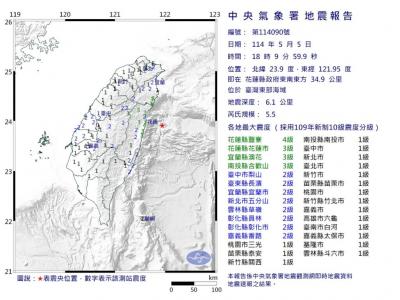
A magnitude 5.9 earthquake that struck about 33km off the coast of Hualien City was the "main shock" in a series of quakes in the area, with aftershocks expected over the next three days, the Central Weather Administration (CWA) said yesterday. Prior to the magnitude 5.9 quake shaking most of Taiwan at 6:53pm yesterday, six other earthquakes stronger than a magnitude of 4, starting with a magnitude 5.5 quake at 6:09pm, occurred in the area. CWA Seismological Center Director Wu Chien-fu (吳健富) confirmed that the quakes were all part of the same series and that the magnitude 5.5 temblor was
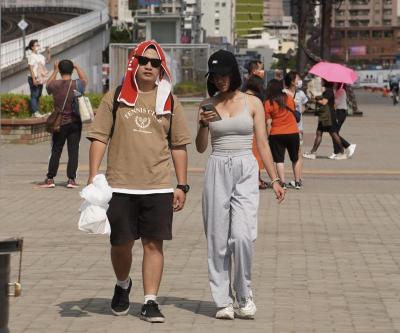
The Central Weather Administration has issued a heat alert for southeastern Taiwan, warning of temperatures as high as 36°C today, while alerting some coastal areas of strong winds later in the day. Kaohsiung’s Neimen District (內門) and Pingtung County’s Neipu Township (內埔) are under an orange heat alert, which warns of temperatures as high as 36°C for three consecutive days, the CWA said, citing southwest winds. The heat would also extend to Tainan’s Nansi (楠西) and Yujing (玉井) districts, as well as Pingtung’s Gaoshu (高樹), Yanpu (鹽埔) and Majia (瑪家) townships, it said, forecasting highs of up to 36°C in those areas

The brilliant blue waters, thick foliage and bucolic atmosphere on this seemingly idyllic archipelago deep in the Pacific Ocean belie the key role it now plays in a titanic geopolitical struggle. Palau is again on the front line as China, and the US and its allies prepare their forces in an intensifying contest for control over the Asia-Pacific region. The democratic nation of just 17,000 people hosts US-controlled airstrips and soon-to-be-completed radar installations that the US military describes as “critical” to monitoring vast swathes of water and airspace. It is also a key piece of the second island chain, a string of


 RSS
RSS