


Practical interaction with the Holy See is beneficial to sustaining Taiwan’s diplomatic relations, Minister Without Portfolio Audrey Tang (唐鳳) said on Tuesday, following her introduction on Saturday of the nation’s democratic progress at a technology conference at the Vatican.
The Artificial Intelligence, Monopoly, Privacy and Democracy conference was organized by the Pontifical Academy of Sciences and attended by representatives from more than 10 nations, including the US, Germany, Israel, Italy and Brazil.
Tang promotes “open government” and was invited to serve as the minister responsible for digital policies in October 2016.
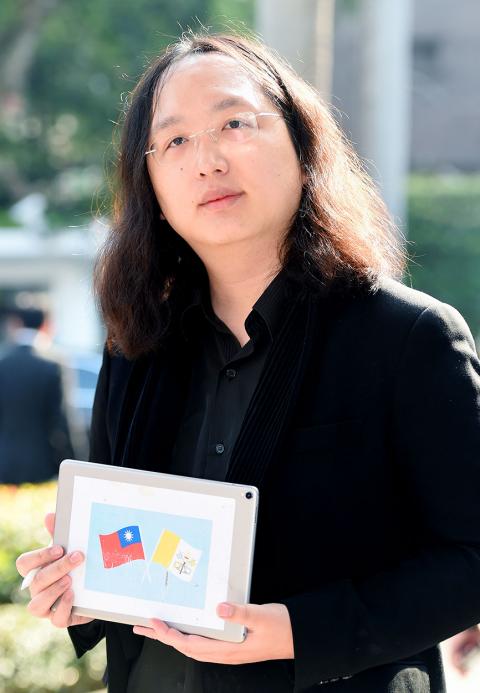
Photo: Liao Chen-huei, Taipei Times
Opening her speech with Taiwanese values as touted by President Tsai Ing-wen (蔡英文), Tang spoke about how technology serves as a driving force for the nation’s democratic development.
Tang did not criticize China, but referred to the 2014 Sunflower movement as “Occupy Parliament” to connect the movement with worldwide occupation protests against political and economic inequality.
She also addressed how domestically developed online programs, such as vTaiwan and g0v.tw, facilitated policy negotiations by bridging the gaps between governmental agencies, businesses and the public.
Taiwanese society is no longer dominated by conflicting values, but is now able to contain the expressions of people with diversified values, Tang told reporters before attending a legislative session in Taipei on Tuesday.
Asked if she had encountered any pressure from Beijing before attending the conference, Tang said her speech was about sustainable development, which is not particularly controversial and is a global issue that needs joint contributions.
Any practical interactions or conversations are beneficial to maintaining diplomatic relations between Taiwan and the Vatican, she said, when asked whether relations would be affected by the ally’s increasing interaction with China.
Additional reporting by CNA

Considering that most countries issue more than five denominations of banknotes, the central bank has decided to redesign all five denominations, the bank said as it prepares for the first major overhaul of the banknotes in more than 24 years. Central bank Governor Yang Chin-lung (楊金龍) is expected to report to the Legislative Yuan today on the bank’s operations and the redesign’s progress. The bank in a report sent to the legislature ahead of today’s meeting said it had commissioned a survey on the public’s preferences. Survey results showed that NT$100 and NT$1,000 banknotes are the most commonly used, while NT$200 and NT$2,000

The Centers for Disease Control (CDC) yesterday reported the first case of a new COVID-19 subvariant — BA.3.2 — in a 10-year-old Singaporean girl who had a fever upon arrival in Taiwan and tested positive for the disease. The girl left Taiwan on March 20 and the case did not have a direct impact on the local community, it said. The WHO added the BA.3.2 strain to its list of Variants Under Monitoring in December last year, but this was the first imported case of the COVID-19 variant in Taiwan, CDC Deputy Director-General Lin Ming-cheng (林明誠) said. The girl arrived in Taiwan on

South Korea is planning to revise its controversial electronic arrival card, a step Taiwanese officials said prompted them to hold off on planned retaliatory measures, a South Korean media report said yesterday. A Yonhap News Agency report said that the South Korean Ministry of Foreign Affairs is planning to remove the “previous departure place” and “next destination” fields from its e-arrival card system. The plan, reached after interagency consultations, is under review and aims to simplify entry procedures and align the electronic form with the paper version, a South Korean ministry official said. The fields — which appeared only on the electronic form

The Ministry of Foreign Affairs (MOFA) is suspending retaliation measures against South Korea that were set to take effect tomorrow, after Seoul said it is updating its e-arrival system, MOFA said today. The measures were to be a new round of retaliation after Taiwan on March 1 changed South Korea's designation on government-issued alien resident certificates held by South Korean nationals to "South Korea” from the "Republic of Korea," the country’s official name. The move came after months of protests to Seoul over its listing of Taiwan as "China (Taiwan)" in dropdown menus on its new online immigration entry system. MOFA last week


 RSS
RSS