


Following a conflict-of-interest controversy surrounding the election of National Taiwan University (NTU) president-elect Kuan Chung-ming (管中閔), the Ministry of Education yesterday said it has again ordered the university to clarify the matter following requests from the Control Yuan and lawmakers.
A 21-member committee elected Kuan on Jan. 5. However, it was later revealed that Kuan was an independent director of Taiwan Mobile and company vice chairman Richard Tsai (蔡明興) was a committee member.
Kuan failed to disclose his connection with Tsai prior to the election, and Tsai did not recuse himself from the election.
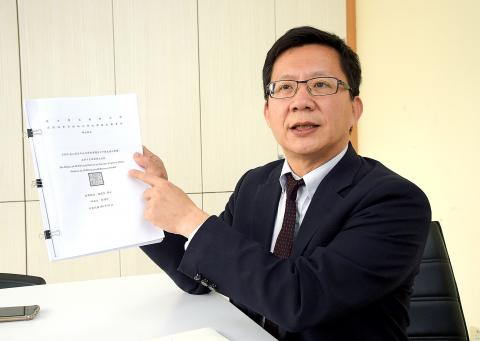
Photo: Huang Yao-cheng, Taipei Times
The alleged conflict of interest prompted the Democratic Progressive Party caucus to issue a resolution yesterday demanding that the ministry “halt the appointment until the questionable [practice] involved in the selection of NTU’s president is investigated.”
Kuan is scheduled to take office on Thursday next week.
Asked if Kuan’s inauguration might be delayed, Department of Personnel Director Chen Kun-yuan (陳焜元) said the ministry “does not want any delay in the [inauguration] process and NTU has been urged to make an immediate response.”
The ministry has a standard procedure to deal with the controversial election of university presidents, he said.
That procedure was followed after the election in October last year of National Yang-Ming University president Steve Kuo (郭旭崧), whose eligibility was questioned as he was an associate professor instead of a professor, Chen said, adding that the university was asked to clarify the eligibility criteria and selection process.
Ordered by the ministry earlier this month to clarify the situation, the NTU committee on Jan. 11 said no rules were broken in the election.
As the Control Yuan on Monday ordered the ministry to probe the scandal, it has reissued the order to the committee.
“NTU has to respond to the issue in an appropriate manner,” Chen said.
Committee spokeswoman Yuan Hsiao-wei (袁孝維) reiterated the Jan. 11 statement, saying that there was no condition that would disqualify Tsai as a committee member.
As a secret ballot was used for the election, comments about committee members’ votes were purely conjecture, Yuan said.

NATIONAL SECURITY: Authorities are working to confirm the identities of the military personnel involved and investigating possible illegal conduct and regulatory violations Authorities are probing possible national security implications after Kinmen police and immigration officers on Sunday found a Chinese woman allegedly posing as a tourist while engaging in prostitution involving more than 10 military personnel. The woman, surnamed Chen (陳), has since been deported, authorities said, adding that investigators are still working to confirm the identities of those implicated, as the records only listed code names and aliases. The case stemmed from a report received by the Kinmen District Prosecutors’ Office on Friday last week from the Jinhu Precinct of the Kinmen County Police Bureau. On Sunday, police, along with the National Immigration

GLOBALGIVING: ‘ Caving to external pressure is not acceptable for an organization that has cultivated justice reform and human rights for 30 years,’ one NGO said A slew of non-government organizations (NGOs) have withdrawn from the GlobalGiving fundraising platform after it announced it would use “Chinese Taipei” instead of “Taiwan” from next month. The Taiwan Good Rice Association wrote on Facebook on Friday that it was informed on April 28 via a teleconference call of the change, which was made because the platform wanted to operate in China. Taiwan Good Rice is to terminate all cooperative relationships with GlobalGiving in response to the platform’s “unilateral and non-negotiable” decision to remove references to Taiwan, the NGO said. “Taiwan is in the official name of Taiwan Good Rice Association and the

HEAVY WEATHER: Typhoon Jangmi is due to crash straight into the Ryukyus as airlines look to shift flights to larger aircraft or cancel flights to Okinawa entirely Taiwan’s international air carriers announced flight adjustments over the weekend as Typhoon Jangmi is forecast to hit the Ryukyu Islands today and tomorrow. The Central Weather Administration (CWA) upgraded Jangmi from a tropical storm to a typhoon at 8am yesterday, with the eye located 580km south of Naha city. It was moving north at 19kph. Today, China Airlines’ CI-120, CI-121, CI-122 and CI-123 flights between Taoyuan and Naha, Okinawa, have been canceled as well as CI-132 and CI-133 between Kaohsiung and Naha. EVA Air’s BR-112, BR-113, BR-186 and BR-185 flights between Taoyuan and Naha are also canceled. Low-cost carrier Tigerair Taiwan canceled IT-230,

Chinese Nationalist Party (KMT) Chairwoman Cheng Li-wun (鄭麗文) yesterday briefed her party’s Central Standing Committee regarding her scheduled visit to the US between Monday next week and June 16, saying that her purpose would be to persuade the US that the Republic of China (ROC) Constitution was a “one China” constitution that would foster stable and peaceful cross-strait relations. The ROC Constitution is the most important defense for all Taiwanese citizens, as it upholds our democracy and has contributed to our robust economy, which aligns with international and US interests, she said. “We would not be troublemakers and drag the US under,”


 RSS
RSS